How long do dental implants last is the question people ask about ten seconds after they hear the price, and it deserves a better answer than “a lifetime.” That answer is technically defensible and practically useless, because it quietly swaps one part of the restoration for the whole thing.
Crowns on natural teeth run on their own logic. When a filling needs to become a crown covers the point where a repair stops holding and full coverage takes over. How long a crown on a natural tooth lasts, and what shortens it, has its own guide: how long dental crowns last.
Here is the distinction that clears it up. An implant system is three pieces: a post placed in the jawbone, an abutment that comes up through the gum, and the visible tooth on top. The FDA describes it in exactly those terms. Those three pieces do not age at the same rate or fail for the same reasons. Once you separate them, most of the contradictory claims you have read stop contradicting each other.
The part built to stay, and the parts that get serviced
Print this table and take it to your consult. It is the whole answer in four rows.
| Part | What it is | Realistic expectation | What happens when it needs work |
|---|---|---|---|
| The implant post | Titanium screw fused into the jawbone | Built to be permanent; commonly still in function decades later | Rarely touched. If it does fail, it comes out and the site heals before anything new goes in. |
| The abutment screw | The small screw holding the tooth onto the post | Can loosen, usually years in | Retightened at a short appointment. Minutes, not surgery. |
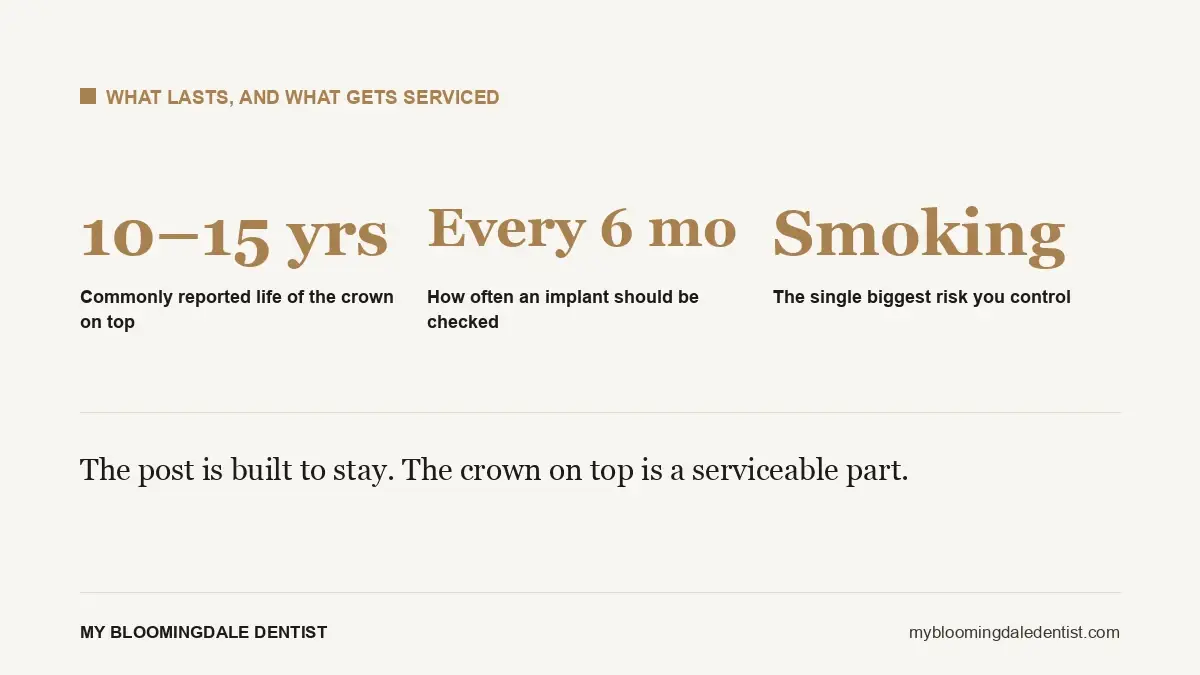
| The crown | The visible tooth you chew with | 10 to 15 years is the range most often reported | Removed and remade. The post stays exactly where it is. |
| Denture attachments | The clips that snap a denture down onto implants | Wear parts, replaced periodically | Swapped chairside. This is normal maintenance, not a failure. |
That last row matters if you are weighing a removable option. The attachments on an implant-supported denture are designed to be replaced, the same way brake pads are, and a plan that never mentions them is an incomplete plan.
What actually decides whether yours reaches twenty years
Five things move the number. Four of them are yours to control.
- Smoking. The National Institute of Dental and Craniofacial Research calls tobacco the single most significant risk factor for gum disease, and the FDA notes that smoking may affect healing and decrease the long-term success of an implant. Stopping before surgery and through the healing months is the highest-return item on this list by a wide margin.
- Gum health around the implant. Bone loss around an implant is quiet. It does not hurt until it is advanced, which is precisely why it gets missed. Bleeding gums around an implant are an early warning, not a minor annoyance.
- Grinding and clenching. An implant has no ligament to cushion it the way a natural tooth root does, so it feels the full load. If you grind, a night guard is not optional equipment.
- Blood sugar. Well-managed diabetes and uncontrolled diabetes are two different conversations. The FDA specifically links a higher chance of implant failure from systemic infection to uncontrolled diabetes.
- Whether anyone is checking. An implant seen every six months has its problems caught while they are cheap to fix. One seen only when it starts hurting does not.
The five-minute routine that protects an implant at home
Nothing exotic, and no special product you have to buy from a dentist:
- Soft brush, twice a day, angled into the gumline around the implant rather than scrubbed across the crown.
- Clean under the crown once a day with floss or a small interdental brush. The gap between crown and gum is where trouble starts, and a toothbrush does not reach it.
- A water flosser helps around bridges and full arches, where floss is awkward.
- Keep metal picks and gritty pastes off the implant collar.
- If the gum around the implant bleeds for more than a few days, book. Do not wait for the next cleaning.
The FDA is blunt on this point: regularly cleaning the implant and the surrounding teeth is very important for its long-term success. Home care is not the boring part of the plan. It is the plan.
What your dentist should be checking at every recall
Ask for these by name. A practice that measures can tell you the numbers; a practice that eyeballs it cannot.
- Gum pocket depths around the implant, compared against last visit rather than judged on their own.
- An X-ray of the bone level on an agreed schedule, not only when something already hurts.
- The abutment screw, checked for any movement.
- The bite. A crown that hits a fraction early takes more force than it was designed for, every single day.
- The contact with the neighbouring teeth, so food stops packing into the gap.
What replacement actually costs, and when you pay it
Almost nobody publishes this, which is why implant maintenance sounds either free or catastrophic online. It is neither.
| What needs doing | How often | What it involves | Cost shape |
|---|---|---|---|
| Screw retightened | Occasional | A short visit, no anesthetic | Minor |
| Crown remade | Commonly 10 to 15 years | A new crown made for the post already in your jaw | A fraction of the original implant, because the surgery is already done and paid for |
| Whole implant replaced | Uncommon | Removal, healing time, then re-placement | Plan for the full sequence again |
For context on the original work: a complete single implant here, meaning the post, the abutment and the final crown, starts at about $2,800. Full-arch numbers are a different conversation, and we break the Chicago-suburb ranges down in our full-mouth dental implants cost guide. Those wider ranges are area market data, not a quote from this office. Your own figure comes in writing at the consult, which is how dental implant treatment in Bloomingdale, IL is quoted here.
Warning signs that mean call now, not at your next cleaning
- The tooth feels like it moves, rocks or twists slightly. That is usually a loose screw, and it is easy to fix early and expensive to ignore.
- Gums around the implant bleed, look puffy, or have pulled back so the metal collar shows.
- A dull ache in an implant that has been silent for years. A healed implant should feel like nothing.
- Food packing hard into one spot every meal, or a bad taste around the implant that brushing does not clear.
None of these mean the implant is lost. All of them mean it should be seen while the fix is still small.
Why we let the site heal before anything is placed
Some offices advertise a tooth out and an implant in on the same day. We deliberately do not work that way, and longevity is the reason. A fresh extraction socket is a wound. Placing into a settled, healed site gives the bone a better grip from day one, and where the jaw needs rebuilding first, Dr. Kim does the grafting in-house and lets the graft mature before the implant goes in. It costs a few months on the calendar and buys years at the other end. Curious what that sequence feels like? Read our honest account of what implant placement and recovery actually feel like.
A consultation with 3D imaging shows the bone you actually have and what the plan would involve, with the full number in writing before anything is scheduled. The $99 new-patient exam includes X-rays. Appointments are available in English, Vietnamese, Korean and Spanish.
Book an implant consultationRelated reading
Weighing implants later in life? Our guide to dental implants for seniors covers candidacy, bone loss and healing. Tired of a denture that will not stay put? See how an implant-supported denture compares with the alternatives on cost and daily life. For the money side in full, read the full-mouth dental implants cost guide, or contact the office with a question about your own case.
Longevity is only half the decision. For the other half, what the evidence says about implant safety covers complication rates, titanium and the health conditions worth raising at a consultation.
Longevity starts with what is underneath. The bone underneath, and when it has to be built up first explains why a thinned jaw gets grafted before anything is placed. For the narrow-post version used to hold a lower denture down, see mini implants and how long they are expected to last.
Frequently asked questions
The titanium post is built to be permanent and is commonly still in function decades after placement. The crown on top is a restoration, and 10 to 15 years is the range most often reported before it needs remaking. Splitting the two apart is the honest way to answer the question.
The crown does eventually, and that is routine work done on the post already in your jaw. Replacing the implant post itself is uncommon and usually follows gum disease around the implant, smoking, or an untreated bite problem. If one does come out, the site is allowed to heal before anything new is placed.
Smoking, untreated gum disease around the implant, uncontrolled diabetes, grinding without a night guard, and skipping the checkups that would catch bone loss early. Four of those five are things you can change.
Generally yes. A bridge depends on the teeth either side and usually needs redoing sooner, and a denture rests on bone that keeps shrinking underneath it. An implant sends chewing force into the bone, which is why the FDA lists helping keep the jawbone from shrinking among the benefits.
Sources: U.S. Food and Drug Administration, Dental Implants: What You Should Know · MouthHealthy by the American Dental Association · MedlinePlus, U.S. National Library of Medicine, Dental crowns · National Institute of Dental and Craniofacial Research, Periodontal (Gum) Disease. Lifespan figures describe typical cases, not a guarantee; your own dentist’s assessment takes precedence.
For how long implants last and what they cost locally, see dental implants in Bartlett, IL.