Most pages on this question start with price. The better starting point is your mouth. Bridge vs implant for one missing tooth is a decision about the teeth on either side of the space, the bone underneath it, and how much time you want the process to take. This guide walks through the three branches, bridge, implant and wait, so you know what to ask before you sit down with a dentist.
The three branches in plain words
A bridge replaces the missing tooth with an artificial one that is attached to the teeth on each side for support. MouthHealthy, the American Dental Association’s patient site, says a fixed bridge can only be removed by a dentist. Our crowns and bridges page describes ours as anchoring a lifelike replacement to the teeth on either side.
An implant is a post placed in the jawbone that works as an anchor for a replacement tooth. For one tooth, the ADA says the dentist makes a custom crown to sit on it. Our dental implants page describes a single implant as replacing the missing tooth without grinding down the healthy teeth on either side.
Waiting means leaving the space for now. It is a real choice, and it is covered below, along with what it does and does not involve.
What do the two teeth beside the space tell you?
This is the factor many comparison pages skip. A bridge leans on the teeth next to the space, and the ADA says its success depends on the foundation, so it is very important to keep the remaining teeth healthy and strong.
From us, here is how that plays out at an exam. If both neighbors are healthy and untouched, a bridge means shaping two good teeth to carry the replacement, and the ADA’s implant page speaks to people who do not want good tooth structure removed to make a bridge. If one or both neighbors already have crowns or large fillings, the trade changes, because those teeth are already restored and may be getting new coverage either way. If a neighbor has a large filling that is wearing out, the choice for that tooth might be a crown, or an onlay, which Dr. Kim places. How much sound tooth is left decides.
The neighbors also need to be sound enough for the job. The exam includes X-rays so you can see what the dentist sees, which is part of how the call gets made.
What waiting does and does not do
Waiting is sometimes the right answer: you may be deciding between options or recovering from an extraction. If the tooth has just been removed, the site has to heal before an implant goes in, so some waiting is part of the implant plan itself.
Leaving the space for the long term has effects. The ADA says that remaining teeth may shift and, in some cases, bone loss can occur around a missing tooth. It also notes that a missing molar can affect how you chew. We will not put a timeline on any of that, because it varies by person. The point is only that “wait” has a cost, and it is worth deciding on purpose instead of by default.
Bridge, implant and wait side by side
The table sorts the branches by what they involve, with no price column. It describes the general picture and what our pages say, not a promise for your tooth.
| Question | Bridge | Implant | Wait |
|---|---|---|---|
| What happens to the neighboring teeth? | They support the replacement, so they are shaped to carry it | They are not used for support, per our implants page | They may shift, per the ADA |
| What about the bone? | The bridge rests on the neighbors, not in the jaw | The FDA lists helping keep the jawbone from shrinking as a benefit of an implant | The ADA says bone loss can occur around a missing tooth |
| How many steps? | A 3D scan, the neighboring teeth are shaped and a temporary is placed, then the final bridge is bonded | Three phases per the ADA: the implant is placed, the bone heals around it, then the crown is attached. Healing can take months, per the FDA | None until you decide |
| Who does it suit? | People whose neighbors are sound or already restored | People with enough bone, or who are candidates for grafting, and good healing health | People still deciding or healing |
What findings at the exam move the decision?
These are the things the dentist checks that change the answer. Bring the list with you.
| Finding | How it moves the decision |
|---|---|
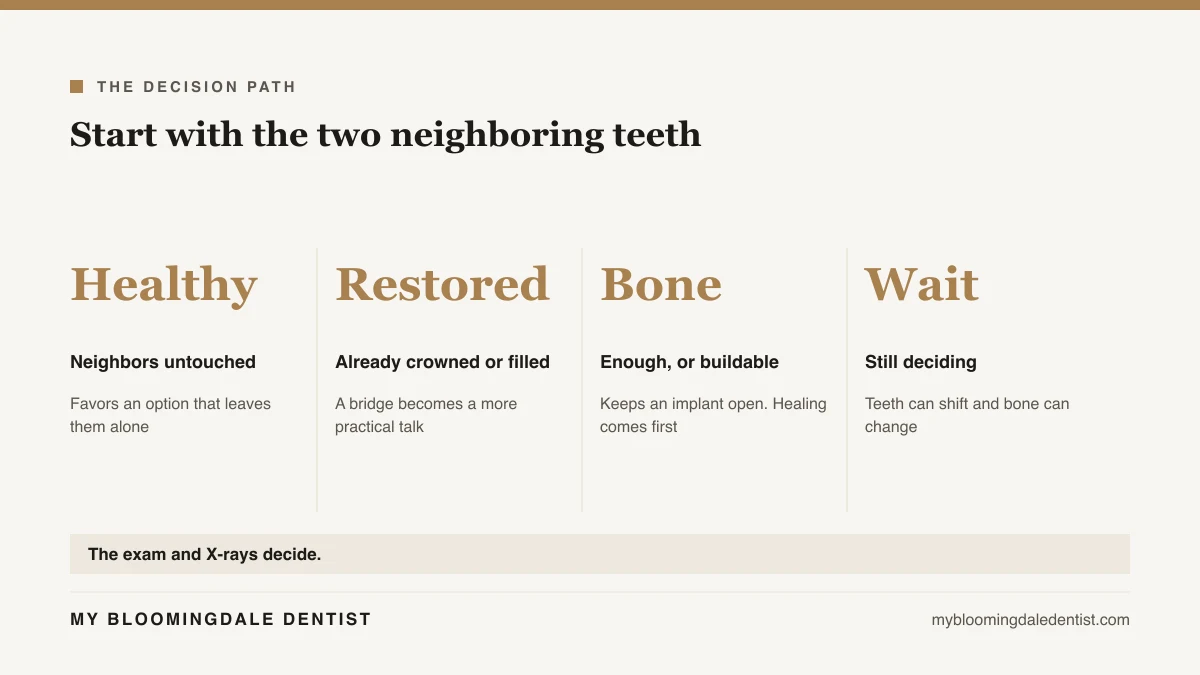
| Neighbors healthy and untouched | Favors an option that leaves them alone |
| Neighbors already crowned or heavily filled | Makes a bridge worth discussing |
| Enough bone, or bone that can be built | Keeps an implant open. We graft in-house, as covered in our bone graft guide |
| Health conditions or tobacco use | The ADA says chronic illness such as diabetes may interfere with healing and tobacco can slow it, and the FDA says smoking may affect healing |
| Gum health | The ADA says a bridge’s success depends on the remaining teeth being healthy |
What should you ask at the exam?
- What condition are the teeth on both sides of the space in, and does that change the answer?
- Is there enough bone for an implant, and would grafting be needed first?
- If I choose an implant, what has to heal first, and what is the order of the visits?
- If I wait, what should I watch for and when should I come back?
If you lean toward an implant, our guide to how long dental implants last covers what affects the long term.
Getting seen at the office
Call (224) 520-8665 or read our new patient page to book. A new-patient exam is $99 and includes X-rays. Our implants page describes 3D planning as part of implant treatment, and your plan and price are quoted in writing before anything is scheduled. You can read how we handle crowns and bridges and dental implants before you come in. If you are in Itasca, dental bridges in Itasca shows how we plan one. The office sees patients during the week and on alternating weekends, so call first. The whole appointment, not only the front desk, can be held in English, Vietnamese, Korean or Spanish. A question that can wait a day can go through the contact form.
Start with the exam. New-patient exam $99, X-rays included. Every price in writing before treatment. English, Vietnamese, Korean and Spanish spoken.
See how single-tooth implants work hereFrequently asked questions
Neither wins every time. A bridge is supported by the teeth on both sides, so their condition matters. An implant stands in the jaw and needs enough bone and time to heal. The exam and X-rays decide which fits your mouth.
A bridge is attached to the surrounding teeth for support, so those teeth are shaped to carry it. The ADA says success depends on the foundation, which is why their health is checked first.
The ADA says remaining teeth may shift and, in some cases, bone loss can occur around a missing tooth. A missing molar can also change how you chew. Timing varies by person.
Sometimes. If the bone needs rebuilding first, Dr. Kim does the grafting in-house. The 3D scan shows whether it is needed.
The site has to heal before an implant goes in. The ADA describes three phases: the implant is placed, the bone heals around it, and then the crown is attached. The FDA says healing can take several months or longer.
The new-patient exam includes X-rays. It is where you learn the condition of the neighboring teeth and bone, and which options fit.
Sources: MouthHealthy by the American Dental Association, Missing Teeth · MouthHealthy, Bridges · MouthHealthy, Implants · U.S. Food and Drug Administration, Dental Implants: What You Should Know