“Ten to fifteen years” is quoted everywhere and explained almost nowhere. If you are asking how long dental crowns last because yours is eight years old, or because you have just been told you need one, the number matters less than the reasons behind it. A crown that is going to last has a sealed edge, enough tooth underneath, a bite it can live with and healthy gums around it. This post walks through each, in the order you can check them. The figures and cautions come from MedlinePlus, the National Institute of Dental and Craniofacial Research (NIDCR) and the American Dental Association (ADA).
How long do dental crowns last? The honest range
MedlinePlus is plain about it: “Most crowns should last at least 5 years and can last as long as 15 to 20 years.” That is a spread of three times, and the spread is the answer. Our crowns and bridges page sits inside it, saying that with good hygiene crowns and bridges commonly last 10 to 15 years or more. Neither number is a warranty or a countdown. A crown that is fifteen years old and sealed is not due for replacement because of its age, and one that is six years old with decay at its edge may be.
The ADA describes what a crown is for: it covers a tooth to restore its shape and size, can strengthen a tooth with a large filling, and can cover a dental implant. A crown is a cover. The tooth underneath is still a tooth, and it can still have the problems teeth have.
Does where the crown sits change the number?
It changes what the crown is up against. As a general dental explanation, back teeth take the heavy chewing and grinding force, so a molar crown is working hardest on its biting surface, while a front-tooth crown takes less chewing load but faces the edge of every bite and any knock to the face. Neither position is a verdict on its own.
What shortens a crown, driver by driver?
The table below goes one level deeper than the usual list. The first column is where to look, the second is what goes wrong, and the third is what you can do about it. Most of the third column is in your hands.
| Driver | What it does to a crown | What you can do |
|---|---|---|
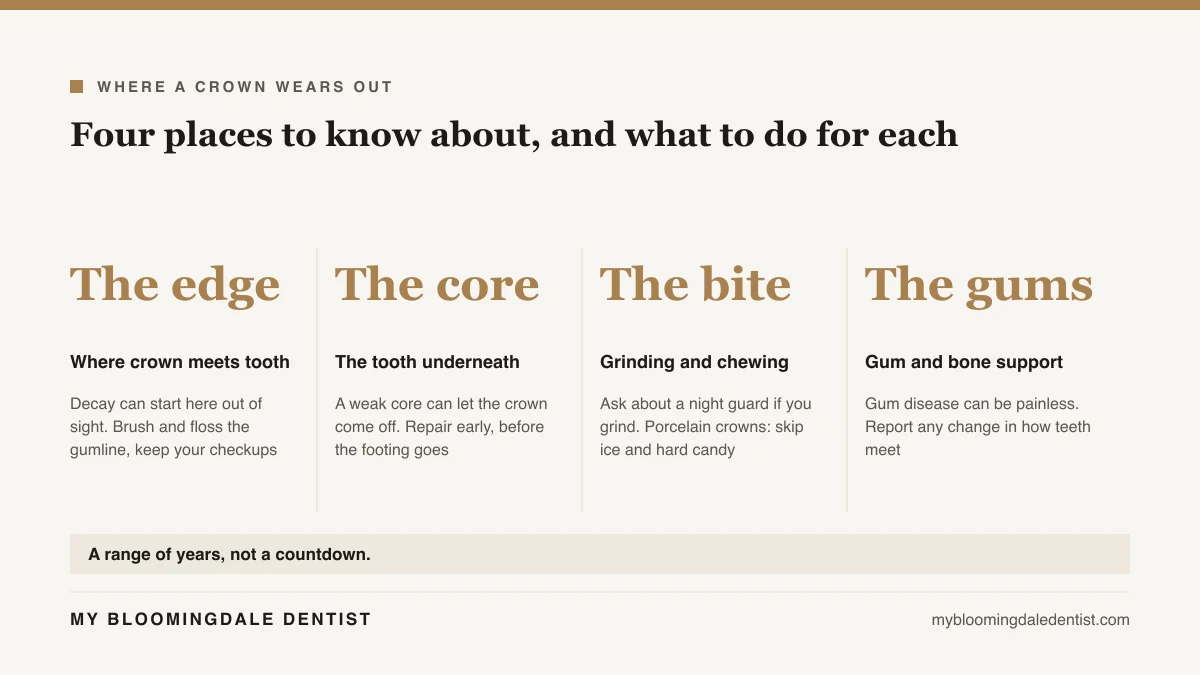
| Grinding or clenching | MedlinePlus says a crown can chip or crack if you grind your teeth or clench your jaw, and NIDCR lists flattened, chipped, cracked or loose teeth among the signs | Ask about a bite splint or mouth guard at night, which MedlinePlus names as protection for a crown |
| The edge, where crown meets tooth | MedlinePlus says the tooth under the crown can still get a cavity | Brush twice a day and floss once, as MedlinePlus advises, paying attention to the gumline |
| The core underneath | MedlinePlus says a crown can fall off if the core of the tooth that holds it is too weak | Have a cavity or crack looked at early, before the tooth under the crown has lost its footing |
| Gum and bone support | The ADA calls gum disease a major cause of tooth loss in adults, and notes it is usually painless | Keep up cleanings, and report any change in how your teeth fit together when you bite |
| The opposing tooth | MedlinePlus notes that some crown materials wear the tooth they bite against more than others | Have the bite checked when the crown is fitted and again if it ever feels high |
| What you bite | MedlinePlus advises avoiding hard candy and ice on a porcelain crown to avoid chipping it | If you have a porcelain crown, skip ice and hard candy |
Grinding deserves a closer look because it can go on without you knowing. MedlinePlus says people can clench and grind without being aware of it, by day or by night, and that grinding during sleep is often the bigger problem because it is harder to control. NIDCR adds that many cases are mild and may not need treatment, while severe bruxism can lead to damaged teeth, jaw pain or tiredness, and headache. The clues worth reporting are a sore jaw on waking, a morning headache, or a partner who hears the grinding. Mention any of those at a visit.
The edge: the seam that needs the most care
The seam where a crown meets the tooth is the place a crown is most exposed. MedlinePlus lists a cavity in the tooth under the crown first among the problems that can follow a crown, and says the answer is the same brushing and flossing you do for every tooth. The practical step is to clean along the gumline of the crowned tooth as carefully as you would a natural one. As a general dental explanation, decay at the edge starts out of sight and is usually found at an exam, not felt, which is why recall visits matter for crowns.
The core and the gums: what sits under and around it
A crown is only as stable as what holds it. MedlinePlus says a crown can fall off if the core of the tooth that holds it is too weak, and that if the nerve of the tooth is affected, the tooth may need a root canal, or may need to be removed and replaced with a dental implant. Around the tooth, the ADA’s gum disease warning signs include “any change in the way your teeth fit together when you bite.” As a general dental explanation, gum health decides how much bone the crown has to lean on, so a bite that feels different is worth reporting early.
How can you read your own crown between visits?
A short look once a month can make your next visit more useful. As a general dental explanation, these are the things worth checking.
- Look along the gumline of the crowned tooth in a mirror for a dark line, redness, or gum that has pulled back.
- Run floss past the edge and notice whether it snags or shreds, which can point to a rough or open margin.
- Close your teeth together and ask whether that side feels higher or different than it did.
- Notice whether hot, cold or sweet food bothers that tooth in a way it did not before.
- Check for a chip on the biting surface with your tongue, a fingertip or the mirror.
Write down what you find, with the date, and bring the note. A change you can date is easier to act on than one you only half remember.
What if the crowned tooth has had a root canal?
A crown can sit on a tooth that has already had a root canal, and the question for that tooth is the same one: how much tooth is left to hold it. A root canal removes the damaged inside of the tooth, and the ADA says a crown can protect the tooth from further damage afterward. The root canal and the crown are part of one treatment, which why a crown after a root canal is part of the same treatment explains. What matters for the number is the same as for any crown: how much sound tooth is left to hold it, and how well the edge stays sealed.
Which signs say a crown is near the end?
None of these is a diagnosis. Each is a reason for an exam, and the last column says how soon. The first three rows come from MedlinePlus’s list of crown problems, the fourth from the ADA, and the last is a general dental observation.
| What you notice | What it can mean | How soon to be seen |
|---|---|---|
| Sensitivity to hot or cold in the crowned tooth, or pain in it | MedlinePlus says the nerve of the tooth can become extra sensitive, and that a root canal may be needed | Call and describe it; pain is not something to wait on |
| The crown feels loose, or comes off | MedlinePlus says this can happen when the core holding it is too weak | Call the same day you notice it, and bring the crown if you have it |
| A chip or crack in the crown | MedlinePlus says a crown can chip or crack, especially with grinding | Call and book a check, and describe where the chip is |
| Your bite feels different on that side | The ADA lists any change in how your teeth fit together as a gum disease warning sign | Book an exam to find out whether it is the crown, the tooth or the gums |
| Food catching at the gumline, or a dark line at the edge | As a general dental explanation, a gap or shadow at the edge is where decay or recession shows first | Mention it at your next cleaning, or sooner if it is new |
What should your dentist check at every cleaning?
Our crowns and bridges page says crowns and bridges are checked at every cleaning so small issues are caught before they become big ones. A general crown check usually looks at the edge, how the bite closes and the gums around the tooth. You can help the visit by naming what you have noticed: a food trap, a cold sensitivity, a tooth that feels high. A new-patient exam at the office costs $99 and includes X-rays, and any treatment is quoted in writing before it starts.
When a crown does need replacing, and when a smaller restoration is enough
A replacement is a decision about the tooth, not about the crown’s age. If the tooth under it is sound, the question is the crown. If there is not enough tooth left to hold a crown, the sequence for replacing the tooth is removal first, healing next, replacement after that, in that order and on the tooth’s timetable. A crown can also cover a dental implant, and how long dental implants last covers that side, because the crown and the implant under it wear on different clocks.
Sometimes a smaller restoration leaves more of the natural tooth. Dr. Kim places onlays, which cover part of the tooth rather than all of it, and the exam shows which options are realistic. The final call is confirmed once the old restoration is out and what is left of the tooth can be measured, not from a photograph and not over the phone. If you are at the earlier stage, deciding whether a tooth needs a crown at all, when a filling needs to become a crown works through that choice.
Getting seen at the office
If a crown has started to feel different, call (224) 520-8665 and say which tooth and what you have noticed. The office sees patients during the week and on alternating weekends. Crowns and bridges in Bloomingdale, IL sets out how the work is done and followed up, and a new-patient exam is $99, X-rays included. The whole appointment, not only the front desk, can be held in English, Vietnamese, Korean or Spanish.
Call and tell us the tooth and what you have noticed. New-patient exam $99, X-rays included. Every price in writing before treatment. English, Vietnamese, Korean and Spanish spoken.
See how crown care works hereRelated reading
A question that can wait a day goes through send the office a message.
Frequently asked questions
MedlinePlus says most crowns should last at least 5 years and can last as long as 15 to 20 years. Our crowns and bridges page says crowns and bridges commonly last 10 to 15 years or more with good hygiene. It is a range, because the edge, the core, the bite and the gums all affect where a particular crown lands.
No restoration comes with that promise. A crown covers a tooth, and the tooth underneath can still get a cavity, as MedlinePlus points out. A crown that stays sealed, with a sound core and healthy gums, gives the crown its best chance within the range, and a regular checkup is how a problem gets caught early.
It can. MedlinePlus says a crown could chip or crack if you grind your teeth or clench your jaw, and that a bite splint or mouth guard at night may be needed to protect it. NIDCR lists flattened, chipped, cracked or loose teeth and jaw soreness among the signs of bruxism, which is worth raising at your next visit.
There is no calendar date. Sensitivity or pain in the crowned tooth, a crown that feels loose or comes off, a chip or crack, or a bite that feels different are reasons to be seen. As a general dental explanation, decay at the edge is often found at an exam rather than felt, which is why crowns are checked at cleanings.
There is no fixed answer. What decides it is how much sound tooth is left to hold the crown and how well the edge stays sealed. MedlinePlus says a crown can come off if the core is too weak. Our guide to a crown after a root canal explains why the two are part of one treatment.
Not on its own. A replacement is a decision about the tooth under the crown, the edge and the bite. If the tooth is sound the question is the crown, and if it is not, the plan is built around the tooth. The exam, with X-rays, is how that is judged, and the price is quoted in writing first.
Sources: MedlinePlus, Dental crowns · MedlinePlus, Bruxism · National Institute of Dental and Craniofacial Research, Bruxism · MouthHealthy by the American Dental Association, Crowns · MouthHealthy, Gum Disease · MouthHealthy, Root Canals. General information for patients, not a diagnosis; your own dentist’s reading of your tooth takes precedence.