If a tooth that had a root canal has started to hurt again, the first feeling is usually dread. The pain returning does not mean you did something wrong, and it does not automatically mean the tooth is lost. This post explains what root canal retreatment means, why a treated tooth can start hurting, what the first appointment looks like, and what the options are afterward. The sources are the AAE, the American Dental Association (ADA) and MedlinePlus, and anything that is general dental explanation is labeled that way.
What root canal retreatment means
The AAE describes it plainly: during retreatment, the endodontist reopens the tooth and removes the filling materials placed in the canals the first time. The endodontist then examines the tooth for additional canals or new infection, removes any infection, cleans and shapes the canals, and places new filling materials. The opening is sealed with a temporary filling, and the tooth should then be restored with a more permanent restoration to seal and protect it. It is the same kind of work as the first root canal, done on a tooth that needs a second look.
Why a treated tooth can start hurting again
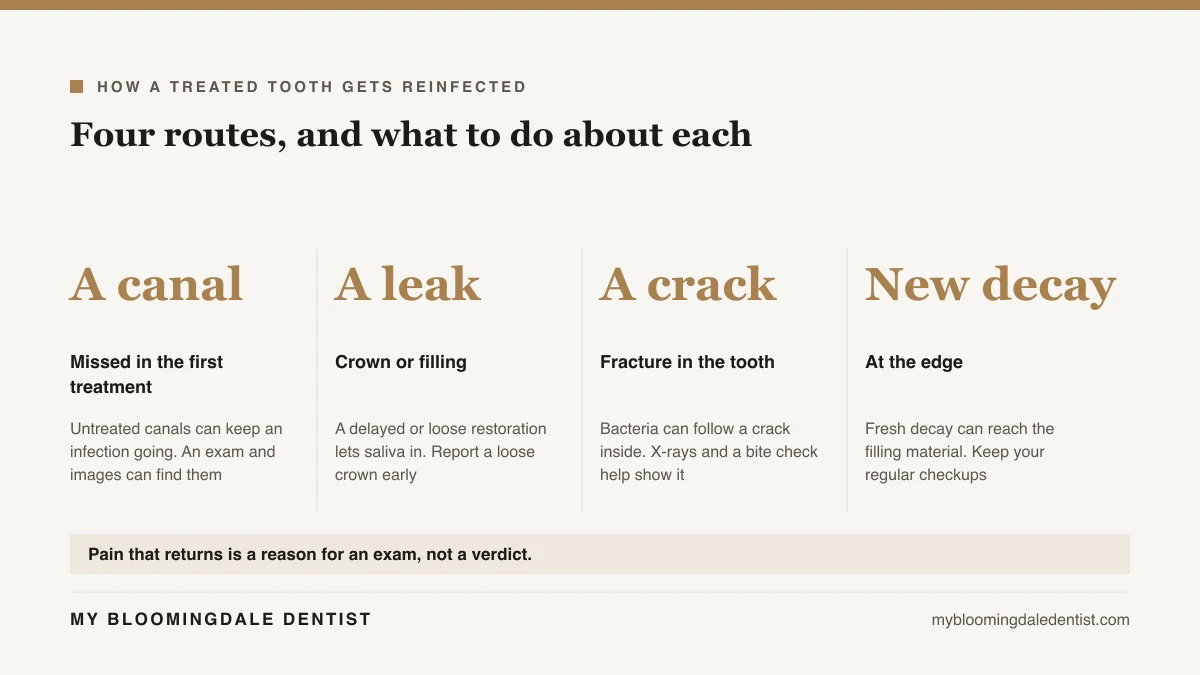
The AAE lists the reasons in two groups. The first group is about the original treatment: narrow or curved canals that were not treated, complicated canal anatomy that went undetected, a crown or other restoration that was delayed, or a restoration that did not prevent saliva from reaching the inside of the tooth. The second group is a new problem on a tooth that was treated well: new decay that exposes the filling material to bacteria, a loose, cracked or broken crown or filling, or a fracture in the tooth.
The ADA’s MouthHealthy site adds that an abscess is an infection caused by tooth decay, periodontal disease or a cracked tooth, and that bacteria entering the pulp can lead to pulp death. So the same few routes show up across sources: something was missed, something leaks, something cracked, or something decayed.
Is the pain really coming from that tooth?
Not always, and that is why the exam comes first. MedlinePlus notes that a deep pocket in the gum around a tooth can also be the source of an infection, and that a dental specialist known as an endodontist should examine the area in that case. As a general dental explanation, pain in the jaw is poor at telling you which tooth it comes from, so a neighbor, the gums or the bite can feel like the treated tooth. X-rays and a careful look at the bite are how that gets sorted out, and the pattern of your symptoms helps.
The table below is a starting guide for the conversation. It is not a diagnosis, and the last column is only about how soon to call.
| What you notice | What it can point to | How soon to be seen |
|---|---|---|
| Dull ache or soreness that fades over days after the root canal | MedlinePlus says you may have some pain or soreness after the procedure, and that an over-the-counter anti-inflammatory can help | Mention it at your follow-up visit |
| Pain that returns months or years later | The AAE says a treated tooth can become painful or diseased months or even years after treatment | Call and book an exam |
| Pain when you bite or press on the tooth | As a general dental explanation, this can come from infection at the root tip, a crack, or a bite that has shifted | Call and book an exam |
| Redness or a bad taste near the tooth, or swelling | MouthHealthy lists pain, swelling, redness in the gums and a bad taste among abscess symptoms | Call the same day you notice it |
| Swelling in the face, or fever | MouthHealthy lists swelling and fever among abscess symptoms | Read our guide on swelling and when to go to the ER before you wait |
What the first appointment looks like
Expect a conversation, a look at the tooth, and images. Our root canal page describes the diagnosis step as an exam and digital X-ray, with an explanation of what we see, and our extraction page describes 3D images used to plan treatment. Bring the answers to a few questions, because they help sort out the cause:
- When did the root canal happen, and was a crown placed afterward?
- Is the pain constant, or only when you bite, or only with hot or cold?
- Has the crown or filling on that tooth ever felt loose or rough?
- Have you had a bump on the gum, a bad taste, or swelling?
Write the answers down with dates. A pain you can date is easier to trace than one you half remember. A new-patient exam at the office costs $99 and includes X-rays, and any treatment is quoted in writing before it starts.
The options after the exam
The exam does not always lead to retreatment. The table describes the three paths people hear about. It describes them and does not recommend one, because the right answer depends on your tooth.
| Option | What it involves | Source |
|---|---|---|
| Retreatment | The AAE says the endodontist reopens the tooth, removes the old filling material, cleans and shapes the canals, and places new filling material. The tooth is then restored to seal and protect it | AAE |
| Surgery at the root tip | A school of dental medicine notes that when a treated tooth has trouble, a dentist may recommend retreatment or an apicoectomy, which is endodontic surgery | Rutgers School of Dental Medicine |
| Removing the tooth | MedlinePlus lists a deep infection in a tooth among the reasons people have a tooth pulled. Healing comes first, and what replaces the tooth is decided afterward | MedlinePlus |
Our root canal and extraction pages treat saving the natural tooth as the usual goal, with an honest recommendation for the specific tooth. The deeper question of how that call is made, and when removal becomes the better choice, gets its own post. The AAE describes retreatment as work done by an endodontist, a specialist. MouthHealthy says you may be referred to a dentist who specializes in the pulp and tissues around the teeth, called an endodontist, and the AAE says to visit your dentist or endodontist for evaluation. If your tooth needs that, the visit here is where it gets decided, and a referral is a normal outcome of that conversation.
What decides which option fits your tooth?
As a general dental explanation, three questions do most of the sorting. First, is there enough sound tooth and bone left to restore and keep? Second, can the cause be reached and fixed, such as a canal that can be cleaned again or a crown that can be replaced? Third, is the tooth cracked in a way that runs below the gumline, which changes the picture for any treatment? The images answer part of this, and the exam answers the rest. This is why a clear answer by phone is not possible, and why a straight answer after the exam is.
What if the first root canal was done at another office?
An earlier root canal elsewhere does not stop an evaluation. Bring what you have: the date, the name of the office if you remember it, and any X-rays you were given. If you cannot get records, the exam here takes fresh X-rays, and the $99 new-patient exam includes them. As a general dental explanation, older images are useful for comparison because they show what the tooth looked like when the first treatment was finished, but they are not required to start.
How a second round can be avoided
Some of it, yes. The AAE lists a delayed crown or restoration among the reasons a treated tooth may not heal, so finishing the treatment with the permanent restoration your dentist recommends is one of the steps the AAE points to. MouthHealthy says that with proper care a restored tooth can last a lifetime, and names the habits: brush twice a day for two minutes with fluoride toothpaste, clean between your teeth once a day, and see your dentist regularly. MedlinePlus says regular checkups are necessary after a root canal and, for adults, usually means a visit twice a year. As a general dental explanation, a routine X-ray at a checkup is one way a problem at the root tip can be seen before it causes pain.
What should you do until you are seen?
As general first aid, avoid biting hard on the tooth, keep the area clean by brushing gently, and write down what changes. MedlinePlus says to avoid rough chewing on a tooth until it is permanently filled or covered. If swelling spreads, if you have a fever, or if it is hard to swallow or breathe, that is no longer a wait-and-see problem. Our guide on when swelling means the ER walks through that call.
How does the crown fit into this?
The AAE lists a delayed crown or restoration, and a restoration that did not prevent saliva from reaching the inside of the tooth, among the reasons a treated tooth may not heal. MedlinePlus says a root canal must be followed by a permanent restoration so the tooth can withstand chewing. That is the reason the root canal and the crown are one treatment, and why a crown after a root canal is part of the same treatment explains where that step fits. If a crown is loose or cracked, that is worth reporting even when the tooth does not hurt.
Getting seen at the office
If a tooth that had a root canal has changed, call (224) 520-8665 and say which tooth and what you have noticed. The office sees patients during the week and on alternating weekends, so call first. Root canal treatment in Bloomingdale, IL explains how care works here, and crowns and bridges covers the protection that follows. A new-patient exam is $99, X-rays included. The whole appointment, not only the front desk, can be held in English, Vietnamese, Korean or Spanish.
Call and tell us the tooth and what you have noticed. New-patient exam $99, X-rays included. Every price in writing before treatment. English, Vietnamese, Korean and Spanish spoken.
See how root canal care works hereRelated reading
A crack is one of the reasons a treated tooth can hurt again, and the cracked tooth guide sorts out when a crack is an emergency and when it is not. A question that can wait a day can go through the contact form.
Frequently asked questions
When retreatment is not the right call, the next question is whether to save or remove the tooth. How the root canal or extraction decision gets made covers the criteria the exam uses.
It is a second round of root canal treatment on a tooth that has already had one. The AAE says the endodontist reopens the tooth, removes the old filling material, examines the canals for additional canals or new infection, then cleans, shapes and refills them. The tooth is then restored to seal and protect it.
The AAE says a treated tooth can become painful or diseased months or even years after treatment. Its list of reasons includes untreated narrow or curved canals, new decay, a loose, cracked or broken crown or filling, and a fracture. An exam with X-rays is how the cause gets identified.
No. MedlinePlus says you may have some pain or soreness after a root canal and that an over-the-counter anti-inflammatory can help. Pain that is new, that returns later, or comes with a bump on the gum, swelling or fever is a reason to be seen.
Our published root canal service is the root canal itself. For a tooth that has already been treated, the exam here is where the next step is decided, and that can include a referral to a specialist. We would rather say so plainly than promise a procedure before the images are reviewed.
Rutgers School of Dental Medicine says it is generally best to preserve your natural teeth if you can, and our root canal page promises an honest recommendation for your specific tooth. The answer depends on how much healthy tooth is left, so the exam and the images decide it.
Bring the date of the original root canal if you know it, whether a crown was placed, and a note of what the pain does and when it started. If you have old X-rays from another office, bring or request them. A new-patient exam is $99 and includes X-rays.
Sources: American Association of Endodontists, Endodontic Retreatment · MouthHealthy by the American Dental Association, Root Canals · MouthHealthy, Abscess · MedlinePlus, Root canal · MedlinePlus, Tooth extraction · Rutgers School of Dental Medicine, Root Canal Retreatment. General information for patients, not a diagnosis; your own dentist’s reading of your tooth takes precedence.