A toothache has a way of getting loud after the offices close. This guide is for dental pain overnight, when you are awake, uncomfortable and not sure whether to wait. It does three jobs: it names the signs that mean the ER cannot wait for morning, it lists what can help for a few hours, and it gives you a short script for the morning call. It is general information, not a diagnosis.
Which signs mean the ER and not the morning?
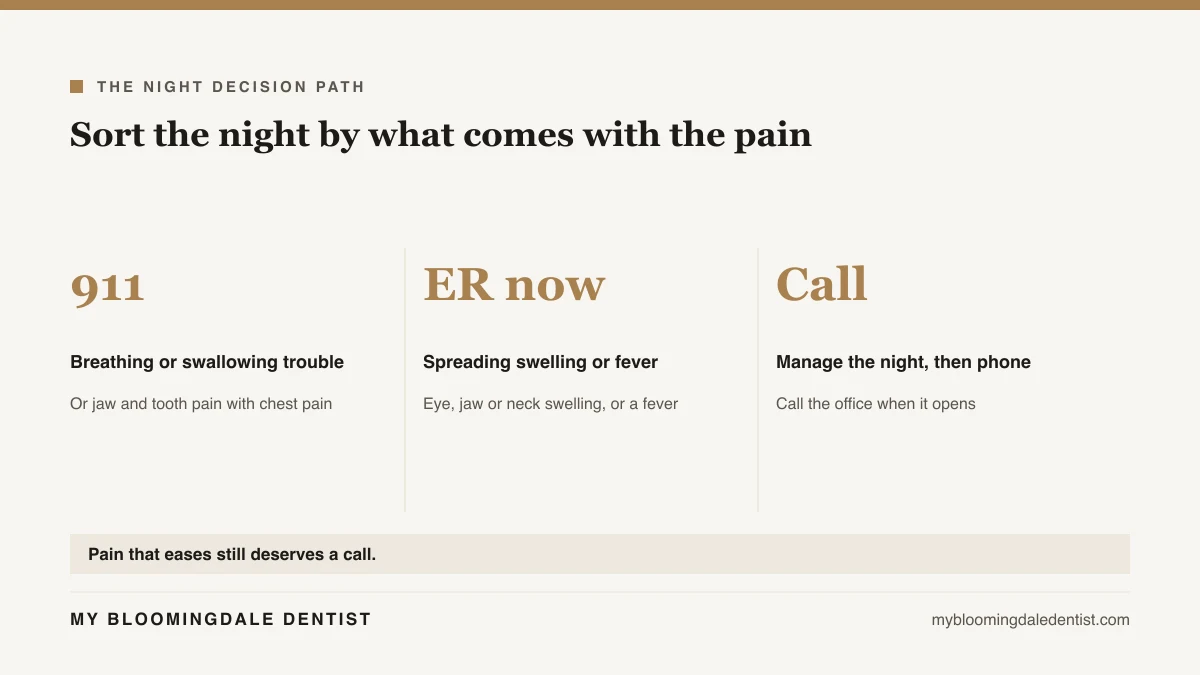
Start with what comes with the pain. The table is the short version. Our guide to when dental swelling needs the ER has the full list, and we will not repeat it here.
| What you notice | What the sources say | Where to go |
|---|---|---|
| Trouble breathing or swallowing, or tooth and jaw pain together with chest pain | From us: the airway and the heart come first. MedlinePlus lists a heart attack among the causes of toothache | Call 911 |
| Swelling spreading toward the eye, under the jaw or into the neck, or a fever | From us: our emergency dentist page sends spreading swelling or a fever to the ER. MedlinePlus lists fever among the symptoms of a tooth abscess and calls a swollen area of the jaw a very serious symptom | The ER, now |
| Throbbing pain with no swelling, no fever, and normal breathing and swallowing | MedlinePlus says OTC pain medicine can be used if you cannot see your dentist right away | Manage the night, then call the office when it opens |
What can help for a few hours?
None of this treats the cause. It is a holding pattern until a dentist can look at the tooth.
- Pain medicine. MedlinePlus says you can use over-the-counter pain medicine if you cannot see your dentist or health care provider right away. From us: follow the label, and ask a pharmacist if you take other medicine or have a health condition.
- A warm saltwater rinse. MedlinePlus lists warm saltwater rinses among the things that may help ease the pain of a tooth abscess.
- From us, as our emergency dentist page puts it: floss gently on either side of the tooth in case something is wedged there.
If the pain started after a crack or break, our guide to whether a cracked tooth is an emergency sorts the cases.
What not to do overnight
Three mistakes come up again and again.
First, do not place aspirin directly on the tooth or gums. MedlinePlus says this increases irritation of the tissue and can cause mouth ulcers. Swallowing a pain medicine as the label directs is a different thing.
Second, do not wait out spreading swelling or a fever. Both are on the ER row of the table above for a reason.
Third, do not read relief as an all-clear. MedlinePlus says the toothache from an abscess may stop if the pressure is relieved, but the infection will remain active and continue to spread. If the pain fades by morning, the call is still worth making.
Why does pain that stops still deserve a call?
MedlinePlus says to seek care for a severe toothache, a toothache that lasts longer than a day or two, a fever, an earache, or pain when opening your mouth wide. It also notes that a tooth can hurt because of trouble somewhere else in the body, which is why the dentist starts by finding the source. The call is how that begins. A cavity, a crack, a lost filling or an infection can each feel like the same 2am ache, and only an exam with X-rays sorts them. If the cause turns out to be deep decay or infection in the nerve, root canal treatment is one of the ways the tooth can be kept.
What should you say when you call?
Jot these down while the pain is fresh. MedlinePlus lists them among the questions a dentist asks at the visit.
| The dentist will ask | What to write down overnight |
|---|---|
| When did the pain start, and where is it? | The time it began and which tooth or side |
| How bad is it, and does it wake you up? | A score out of ten, and whether it wakes you |
| What makes it better or worse? | Heat, cold, biting, lying flat |
| What medicines are you taking? | What you took tonight, and when |
| Any other symptoms, such as fever, or any injury? | Temperature, swelling, anything that hit your mouth |
Say your preferred language when you call. The office can hold the whole appointment, diagnosis, options and price, in English, Vietnamese, Korean or Spanish. Ask what to do next, and what to do if the pain changes before you are seen.
What happens at the visit itself
MedlinePlus describes the visit this way. The dentist examines your mouth, teeth, gums, tongue, throat, ears, nose and neck, and you may need dental X-rays. The questions above guide that exam, and treatment depends on the source of the pain. MedlinePlus lists removing and filling cavities, root canal therapy and extraction of the tooth as the treatments that may follow, and a protective appliance if grinding is the cause.
That list is the reason the exam comes first. The same ache can lead to a filling, a root canal or a different plan, and nobody can tell which from a description alone. From us, the practical point is that the exam is where the options get laid out, and you decide with the full picture in front of you. If a tooth does need to come out, our extraction recovery timeline shows what the days after look like.
Getting seen at the office
Call (224) 520-8665 when the office opens. The office sees patients during the week and on alternating weekends, so call first. A new-patient exam is $99 and includes X-rays, and your plan and price are quoted in writing before anything is scheduled. A question that is not urgent can go through the contact form.
Start with the call and the exam. New-patient exam $99, X-rays included. Every price in writing before treatment. English, Vietnamese, Korean and Spanish spoken.
Read how emergency visits work hereFrequently asked questions
MedlinePlus says you can use over-the-counter pain medicine if you cannot see your dentist right away, and lists warm saltwater rinses among the things that may ease abscess pain. Follow the label on any medicine. None of this treats the cause.
From us: go to the ER for swelling that spreads toward the eye, under the jaw or into the neck, or for a fever, and call 911 for trouble swallowing or breathing. Separately, MedlinePlus calls a swollen area of the jaw a very serious symptom of a tooth abscess.
No. MedlinePlus says not to place aspirin directly on the tooth or gums, because it increases irritation of the tissue and can cause mouth ulcers.
Yes. MedlinePlus says an abscess toothache may stop if pressure is relieved, but the infection remains active and can continue to spread.
Say where the pain is, when it started, what makes it better or worse, what you have taken, and whether you have a fever or swelling. Say your preferred language too.
MedlinePlus lists several other causes of toothache, including an earache, a sinus infection and a heart attack. That is one reason the dentist begins by finding the source of the pain.
Sources: MedlinePlus, Toothaches · MedlinePlus, Tooth abscess. General information, not a diagnosis. If you are having trouble breathing or swallowing, call 911.