Almost nobody explains when a filling needs to become a crown. Page after page will tell you what a filling is and what a crown is, as though you were picking between two products on a shelf. You are not. You are being told that a tooth you already had repaired has changed, and that the repair which held for years has run out of road. What follows is the part that gets left out: what has to be true about the tooth before the answer moves from patch it again to cover it.
A filling replaces decay. A crown replaces structure.
Those are two different jobs, and almost every argument about crowns comes from treating them as one. The National Institute of Dental and Craniofacial Research describes a filling plainly: a dentist will remove the decayed tooth tissue and then restore the tooth by filling it with a filling material. The hole gets sealed. The walls of the tooth around that hole keep doing the chewing.
A crown does the opposite. It goes over the outside of the tooth and takes the load off those walls, because the walls are no longer up to the job. The American Dental Association puts the threshold in one sentence on its patient site: a crown can help strengthen a tooth with a large filling when there isn’t enough tooth remaining to hold the filling.
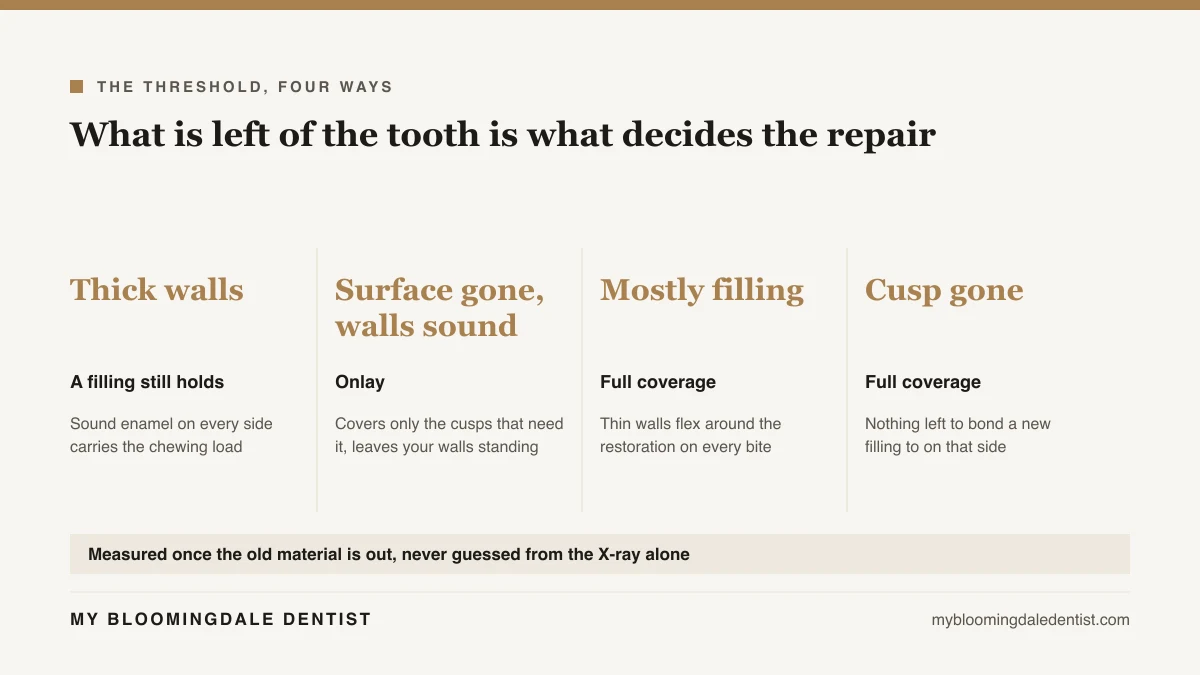
That sentence is the test. Not the size of the cavity. Not how long ago the filling went in. How much sound tooth is left holding it.
When a filling needs to become a crown
Here is the threshold nobody publishes, laid out the way the decision gets made in the room.
| What the tooth looks like | What a filling does | What a crown does | What decides it |
|---|---|---|---|
| Small cavity, thick walls left on every side | Seals it. The tooth carries on as normal | More than the tooth needs | Width of sound enamel left standing |
| Biting surface past another filling, walls still sound | Has run out of surface to bond to and keeps failing at the same spot | Takes down walls that did not need taking down | Whether it is only the surface that has gone, or the walls with it |
| Wide old restoration, thin walls around it | Stays in, but the walls flex around it every time you bite | Wraps the tooth so the walls stop taking the load | How much of the biting surface is filling rather than tooth |
| One cusp already broken off | Nothing to hold the missing corner to | Rebuilds the corner and covers the rest | Whether a cusp is gone or just chipped |
| Sharp pain on biting that spikes on release | Cannot hold a cracked tooth together | Holds the tooth as one piece | Where the crack runs and how deep |
| Back tooth that has had a root canal | Seals the access hole and leaves a hollow tooth under load | Splints the remaining walls together | Tooth position and how much chewing force it takes |
Read the last column. Every one of those calls is about the tooth, not about the hole in it. Two people can have cavities that look identical on an X-ray and get different answers, because one of them has thick enamel walls left and the other has had the same tooth filled three times already.
The rule of thumb many dentists work to is that once a restoration is carrying a large share of the biting surface, roughly half or more, another filling is the repair that fails first. There is no exact percentage that applies to every tooth, and anyone quoting you one to the decimal place is guessing. What is measurable is how much enamel wall is left, how thick it is, and whether it has a crack running through it.
Look at the row about a biting surface that has gone while the walls are still sound. Neither column fits it well, because that row has a third answer, and it is the one page one of the search results does not mention at all. It gets its own section further down.
Which five situations move a tooth across the line?
- A cusp has fractured. The pointed corners of a back tooth do the grinding. When one snaps off, usually around the edge of an old filling, there is nothing left to bond a new filling to on that side.
- The same filling keeps coming out. One debond is bad luck. A third is the tooth telling you the shape of what is left will not hold a filling in place any more.
- Cracked-tooth symptoms. Pain when you bite on something hard, and a sharper jolt when you let go. That release pain is the classic sign of a crack flexing open and snapping shut. A filling sits inside a crack. It cannot hold the two halves together.
- Decay has worked in under the margin. Old restorations develop a gap at the edge over years. Once bacteria are working underneath, the new cavity is often wider than the old filling was, and what is left is a shell.
- The tooth has had a root canal. A treated back tooth has lost structure and is hollow where the access opening was, and the ADA describes the follow-up visit as replacing the temporary with a regular filling or a crown to protect the tooth from further damage. On molars, that protection is usually a crown. Why a crown after a root canal is part of the same treatment covers that sequence on its own.
Notice what is not on that list. Age of the filling on its own. A stain at the edge on its own. A dark spot on an X-ray that has not changed in three years. None of those moves a tooth across the line by itself, and being told they do is worth a second opinion.
What it looks like from the chair
The sequence is less dramatic than people expect, and it is worth seeing laid out before you agree to it.
| Step | What happens | What you leave with |
|---|---|---|
| Look and scan | 3D X-ray plus a digital scan of the tooth and your bite. The old restoration is assessed at the margins, not just on the surface | A recommendation and a written figure before anything starts |
| Preparation | The failing restoration and any decay under it come out. What is left is measured. This is the point where a filling, an onlay or a full crown is confirmed, because until the old material is out nobody can see how much tooth there is | A temporary while the lab work is made, whether the answer is an onlay or a full crown |
| Fit | The permanent crown is seated, the bite is checked and adjusted so it is not high | A tooth you can chew on normally |
| Review | The margin and the gum around it are checked at your next cleaning | A recall interval that suits the tooth |
The honest part of that table is row two. A dentist can tell you what is most likely from the scan, and should. Nobody can be certain how much sound tooth is underneath until the old material is out. If someone promises you a definite answer before that, they are promising something they cannot see.
Is an onlay the middle option?
Almost every article on this subject gives you two choices, as though a tooth only ever came in two states. There is a third restoration sitting between them, and it is missing from the whole first page of results because it is harder to explain than either of the other two. It also happens to be the one that applies to exactly the tooth this article is about: a tooth that has gone past what a filling can hold, but has not lost its walls.
An onlay is a lab-made restoration bonded onto the tooth that covers only the part which needs covering, usually one or more of the chewing cusps, and leaves the sound enamel walls standing. A full crown takes the tooth down on every side so it can be wrapped. An onlay does not. That is the entire difference, and on a tooth that still has structure worth keeping it is not a small one. You will hear the word inlay used nearby: same kind of lab-made repair, sitting inside the cusps rather than over them.
| Another large filling | Onlay | Full crown | |
|---|---|---|---|
| What it does | Fills the hole and leaves your walls carrying the bite | Rebuilds and covers the damaged cusps, leaves the sound walls alone | Covers the whole tooth and takes the load off every wall |
| Tooth removed to fit it | The decay, and nothing else | The damaged surface, and little beyond it | A layer from every side of the tooth |
| Where it fits | Small to moderate cavity, thick walls on every side | Biting surface past another filling, two or three walls still sound | Walls thin or gone, a cusp lost, or a crack that has to be held together |
| Where it is the wrong call | Once the restoration is carrying most of the biting surface | A cracked tooth that has to be held as one piece, or walls that have already gone | A tooth with plenty of sound structure left, where it takes more than the tooth needs |
| How it is made | Shaped in the chair in one visit | Digitally scanned, made to fit, temporary in between, then bonded on | Digitally scanned, made to fit, temporary in between |
Read the onlay column against the one on either side of it. You keep more of your own tooth than a crown takes, and you get more support than another filling gives. That is the trade, and it is only available on a particular shape of tooth, which is the real reason the two-choice version of this conversation is the one that gets published.
Crown and bridge treatment in Bloomingdale, IL covers onlays as well as full crowns, so this is a question you can put directly to us, and it is worth asking for one by name. The useful wording is the sentence you can say out loud in the chair: is there enough sound wall left on this tooth for an onlay, or has it gone past that? An answer either way tells you something. Being handed the default without the question ever coming up tells you nothing.
Itasca and Wood Dale patients weighing the same onlay-or-crown call have their own pages: cosmetic dentistry in Itasca, IL and cosmetic dentistry in Wood Dale, IL.
One caveat, and it is the same one as row two of the chair table above. Whether an onlay is on the table gets confirmed once the old restoration is out and the remaining tooth can be measured. Not from a photograph, and not over the phone.
What shortens a crown once it is on?
A crown is not a permanent tooth. It is a very good cover for one, and four things decide how long it lasts.
Grinding and clenching. Sustained sideways force is hard on any restoration. If you grind, a night guard protects the crown and the teeth either side of it, and it is a cheap insurance policy compared with redoing the work.
The margin. Where the crown meets the tooth is the only vulnerable seam. Kept clean, it stays sealed. Neglected, decay starts there, and it starts out of sight.
Gum health. Gum disease takes the bone around the tooth. A perfect crown on a tooth that is losing its foundation is a good roof on a house with a failing footing.
What is opposite it. A crown biting against a natural tooth wears differently from one biting against another restoration. It is why the bite check at fit matters more than it sounds.
Three of those four are in your hands, which is the useful thing to take away.
When it is no longer a restoration question
Sometimes the answer is that there is not enough tooth left to restore at all. A crack that runs down into the root, or decay that has traveled below the bone level, takes the tooth out of the crown conversation entirely.
When a crack is part of the picture, the first question is timing. How to tell whether a cracked tooth is an emergency sets out which signs mean the tooth should be seen today.
When that happens the sequence is removal first, healing next, and replacement after that, in that order and on the tooth’s timetable rather than a marketing one. What a bone graft does and how long it takes to heal covers the step that often sits between removal and whatever goes back in. Nobody here will quote you a finish date at the consultation for work that depends on how you heal.
What does it cost to find out which one you need?
The finding-out part is cheap and the guessing part is expensive, which is backwards from how most people treat it. A new-patient exam with X-rays here is $99, and that visit is what produces the answer: a look at the margins, a 3D image, and a written figure for whatever is recommended before anything is booked.
Crowns are quoted per tooth, because the work in front of a molar with a fractured cusp is different from the work in front of a premolar with a wide old filling. You get that number in writing, at the consultation, before treatment starts. If a front tooth is involved and the appearance of the restoration matters to you, cosmetic dental treatment in Bloomingdale, IL is where the shade and shape side of that conversation lives.
A $99 new-patient exam includes X-rays and a 3D scan of the tooth, and you get the recommended treatment in writing before anything is scheduled. Appointments in English, Vietnamese, Korean and Spanish.
Book a crown consultationRelated reading
If the tooth is hurting right now rather than being planned for, emergency dental care in Bloomingdale, IL is the faster route, and it covers what to do with a broken cusp before you can get seen. Anything else, get in touch with the office.
Frequently asked questions
The deciding factor is how much sound tooth is left around the filling, not the age of the filling. A fractured cusp, a filling that keeps debonding, sharp pain when you bite and release, or decay that has worked in under the edge all point toward full coverage. A 3D X-ray and a look at the margins settle it, and the final call is made once the old material is out and the remaining tooth can be measured.
It can, and sometimes that is the right answer. The problem is that each replacement takes a little more tooth structure, so a tooth that has been filled repeatedly ends up as a shell holding a large restoration. The American Dental Association puts it simply: a crown can strengthen a tooth with a large filling when there is not enough tooth remaining to hold that filling.
Often, yes, and it is worth asking about by name. An onlay covers only the part of the biting surface that needs covering and leaves the healthy walls untouched, so you keep more of your own tooth than a crown takes. It suits a tooth that is past another filling but still has two or three sound walls. It is not the answer for a tooth with a crack that needs holding together as one piece, and how much sound wall is left is what decides whether it is on the table at all. My Bloomingdale Dentist places onlays as well as full crowns.
Not always, and tooth position is what decides it. A back tooth takes heavy chewing force and has lost structure to the access opening, so full coverage is usually recommended. A front tooth takes far less load and can sometimes be restored with a filling. The ADA describes the follow-up visit as replacing the temporary with a regular filling or a crown to protect the tooth from further damage.
A new-patient exam with X-rays at My Bloomingdale Dentist is $99, and that visit produces the answer along with a written figure for whatever is recommended. Crowns are quoted per tooth because the work varies with how much structure is left, and you get that number before anything is scheduled.
Sources: MouthHealthy by the American Dental Association, Crowns · MouthHealthy by the American Dental Association, Root Canals · National Institute of Dental and Craniofacial Research, Tooth Decay · MedlinePlus, Tooth Disorders. General information, not a diagnosis; your own dentist’s reading of your history and your scan takes precedence.