Are dental implants safe is a fair thing to ask about a device that will live in your jaw for the rest of your life. It is also a question the internet answers badly, either with a shrug or with a scare piece about metal in the body.
So here is the useful version. Below we name every risk plainly, say how each one shows up and what is done about it, split the health conditions that are a genuine stop from the ones that just need managing first, and hand you the six questions to ask before you agree to anything.
What “safe” means for a device that lives in your jaw
Implant systems are not a grey-market product. The FDA states that they are typically made of materials meeting international consensus standards from ISO or ASTM International, that most are titanium or zirconium oxide, and that biocompatibility testing is part of the evaluation that helps ensure the materials cause no adverse effects once implanted. Before a manufacturer can sell a system in the United States, it has to show the FDA that system is as safe and as effective as ones already on the market.
Two things you can do with that, today:
- Ask what brand and model of implant system is being placed, and keep it with your records. The FDA recommends this outright. Almost nobody does it, and it matters years later when a part needs matching or a question comes up.
- Tell imaging staff you have implants before an MRI or X-ray. Implants can distort those images. The FDA says it is not aware of any adverse events reported for MRI or X-ray procedures with dental implants.
The complication list, in plain English
These are the real risks. Most are uncommon, and most are reduced by planning rather than by hoping.
| What can go wrong | When it shows up | What you would notice | What is done about it |
|---|---|---|---|
| Infection at the surgical site | First few weeks | Swelling that grows instead of settling, fever, a bad taste | Seen and treated promptly; early is easy |
| Abutment screw loosening | Months to years in | The tooth feels like it twists or shifts slightly | Retightened at a short appointment |
| Nerve irritation, lower jaw | During or right after surgery | Numbness or tingling that outlasts the anesthetic | Avoided by mapping the nerve canal on the 3D scan before the plan is made |
| Sinus involvement, upper jaw | During surgery | One-sided pressure or congestion afterwards | Avoided by measuring available bone height under the sinus floor first |
| Bone loss around the implant | Years in, quietly | Often nothing at first; bleeding gums are the early clue | Caught by gum probing and X-rays at recalls |
| The implant does not fuse | First months | It feels loose before the tooth is even attached | Removed, the site heals, then reassessed |
The FDA publishes essentially this list. A practice that names these for you before surgery is doing its job. One that tells you there are no risks is not.
Health conditions: a genuine stop, or manage it first?
This is the split almost no page-one article makes, and it is the one that decides whether you are a candidate.
| Situation | Where it sits | What it means in practice |
|---|---|---|
| Well-managed diabetes | Proceed, with the medical picture in hand | Healing is far more predictable when blood sugar is controlled, and we want that before scheduling. |
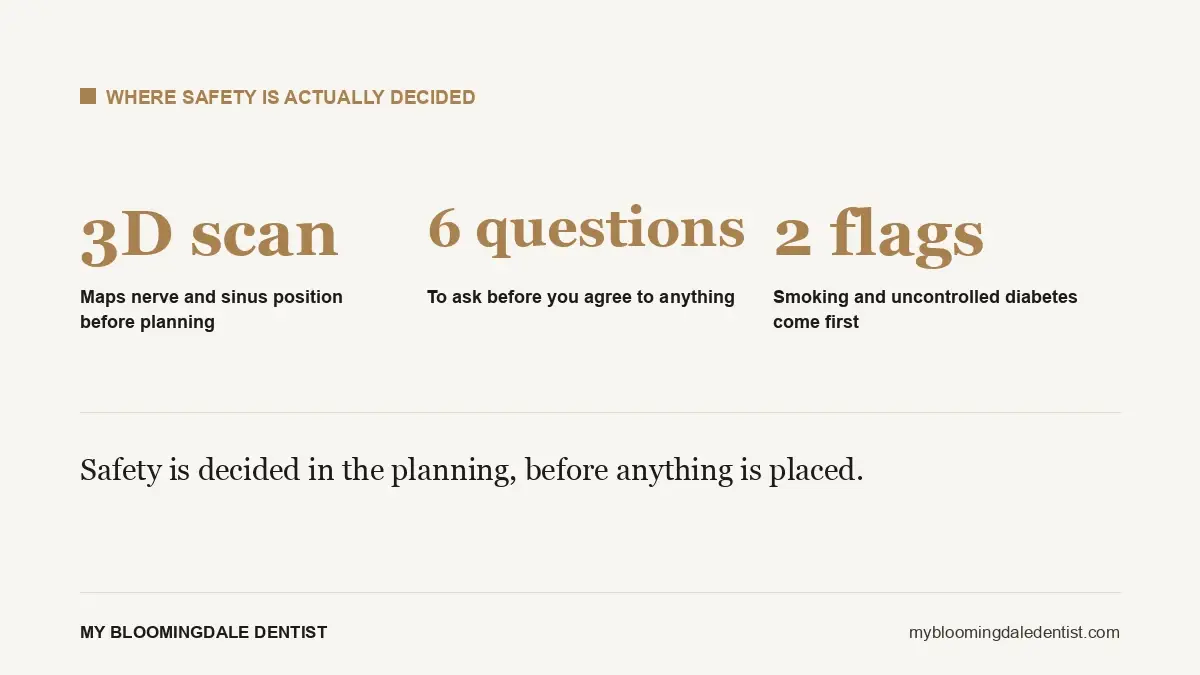
| Uncontrolled diabetes | Not yet | The FDA links a higher chance of implant failure through systemic infection to uncontrolled diabetes. Stabilise it, then reassess. |
| Smoking | Not yet, or eyes open | The FDA notes smoking may slow healing and reduce long-term success. The NIDCR calls tobacco the most significant risk factor for gum disease. |
| Active gum disease | Treat first | Placing an implant into infected tissue builds a problem instead of fixing one. |
| Not enough bone height or width | Plan around it | Bone grafting is done in-house and the graft is allowed to mature before the implant goes in. |
| Illness or treatment that slows healing | Medical clearance first | The ADA notes chronic illnesses such as diabetes or leukemia may interfere with healing after surgery. |
| A jaw that is still growing | Wait | An implant does not move with a developing jaw the way a natural tooth does. |
Notice what is not on that list: being old. The ADA puts it plainly, your general health matters more than your age, which is the same conclusion we reach in our guide to dental implants for seniors.
Is titanium a problem? The honest answer
Titanium and zirconium oxide are the two dominant implant materials, and their safety profiles are, in the FDA’s words, well known. Biocompatibility testing exists specifically to show that contact with body tissue causes no irritation or allergic reaction.
True titanium allergy exists but is uncommon, and it is not the usual reason implants fail. If you have a documented metal sensitivity, raise it at the consult and bring any allergy testing you already have. Ceramic systems exist, and knowing the brand and model of what is being placed is what lets anyone look up exactly what is in it. The far more common cause of trouble is bacterial rather than metallurgical: plaque left at the gumline, month after month.
What a proper safety screening covers before anyone drills
- Full medical history and a current medication list. Bone medications and blood thinners change the plan, and they only change it safely if we know about them.
- A 3D X-ray. Not a flat film. It shows the real volume of bone and where the nerve canal sits in the lower jaw or the sinus floor sits in the upper, before a single decision is made.
- Gum health assessed and treated first. Active disease gets handled before an implant is scheduled.
- The bite examined. How you close determines the force the implant carries for the next twenty years.
- A written plan and a written number, including anything the jaw needs first, before anything is booked.
The $99 new-patient exam includes X-rays and is the cheapest way to find out whether you are a candidate at all.
Glendale Heights patients can see what that first visit and a complete implant cost here at dental implants in Glendale Heights, IL.
Six questions to ask before you say yes
- What brand and model of implant system are you placing, and can I have that for my records?
- Can I see my 3D scan, and where does the plan sit relative to the nerve or the sinus?
- Who does the surgery and who makes the final tooth, and is that the same person?
- What happens if it does not fuse, and who covers the redo?
- What is the total in writing, including anything my jaw needs first?
- What is the recall schedule, and what will you measure at each visit?
Any office that finds these awkward has told you something useful.
Why we will not place an implant the same day a tooth comes out
Some practices advertise exactly that. We deliberately do not work that way, and safety is the reason. A fresh extraction socket is an open wound with its own bacteria and an unpredictable shape. Letting it heal means one surgery to recover from at a time, a settled site the implant can grip properly, and where grafting is needed, time for the graft to mature. A few months on the calendar removes a whole category of problem.
A consultation with 3D imaging shows what your jaw has to work with and the full number in writing before anything is scheduled. Appointments are available in English, Vietnamese, Korean and Spanish.
Book an implant consultationRelated reading
Curious what the surgery is like? Read our day-by-day account of implant recovery. Considering implants later in life? Start with dental implants for seniors. Wearing a denture that moves? See how an implant-supported denture compares on cost and daily life. You can also read about dental implant treatment in Bloomingdale, IL, or contact the office.
Safety and longevity are two halves of the same question. For the second half, how long implants actually last, part by part gives separate timelines for the post, the abutment screw and the crown.
Screening decides the shape of the plan, not just whether to go ahead at all. When a graft comes before the implant covers what the scan is measuring and why the waiting is built in, and the narrow-post version of the same treatment sets out where minis genuinely fit and where they do not.
Frequently asked questions
For healthy adults, yes. Implant systems are regulated medical devices made from materials that meet international consensus standards and are tested for biocompatibility. The risks that matter are surgical and biological, and most of them are managed by proper screening and 3D planning before the day of surgery.
The FDA lists infection, damage to nearby teeth or tissue, sinus perforation in the upper jaw, numbness from nerve impingement, screw loosening, difficulty cleaning around the implant, and implant failure. Most are uncommon, and most are reduced by 3D planning and by treating gum disease first.
True rejection in the immune sense is rare. When an implant does not stay, the usual reasons are failure to fuse with the bone in the first months, or bacterial infection around it years later. Both are handled by removing the implant, letting the site heal, and reassessing.
Anyone with active untreated gum disease, uncontrolled diabetes, or a jaw that is still growing should wait and be reassessed. People who smoke can have implants, but the FDA notes smoking may slow healing and reduce long-term success. Screening sorts this out before anything is scheduled.
Sources: U.S. Food and Drug Administration, Dental Implants: What You Should Know · MouthHealthy by the American Dental Association · National Institute of Dental and Craniofacial Research, Periodontal (Gum) Disease. General information, not a diagnosis; your own dentist’s reading of your health history and scan takes precedence.
Bartlett patients weighing the procedure can read what implants involve at our Bartlett-area practice.