Someone has told you that you need a bone graft for a dental implant, and it landed like bad news. Another procedure, more money, more waiting. Here is the part that rarely gets explained at the front desk: the graft is usually what makes the implant possible at all, and skipping it does not save you money. It moves the problem later, when there is a crown sitting on top of it.
What a bone graft really does
MedlinePlus puts the general principle in one line: a bone graft transplants bone tissue, and once your body accepts it, “it provides a framework for growth of new, living bone.” The graft is scaffolding.
In the jaw, material gets packed into the area that has thinned. Over the following months your own bone grows through it and takes it over, so what ends up holding the implant is your bone, not the material that was placed. That material can be your own bone, processed donor bone, or a synthetic mineral.
How the decision gets made, and what the 3D scan measures
A flat dental X-ray is a shadow. It shows roughly how much height there is and very little else, which is why people get told one thing at one office and something different at another. A 3D scan gives a volume instead, and three things get read off it:
- Height. How much bone sits above the nerve canal in the lower jaw, or below the sinus floor in the upper. That distance sets the length of post that can safely be used.
- Width. How thick the ridge is from cheek side to tongue side. A post needs bone wrapped around it on every side, and a ridge can look healthy on a flat film while being too narrow to hold anything.
- Quality. Dense bone and soft, spongy bone behave differently under load, which changes how long the site is left alone before a crown goes on.
That is a ten-minute answer, and it comes before anyone schedules surgery or quotes a number. The $99 new-patient exam includes X-rays.
Can you get an implant without a graft?
Often, yes. Three honest outcomes:
- No graft needed. The tooth came out recently, the ridge is still full height and width, and there was no long-running infection underneath it.
- A small amount of material at the same appointment. There is enough bone for the post but a shortfall on one side that needs covering. Not a separate surgery, and it adds no months. It happens while you are already in the chair.
- A separate graft first. The gap is years old, the ridge has narrowed, or the tooth was lost to advanced gum disease, which takes bone with it. Bone gets rebuilt, given time, re-scanned, and only then does the implant go in.
The answer that should make you uneasy is an office telling you which of those three you are before it has scanned you. Nobody sees through a jaw.
What happens if you wait
Bone in the jaw exists to hold teeth. Take the root away and the body stops maintaining that section. MedlinePlus notes that after an extraction the clot fills the socket as the bone grows back in, and that some people have changes to the bone and tissue near the site. Loss is fastest in the first year and continues slowly for as long as the gap is empty. So a graft that would have been minor at year one is a bigger job at year eight. And if you wear a removable denture over that ridge, the shrinking is why one that fit beautifully two years ago has started rocking.
How long a bone graft for a dental implant takes to heal
The ranges below are typical, not a promise. The dates that matter are on your own written plan after your scan.
| Stage | Typical time | What is happening | What you notice |
|---|---|---|---|
| Gum closes over the site | 1 to 2 weeks | Soft tissue seals. MedlinePlus gives the same window for a socket after an extraction | Soreness settles in a few days |
| Early consolidation | 4 to 8 weeks | Your own bone begins growing into the material | Nothing. The site feels ordinary |
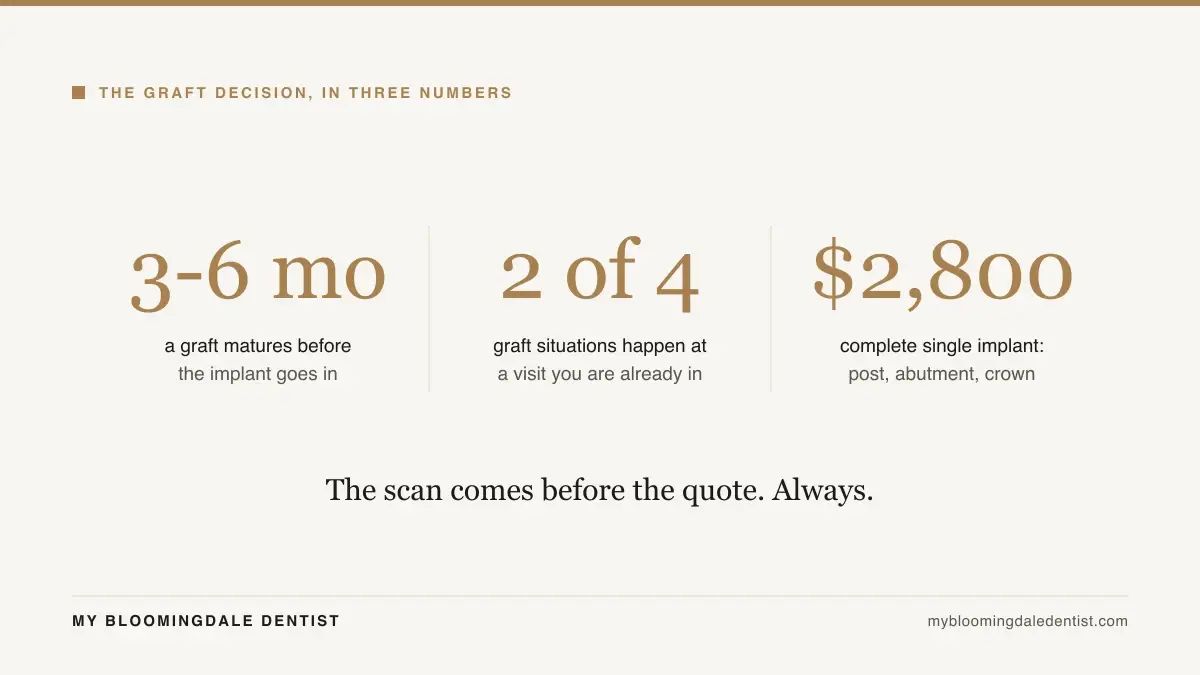
| Graft matures | 3 to 6 months | Material is replaced by bone strong enough to grip a post | Calendar time, not recovery time |
| Re-scan and decision | One visit | A new 3D image confirms the bone is there | A yes or a longer wait, in writing |
| Implant fuses to bone | Several months | The FDA notes healing may take several months or longer | A temporary tooth, not a gap |
Add it up and a site that needs rebuilding first is a nine to twelve month project from first scan to final crown. Nobody enjoys hearing that. It is still shorter than doing it twice.
Not every graft is the same job
“Bone graft” is one phrase for four jobs that are nothing alike in scale, wait or price.
| The situation | What the graft is doing | When | Who handles it |
|---|---|---|---|
| Tooth is coming out now | Filling the socket so it heals full instead of collapsing | Same visit as the extraction | In-house |
| A shortfall beside the post | Covering a thin spot so the implant has bone all round | Same visit as the implant | In-house |
| The ridge has narrowed | Rebuilding width so a post has something to sit inside | Separate visit, months ahead | In-house |
| Not enough bone in height | Rebuilding vertically, the most involved version | Separate visit, longest wait | Sometimes referred out |
Two of those four happen while you are already in the chair for something else, so brace yourself only once you know which row you are in.
Why we will not place the implant the same day the tooth comes out
Some practices advertise exactly that, and it is a genuinely attractive offer. We deliberately do not work that way. A fresh extraction socket is an open wound with its own bacteria and an unpredictable shape. Letting it close means one recovery at a time, a settled site the post can grip, and where a graft is involved, real time for it to mature into bone rather than being loaded while it is still material. A few months on the calendar removes a category of problem that is expensive and miserable to fix afterwards. So no teeth in a day here.
What a bone graft costs around Bloomingdale
National ranges get published online and they are wide enough to be close to useless, because the number depends on how much bone is being rebuilt and what material the site needs. Here is what we publish instead. A complete single implant, meaning the post, the abutment and the final crown, starts around $2,800 for dental implant treatment in Bloomingdale, IL. Grafting, and the extraction if the failing tooth is still there, get added to that plan and quoted at your consult in writing. Nobody hands you a number after the work. For bigger cases, our breakdown of full-mouth implant costs works through the area market ranges.
Six questions to ask before you agree to a graft
- Can I see my scan, and can you point to where the bone is short?
- Is this a small top-up at the time of the implant, or a separate surgery months in advance?
- What material are you using, and is it my own bone, donor bone or synthetic?
- When will you re-scan me, and what result would make you say the implant still cannot go in?
- What is the total in writing, graft and implant and crown together?
- If the graft does not take, what happens next and who pays for the redo?
An office that finds those questions awkward has told you something useful.
A consultation with 3D imaging shows what you have to work with, and the full number in writing before anything is scheduled. Appointments in English, Vietnamese, Korean and Spanish.
Book an implant consultationRelated reading
Worried about the surgery itself? Read our day-by-day account of implant recovery. Wondering how the finished result holds up? How long implants last, part by part gives separate timelines for the post, the screw and the crown. If bone loss is why the tooth went, implants later in life covers what changes with age. Anything else, get in touch with the office.
If the scan shows a ridge thinned by years of denture wear rather than a single gap to fill, the conversation sometimes turns to narrower mini implant posts instead. That guide covers the one job they do well and the cases they are wrong for.
Frequently asked questions
No. If the tooth came out recently and the ridge still has its full height and width, an implant often goes in without one. A graft becomes likelier the longer a gap has been left empty, or where advanced gum disease took bone with it. A 3D scan settles it, before anyone quotes you a price.
Typically three to six months, then a new scan to confirm the bone is there before the implant is planned on it. Small amounts of material placed alongside an implant at the same appointment do not add that wait at all.
Most people describe the first two or three days as sore rather than painful, comparable to having a tooth out. The gum closes over the site within one to two weeks. After that the graft matures quietly underneath and you feel nothing while it does.
It depends on how much bone is being rebuilt and where. At My Bloomingdale Dentist a complete single implant, meaning post, abutment and final crown, starts around $2,800, and grafting is added to that plan and quoted at your consult in writing.
Sources: MedlinePlus, Tooth Extraction · MedlinePlus, Bone Graft (general medical overview) · U.S. Food and Drug Administration, Dental Implants: What You Should Know · MouthHealthy by the American Dental Association, Implants. General information, not a diagnosis; your own dentist’s reading of your health history and your scan takes precedence.