Most pages on bone loss after tooth extraction stop at “the socket heals in a couple of weeks.” That answers the first question and skips the one that matters for what comes next. The socket is only the opening. The jawbone around it keeps responding to the missing tooth, and that is why a replacement plan belongs in the conversation early. This guide covers what happens to the socket, what the sources say about the bone, and what to bring to the exam.
What happens to the bone when a tooth comes out?
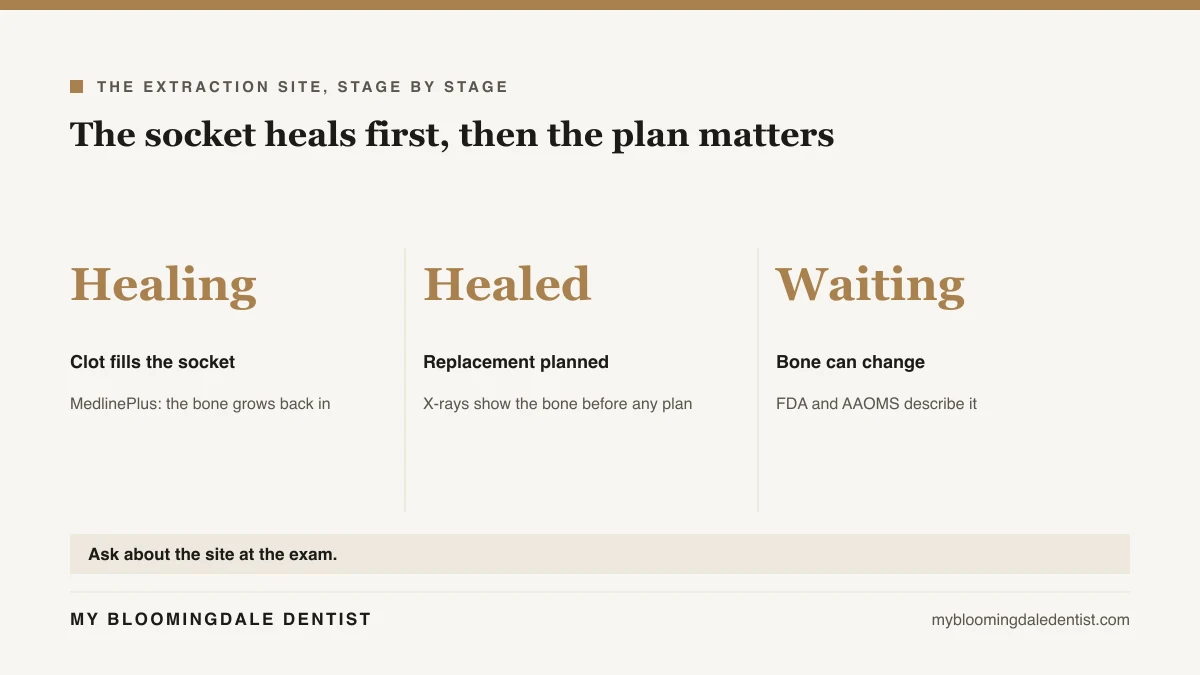
In the first stage, the body does the work. MedlinePlus, the National Library of Medicine’s patient site, says that after an extraction the blood clot fills the socket as the bone grows back in. Protecting that clot is the point of the aftercare routine, and our dry socket prevention guide covers it day by day. The day-by-day healing itself is in our extraction recovery timeline, and we will not repeat it here.
The second stage is what happens to the bone around the space over a longer stretch, once the tooth that used to sit in it is gone. The American Association of Oral and Maxillofacial Surgeons says on its dental implant surgery page that the loss or extraction of a tooth can alter the surrounding bone, potentially affecting future dental treatment. The FDA, in its dental implant guidance, says that when a tooth is lost due to injury or disease, a person can experience complications such as rapid bone loss, defective speech, or changes to chewing patterns.
Neither source gives a figure we could responsibly repeat, so we are not giving one. From us, the practical reading is simple. A socket that has healed is not the end of the story, and the bone around it is something to ask about, not something to assume.
How the site changes, stage by stage
This table sorts the stages by what the sources describe and what each one means for your decision. It is a general picture, not a promise about your jaw.
| Stage | What the sources describe | What it means for your decision |
|---|---|---|
| Right after the extraction | MedlinePlus: the clot fills the socket as the bone grows back in | Healing is the first job. Follow the aftercare you were given and call the office if something feels off |
| Once the socket has healed | From us: our implants page says a failing tooth has to come out and heal first, before the implant goes in | This is when the exam and X-rays show how much bone is there and which replacement options are open |
| Over the longer term, with no replacement | FDA: complications such as rapid bone loss can follow a lost tooth. AAOMS: the loss or extraction of a tooth can alter the surrounding bone | Waiting is a choice with effects, so ask the dentist about timing. Our implants page says that when a tooth has been missing for years, the bone has usually shrunk and rebuilding it is a separate step |
Why does timing matter for a bridge, denture or implant?
Each option sits differently on the site, so the bone matters differently to each one.
An implant is a post placed in the jawbone. The FDA lists helping keep the jawbone from shrinking due to bone loss among the benefits of dental implants. It also says that healing around the implant can take several months or longer, which is part of why the planning starts early. If the bone has thinned, our dental implants page says rebuilding it is a separate step, and Dr. Kim does bone grafting in-house. Our bone graft guide covers when a graft is needed.
A bridge rests on the teeth beside the space, and a removable denture rests on the gum. From us, that means neither one puts a post into the jaw. They solve the missing tooth differently, and the exam is where each one gets weighed against the condition of the bone and the neighboring teeth.
Waiting is the third path. It is reasonable when you are still deciding or still healing, and it is worth deciding on purpose instead of by default.
One exception is worth knowing. Our tooth extraction page says most teeth other than wisdom teeth should be replaced, which protects the bite and the bone. Ask whether the tooth in question is a wisdom tooth.
What should you ask at the exam?
Bring these. They turn a general worry into specific answers about your mouth.
| Question to ask | Why it matters |
|---|---|
| Is there a plan for this site before the tooth comes out? | Our extraction page describes mapping the replacement plan before removal, so the order of steps is known in advance |
| What do the X-rays and 3D scan show about the bone? | The exam includes X-rays, and our implants page describes 3D planning, so you can see what the dentist sees |
| If I want an implant, what has to heal first? | The extraction site heals before the implant goes in, and the order of visits follows from that |
| If I wait, what should I watch for and when should I come back? | Waiting has effects, so it helps to agree on a check-in instead of leaving it open |
| Is this tooth one that should be replaced? | Our extraction page says most teeth other than wisdom teeth should be replaced |
Health matters here too. MedlinePlus advises against smoking or using tobacco while the extraction site heals, and the FDA says smoking may affect healing around an implant. If you smoke, tell the dentist at the exam so the plan accounts for it.
Getting seen at the office
Call (224) 520-8665 to book. A new-patient exam is $99 and includes X-rays. Your plan and price are quoted in writing before anything is scheduled. The office sees patients during the week and on alternating weekends, so call first. The whole appointment, not only the front desk, can be held in English, Vietnamese, Korean or Spanish. A question that can wait a day can go through the contact form. You can also read how we handle dental implants before you come in.
Start with the exam and X-rays. New-patient exam $99. Every plan in writing before treatment. English, Vietnamese, Korean and Spanish spoken.
See how extractions are planned hereFrequently asked questions
The American Association of Oral and Maxillofacial Surgeons says the loss or extraction of a tooth can alter the surrounding bone. The FDA lists rapid bone loss among the complications that can follow a lost tooth. How much varies by person, so an exam with X-rays is the way to see your own.
MedlinePlus says the blood clot fills the socket as the bone grows back in. The day-by-day version is in our extraction recovery timeline. Healing speed depends on the person and the tooth, so follow the aftercare you were given.
Ask the dentist about timing for your tooth. The site has to heal before an implant goes in, and waiting has effects, so it helps to agree on a plan and a check-in. Our extraction page says most teeth other than wisdom teeth should be replaced.
Neither puts a post into the jaw, and we do not make a claim either way. The FDA lists helping keep the jawbone from shrinking among the benefits of dental implants. Ask at the exam how each option fits the bone you have.
Our implants page says that when a tooth has been missing for years the bone has usually shrunk and rebuilding it is a separate step. Dr. Kim does bone grafting in-house, and the scan shows whether it is needed.
The new-patient exam includes X-rays. It is where you learn the condition of the site and the bone, and which options fit.
Sources: MedlinePlus, Tooth extraction · U.S. Food and Drug Administration, Dental Implants: What You Should Know · American Association of Oral and Maxillofacial Surgeons, Dental Implant Surgery. General information, not a diagnosis.