Search for whether a cracked tooth is an emergency or not and you get two kinds of answers. The medical sites sort cracks into named types and never say what to do tonight. The practice sites say “call us” for every version, which is not triage. Here is the decision rule, the four things people mean by “cracked,” which lane each belongs in, and what to do with the tooth until you are seen. The clinical descriptions come from the American Association of Endodontists and MedlinePlus. This is a sorting guide, not a diagnosis.
What is the one question that sorts it?
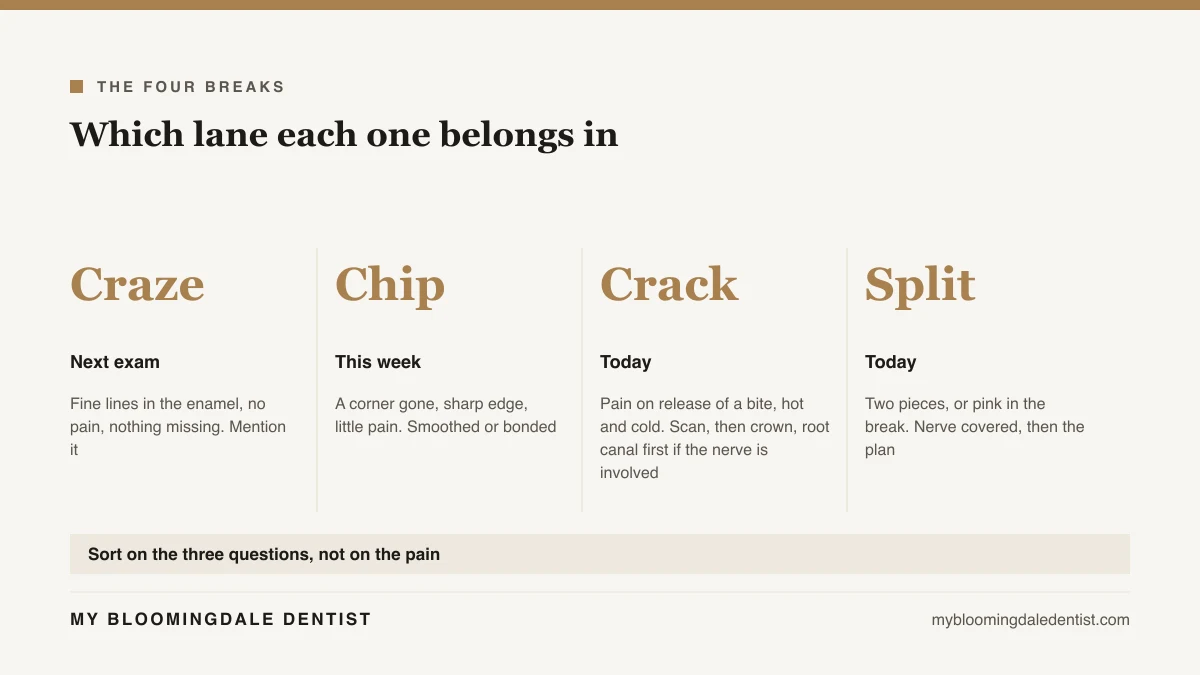
It is really three questions, asked in order, and they are about the inside of the tooth rather than the outside.
- Is there pink, red or blood in the broken surface? That is the nerve chamber, open to the mouth. It is painful, it gets infected, and it needs to be covered today.
- Does anything move? A piece that flexes when you press it with your tongue, or a whole tooth that shifts, means the break runs deeper than the surface.
- Does it hurt when you release a bite, more than when you make one? The American Association of Endodontists describes cracked tooth pain as erratic pain when chewing. The sharp jolt on letting go is the classic sign of a crack flexing open and snapping shut; live post when a filling needs to become a crown describes that release pain the same way.
A yes to any of the three is a today problem. Three noes is a this-week problem. Either way the tooth gets looked at; what changes is the clock.
The four things people call a cracked tooth
The AAE sorts cracks into named types, and the names are useful because they tell you which lane you are in.
| What you see | What it usually is | Today or not today | What the office does |
|---|---|---|---|
| Fine lines in the enamel, no pain, no missing piece | Craze lines. The AAE calls them “tiny cracks that affect only the outer enamel,” “very shallow,” and says they “cause no pain” | Not today. Mention it at your next exam | Checks them, usually nothing else |
| A corner or edge gone, sharp to the tongue, little or no pain | Chipped enamel, or a fractured cusp on a back tooth, which the AAE describes as “a piece of a tooth’s chewing surface breaks off, often around a filling” | This week. Today if it is sharp enough to cut, or if the exposed area is sensitive | Smooths the edge, bonds the corner, or covers the cusp |
| Pain on release of a bite, sensitivity to hot and cold, nothing obviously missing | A cracked tooth in the AAE’s sense: “a crack extends from the chewing surface of your tooth vertically toward the root” | Today. Do not chew on it in the meantime | Finds the crack on a scan, then decides between a crown and, if the nerve is involved, a root canal first |
| The tooth is in two pieces, or a piece rocks separately, or you see pink or blood | A split tooth, or an exposed nerve. The AAE: “a split tooth cannot be saved intact” | Today | Covers the nerve, stabilizes what can be kept, and plans the rest |
The AAE lists a fifth type, the vertical root fracture, which starts in the root and works upward and “often show[s] minimal signs and symptoms.” It is not something you can sort at home; if the gum beside a tooth swells, that goes in the today lane for the swelling.
Today, this week, or next available
Sorted by what the injury needs, not by anything else.
Today. Pink or blood in the break. A piece or a tooth that moves. Pain on releasing a bite. A back tooth that has lost a cusp and now hurts to cold. A tooth that was cracked in an accident, because the blow can have done more than the crack shows. The office holds same-day emergency slots during the week and sees patients on alternating weekends; say “cracked tooth” and describe the three answers when you call.
This week. A chip with no pain and no movement, a sharp edge you can cover, a fractured cusp that does not hurt. MedlinePlus says you may not need an emergency visit for a simple chip or a broken tooth that is not causing discomfort, and then adds the part people skip: you should still have the tooth fixed, to avoid sharp edges that cut the lips or tongue.
Next available. Craze lines. A rough spot on an old filling that does not hurt. Mention them, and let the exam decide.
One caution on the this-week lane. The AAE notes that some cracks show minimal signs and symptoms, so not hurting is a reason to have it looked at this week, not a reason to forget it.
When does it stop being about the tooth?
Three signs move a broken tooth out of the dental lane altogether. Bleeding that does not settle after fifteen minutes of firm pressure on gauze. A tooth that has been pushed out of its position, or a jaw that will not close normally, after a blow to the face. And swelling of the face or jaw, or a fever, in the days after a break. The first two can mean an injury to the jaw rather than the tooth; the third means an infection has moved past the tooth. Call the office if you can reach it, and go to an emergency room if you cannot, or if breathing or swallowing is affected. Dental swelling, and when it belongs in the ER draws that line in detail. A hospital can manage bleeding, trauma and infection; it cannot fix the tooth, so a dental visit follows either way.
What can you do until the appointment?
These steps make you more comfortable and stop a small break from becoming a bigger one. None of them repairs anything.
- Rinse gently with warm water. The ADA’s advice for a cracked tooth is to rinse the mouth with warm water to clean the area and to put cold compresses on the face to keep any swelling down.
- Keep any piece that came off, in a damp cloth, and bring it. It may or may not be usable, and the dentist can tell.
- Cover a sharp edge with orthodontic wax or sugar-free gum so it stops cutting your tongue.
- Chew on the other side, and keep hard, sticky and very hot or cold foods away from the tooth.
- Over-the-counter pain relief, taken as the label says. Never hold aspirin against the gum; it burns the tissue.
- For bleeding, MedlinePlus says to apply direct pressure with gauze. Fold it, press, and do not keep checking.
The limit of all this is that it does not close the crack. Chewing on it is what moves it. These steps buy comfort until the visit; they do not replace it.
How does each break get repaired?
This is the part that other pages either skip or turn into a menu. The AAE gives the general pattern: a fractured cusp gets a new filling or a crown; a cracked tooth is treated with a root canal and a crown to protect the crack when the nerve is involved; a split tooth cannot be saved intact. In practice that becomes four options, and the tooth, not the patient, picks between them.
A small chip is bonded. Where the walls are still sound, there is a middle option between a large filling and a full crown, the partial-coverage onlay. Dr. Kim places onlays at the Bloomingdale office, and it is worth asking about by name. A tooth with a crack running through it is usually not that case: it needs to be held together as one piece, which is what a full crown does. Posts on the filling-to-crown threshold and the crowns, bridges and onlays in Bloomingdale, IL page both say the same thing, and nobody can promise which repair a tooth needs before it has been seen and scanned. If the crack has reached the nerve, a root canal in Bloomingdale, IL comes first and the crown follows.
When the tooth is split to the root, the sequence changes. The tooth comes out, the socket heals, and only then are the replacement options planned, with no timeline promised for work that depends on healing.
What about a chipped front tooth?
A front tooth is where people most want an instant fix, and it is where the conservative answer is most often the right one. A small corner is bonded with tooth-colored material in the shade of the tooth beside it, and a bonded corner keeps every bit of the natural tooth that is still there. A larger break, or one that has taken the biting edge, moves toward a crown, and a break that exposes the nerve is a today visit whatever it looks like. If the tooth was hit hard enough to loosen it or push it out of line, the injury is treated first and the cosmetic question waits until the tooth has settled. What the shade will look like is settled with a scan and a lab, not guessed in the chair.
Getting seen at the office
Call (224) 520-8665 and describe the break using the three questions above. If you are new to the practice, the $99 new-patient exam includes X-rays, and every repair is quoted in writing before it starts. Appointments can be held in English, Vietnamese, Korean and Spanish, covering the exam, the options and the price, not just the front desk. The same-day emergency dentist in Bloomingdale page sets out what an emergency visit involves.
Call and describe it. The office will tell you whether it is today or this week. $99 new-patient exam with X-rays; repairs quoted in writing first. Care in English, Vietnamese, Korean and Spanish.
See what an emergency visit coversRelated reading
If a tooth came out whole rather than breaking, that is a different clock entirely, covered in what to do with a knocked-out tooth. For questions that are not urgent, you can send the office a message.
Frequently asked questions
It depends on three things: whether there is pink or blood in the break, whether the piece or the tooth moves, and whether it hurts when you release a bite. Any yes means the tooth should be seen today. A chip with none of those can be scheduled this week, but it should still be repaired, because sharp edges cut the lips and tongue.
A craze line or a small painless chip usually can, as long as nothing moves and nothing bleeds. A crack that hurts on release of a bite, a piece that flexes, or an exposed nerve should not wait. If you are unsure, call and describe it; the office will say which it is.
Keep it in a damp cloth and bring it to the appointment. It may or may not be usable in the repair, and the dentist can tell. Rinse your mouth gently with warm water, cover any sharp edge with orthodontic wax or sugar-free gum, and chew on the other side.
No. The American Association of Endodontists notes that some crack types, such as vertical root fractures, often show minimal signs and symptoms. A crack that does not hurt is a reason to have it looked at this week, not a reason to forget it.
The AAE’s general pattern is that a fractured cusp gets a filling or a crown, a cracked tooth with the nerve involved gets a root canal and a crown, and a split tooth cannot be saved intact. Which one applies is decided after the tooth has been seen and scanned; nobody can promise the repair beforehand.
Usually not for a small chip. A small corner is bonded with tooth-colored material matched to the neighboring tooth, which keeps all the natural tooth that is left. A larger break or one that exposes the nerve moves toward a crown, and a tooth that was loosened by the blow is treated for the injury first.
Sources: American Association of Endodontists, Cracked Teeth · MedlinePlus, Broken or knocked out tooth · MouthHealthy by the American Dental Association, Dental Emergencies. General information, not a diagnosis. For a head or jaw injury, or bleeding that will not stop, go to an emergency room or call 911.