A chipped front tooth feels urgent because everyone can see it. Dental bonding for a chipped front tooth is often the conservative option, as our cosmetic dentistry page describes it, and it is also easy to oversell. The useful question is not only whether bonding can fix the chip. It is what the chip is hiding, and where bonding stops being the right tool. This guide is the scope map, so you know what to expect before you sit down.
Dental bonding, in plain terms
Bonding means shaping tooth-colored resin onto a tooth to repair it. On our cosmetic dentistry page, composite bonding is described as chips, spacing and worn edges reshaped with tooth-colored resin in a single visit, a conservative approach that is also reversible.
That description sets the scope. Bonding adds material to a tooth that is otherwise sound. Our cosmetic dentistry page says it plainly in the FAQ: for small chips, bonding is fast, affordable and preserves your tooth, while larger damage may need a crown.
Which chips does bonding handle well?
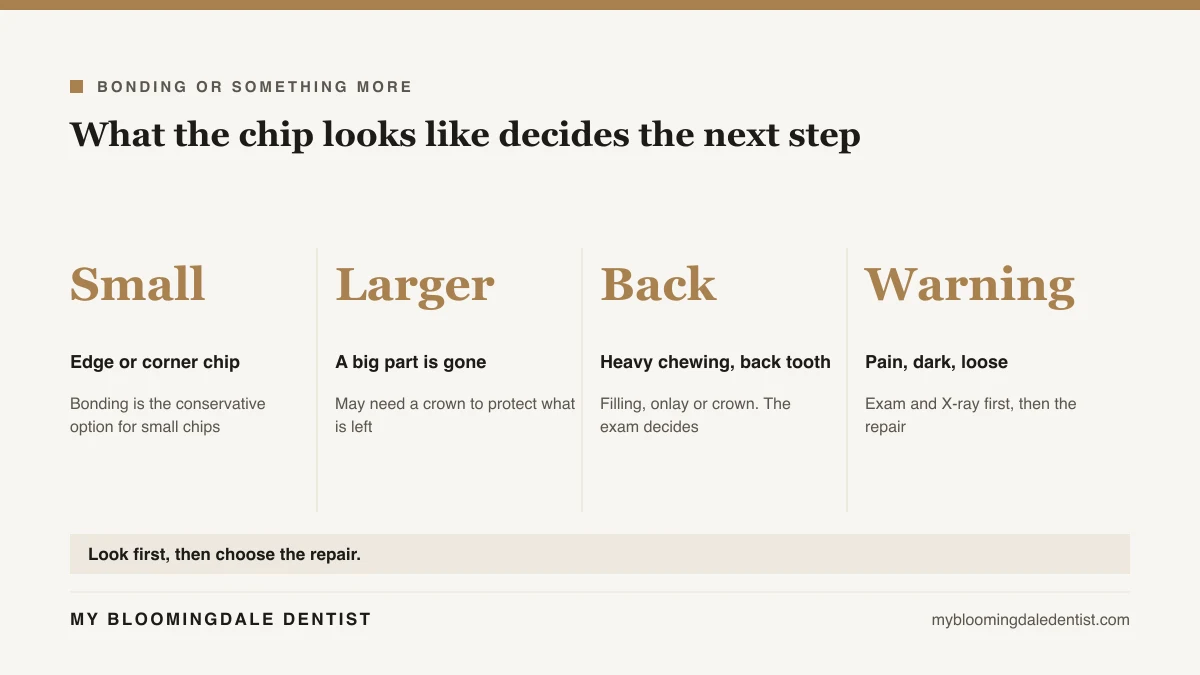
The table sorts common situations by what the chip looks like and where it is. It describes what usually fits, not a promise for your tooth, because the exam decides. Nothing here is a price or a timeline.
| What the chip looks like | What usually fits | What happens next |
|---|---|---|
| A small chip on the biting edge or corner of a front tooth, no pain | Bonding is the conservative option our cosmetic dentistry page describes for small chips | An exam and X-ray come first, then the resin is shaped and shade-matched |
| A larger break that takes a big part of the tooth | Our cosmetic dentistry page says larger damage may need a crown. MouthHealthy says a crown can protect a weak tooth or restore one that is already broken | The dentist explains why bonding would not hold and what the crown involves |
| A chip with pain, sensitivity or a darker color | Not decided by looks. Pain, sensitivity or a darker color are reasons for an exam and X-ray first | Exam and X-ray first, then the repair is chosen |
| A chip on a back tooth that does the heavy chewing | A different conversation. The exam decides which repair fits | See the section on where bonding stops, below |
What signs mean the chip is more than a chip?
A chip can be the visible end of a bigger problem. MouthHealthy tells people with a cracked tooth to rinse the mouth with warm water and put cold compresses on the face to keep swelling down. It also says that in any dental emergency it is important to see your dentist or an emergency room as soon as possible. The signs below are reasons to have an exam before any repair.
- Pain when you bite down, or when the tooth meets hot or cold.
- The tooth looks darker than its neighbors, or feels loose.
- The chip is large, or a thin wall of tooth is all that is left.
- A sharp edge keeps cutting your tongue or lip.
If any of these apply, an X-ray and a close look come before any material goes on. The triage for cracked, chipped and broken teeth is in our guide on which one needs a chair today. If your face is swollen or you have a fever, our guide on dental swelling and when to go to the ER comes first.
Where does bonding stop?
Bonding stops where the tooth needs more than a surface repair. When a large part of the tooth is gone, the answer moves toward a crown or another prosthetic restoration. MouthHealthy says a crown can strengthen a tooth with a large filling when there is not enough tooth remaining to hold the filling, protect a weak tooth from breaking, or restore one that is already broken. Our crowns and bridges page covers crowns, bridges and the restorations built from a digital scan.
For a back tooth the answer can run from a filling to an onlay to a full crown, and Dr. Kim places onlays. How much sound tooth is left decides which. A related decision, when a large filling needs to become a crown, is covered step by step in when a filling needs a crown, and our crowns page has a section on onlays.
What to do today
A few steps protect the tooth until you are seen.
- Rinse your mouth with warm water to clean the area, as MouthHealthy advises for a cracked tooth.
- Skip ice, popcorn kernels and hard candy. MouthHealthy says all three can crack a tooth.
From us: keep any piece you can find and bring it, since whether it can be used is the dentist’s call, and favor the other side of your mouth until you are seen. MouthHealthy also says to use scissors, never your teeth, to cut things. If the chip came from an accident or sports, the same ADA site says mouthguards help cushion a blow to the face and lower the risk of broken teeth, and a dentist quoted on that page says your top teeth take the brunt of trauma because they stick out more.
Why did the tooth chip in the first place?
Sometimes the answer is one accident. Sometimes it is a pattern. MouthHealthy lists chipped or cracked teeth among the signs of teeth grinding, a habit many people have without knowing it. If you chip a tooth with no clear cause, say so at the visit.
What the visit looks like
You can expect three things: a close look at the tooth and the bite, an X-ray, and a conversation about the options for that tooth. If bonding fits, the resin is shaped and the shade matched, and our cosmetic dentistry page describes it as a single visit with no drilling. If it does not fit, you hear why and what comes next.
Getting seen at the office
If you have chipped a front tooth, call (224) 520-8665 and tell us what happened and whether there is any pain. The office sees patients during the week and on alternating weekends, so call first. A new-patient exam is $99 and includes X-rays, and any treatment is quoted in writing before it starts. The whole appointment, not only the front desk, can be held in English, Vietnamese, Korean or Spanish. A question that can wait a day can go through the contact form. For pain, swelling or a broken tooth, our emergency dentist page explains how emergency visits work.
Tell us what happened and we will look at it. New-patient exam $99, X-rays included. Every price in writing before treatment. English, Vietnamese, Korean and Spanish spoken.
See how bonding works hereFrequently asked questions
For a small chip, often yes. Our cosmetic dentistry page describes composite bonding as tooth-colored resin that reshapes chips in a single visit, conservative and reversible. The exam and X-ray come first, before anything is placed.
Our cosmetic dentistry page says larger damage may need a crown. MouthHealthy says a crown can protect a weak tooth from breaking or restore one that is already broken. How much tooth is left is what decides it.
MouthHealthy advises rinsing the mouth with warm water to clean a cracked tooth and using cold compresses on the face to keep swelling down, and says that in any dental emergency you should see a dentist or an emergency room as soon as possible. Our advice is to bring any piece you can find and avoid biting on that tooth.
Pain, sensitivity, a darker color or a loose feeling are reasons for an exam and an X-ray before any repair.
Back teeth do the heavy chewing, so a chip there is a different conversation. Depending on the tooth, the answer may be a filling, an onlay or a crown, and Dr. Kim places onlays. The exam decides which one fits.
A new-patient exam is $99 and includes X-rays. Any treatment is quoted in writing before it starts, and the exam is where you find out whether bonding fits your chip.
Sources: MouthHealthy by the American Dental Association, Dental Emergencies · MouthHealthy, Crowns · MouthHealthy, Mouthguards · MouthHealthy, Teeth Grinding