If your teeth zing at cold water, whitening is a fair thing to worry about. Custom take-home whitening trays and enamel sensitivity are really one question: how do you get a brighter shade without irritating the tooth? This guide explains how the two main professional methods differ, why our office chose trays, who should be examined before any whitening, and what to do if sensitivity shows up.
Why does our office use custom take-home trays?
Our cosmetic dentistry page describes professional take-home whitening this way: custom-fitted trays made from your digital scan, with professional-strength gel you use at home. We deliberately skip high-concentration in-office treatments because they can cause sensitivity and stress your enamel. Gradual and comfortable is the goal.
That is a choice, and it is worth saying plainly. Some practices lead with a single-visit session. Our position runs the other way. If the aim is a brighter smile with the least irritation, the slower method is the one we would put our name on.
How each method works and where sensitivity comes from
According to MouthHealthy, the American Dental Association’s patient site, whitening products contain one of two bleaches, hydrogen peroxide or carbamide peroxide. The bleach breaks stains into smaller pieces, which makes the color less concentrated and your teeth brighter.
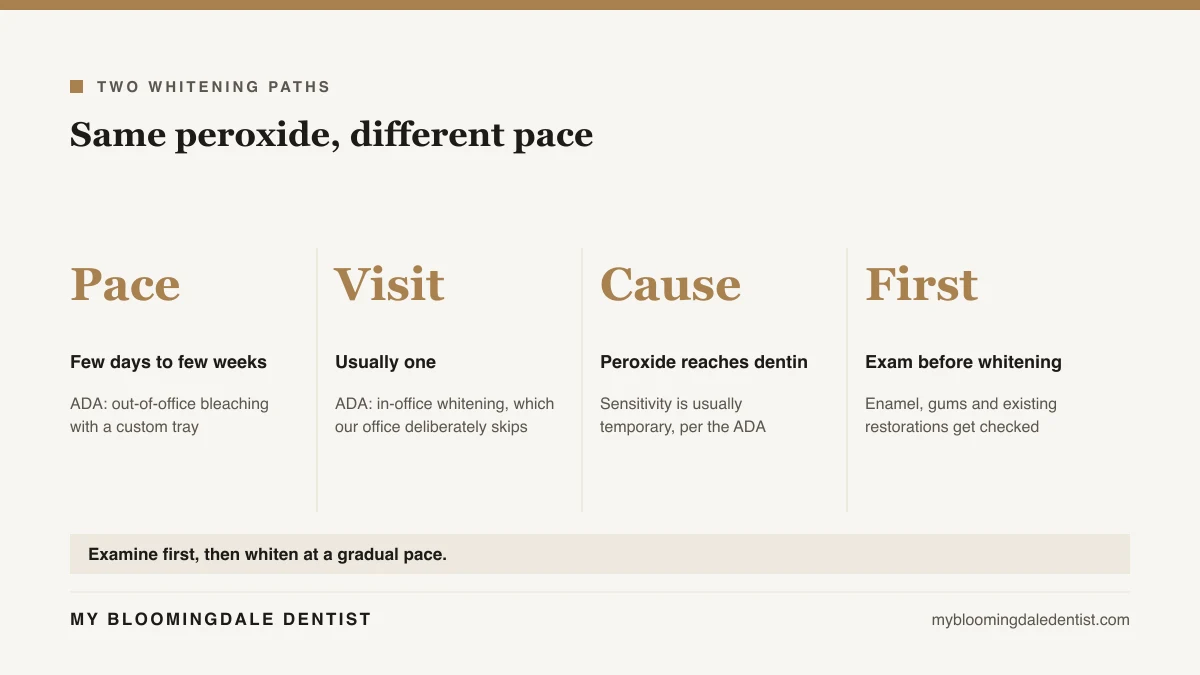
The same page describes the two professional routes. In-office whitening usually requires only one visit: the dentist applies a protective gel to your gums or a rubber shield, then applies the bleach to the teeth. For at-home whitening, the dentist provides a custom-made tray with instructions on how to place the solution and for how long. The ADA says this may be preferred if you feel more comfortable whitening at home at a slower pace, still with a dentist’s guidance, and that out-of-office bleaching can take anywhere from a few days to a few weeks.
Sensitivity has one source in both cases. The ADA explains that some people feel it when the peroxide gets through the enamel to the softer dentin layer and irritates the nerve of the tooth. In most cases the sensitivity is temporary. The ADA also warns that overuse of whiteners can damage tooth enamel or gums, which is why directions matter.
The two methods side by side
This table describes the methods in general terms, using the ADA page and our own service description. It is not a promise about your teeth, and it carries no price or shade claim.
| Question | Single-visit in-office session | Custom take-home tray |
|---|---|---|
| How long does it take? | ADA: usually one office visit | ADA: a few days to a few weeks, at home |
| Who applies the bleach? | The dentist, after protecting the gums | You, following the dentist’s instructions |
| What about sensitivity? | Peroxide can reach the dentin and irritate the nerve. Our cosmetic dentistry page says high-concentration treatments can cause sensitivity and stress enamel | The same peroxide, used at a slower pace. ADA: sensitivity is usually temporary, and treatment can be delayed and tried again |
| Is it made to fit you? | Applied in the chair | Yes. Our trays are made from your digital scan |
| Offered at our office? | No. We deliberately skip it | Yes. Professional-strength gel, not maximum-strength |
Who should be examined before any whitening?
Whitening is not a good first step for every mouth. The ADA tells you to talk to your dentist before deciding, because whiteners may not correct every type of discoloration, and because whitening does not work on crowns or fillings. The reasons below are the ones we check for at the exam.
| What we look for | Why it matters before whitening |
|---|---|
| Thin or worn enamel | The ADA says the dentin underneath is where sensitivity starts, and dentin shows when enamel is lost |
| Gum recession or exposed roots | The ADA notes that dentin can also be exposed when gums recede, which causes hypersensitivity |
| Existing crowns, fillings or other restorations | The ADA says whitening will not change them, so shades can end up uneven |
| Gum disease or untreated decay | These are treated first, and a cleaning and exam is where they are found |
| Dark or gray discoloration, or one tooth darker than the rest | The ADA says gray tones may not bleach at all, and discoloration from an injury or medications may not respond |
What a custom tray involves at our office
Our cosmetic dentistry page lays out the process. We take a digital scan of your teeth, the trays are made from that scan, and you use professional-strength gel at home. The kit is quoted at your visit, so you see the cost before you decide.
The exam comes first. That is the visit where thin enamel, recession, older restorations and gum health get checked, so the plan fits your mouth instead of a template.
What helps if your teeth are sensitive during whitening?
Start by telling your dentist before you begin if cold or sweet foods already bother you. The ADA’s sensitive teeth page explains that sensitivity can be treated, and the treatment depends on the cause. It lists options a dentist may suggest, such as desensitizing toothpaste or fluoride gel.
On whitening itself, the ADA says the sensitivity is usually temporary and that you can delay treatment, then try again. If it lingers, follow the instructions you were given and call the office. Do not stretch the schedule on your own, because overuse is how enamel and gums get irritated.
Is professional whitening better than store-bought kits?
The ADA says over-the-counter bleaching products contain a lower concentration of the bleaching agent than a dentist would use in the office, and it suggests discussing options with your dentist and looking for the ADA Seal of Acceptance. What a professional tray adds is the exam beforehand, the fit to your teeth, and someone to call. Our cosmetic dentistry page puts it simply: gradual whitening with a custom tray is far safer than guessing with over-the-counter kits.
If you have a chipped edge as well as a dull shade, read our guide to dental bonding for a chipped front tooth. Bring it up at the same exam so the plan covers both.
Getting seen at the office
Call (224) 520-8665 or read our new patient page to book. A new-patient exam is $99 and includes X-rays. Your enamel, gums and any existing restorations get checked at that visit, and a regular cleaning and exam is a good time to bring up whitening. The office sees patients during the week and on alternating weekends, so call first. The whole appointment, not only the front desk, can be held in English, Vietnamese, Korean or Spanish. A question that can wait a day can go through the contact form.
Start with the exam. New-patient exam $99, X-rays included. Every price in writing before treatment. English, Vietnamese, Korean and Spanish spoken.
See how take-home whitening works hereFrequently asked questions
They can, because the bleach is the same peroxide. The ADA says sensitivity happens when peroxide gets through the enamel to the dentin, that it is temporary in most cases, and that you can delay treatment and try again.
Our cosmetic dentistry page says high-concentration in-office treatments can cause sensitivity and stress enamel. We use custom take-home trays with professional-strength gel instead, at a gradual pace.
Anyone with thin enamel, gum recession, exposed roots, existing crowns or fillings, gum disease, or one tooth darker than the rest. The exam is where those are checked, and the ADA advises talking to your dentist before you start.
No. The ADA says whitening will not work on crowns or fillings, which is one reason to have your teeth examined first.
Tell the dentist before you start. The ADA says sensitivity can be treated and that the treatment depends on the cause, such as lost enamel or exposed roots, so the exam comes first.
Our cosmetic dentistry page says gradual whitening with a custom tray is far safer than guessing with over-the-counter kits. The ADA adds that you should discuss any over-the-counter kit with your dentist and look for the ADA Seal of Acceptance.
Sources: MouthHealthy by the American Dental Association, Teeth Whitening · MouthHealthy, Sensitive Teeth