The question comes up constantly and it deserves a straight answer, because the usual one is not much of an answer. You have paid for a root canal, you have sat through it, the pain has gone, and now you are being told there is another appointment and another bill. It is reasonable to ask why the crown after a root canal is not optional. The reason is that the two procedures do completely different jobs, and only one of them addresses what leaves the tooth able to break later.
What the root canal does, and what it leaves behind
Inside every tooth is a chamber with nerve and blood vessels in it. When decay or a crack lets bacteria reach that chamber, it becomes infected, and that infection is what produces the pain and eventually the swelling. A root canal cleans the chamber and the canals running down the roots, disinfects them and seals them.
That fixes the infection. It does nothing for the structure. To reach the chamber the dentist has to go through the top of the tooth, so a treated tooth is a tooth with a hole drilled through the middle of its strongest part, usually on top of the damage that let bacteria in to begin with. The walls that remain are thinner than they were, and the tooth no longer has its internal blood supply.
The American Dental Association describes the standard sequence on its patient site: a temporary filling goes on to protect the tooth until a definitive restoration like a permanent filling or crown can be placed at the earliest opportunity, and at the follow-up visit the dentist removes that temporary and replaces it with a regular filling or a crown to protect your tooth from further damage. Protecting the tooth from further damage is the crown’s entire job description.
Why a crown after a root canal is standard on back teeth
Chewing force is not distributed evenly across your mouth, and that single fact explains most of the disagreement people run into about whether a crown is really needed.
| Tooth position | What it does | Usual restoration after treatment | Why |
|---|---|---|---|
| Front incisors | Cut and tear. Light load | Often a filling in the access opening | Access hole is small, walls stay largely intact, force is light |
| Canines | Guide the bite sideways | Depends on how much tooth was lost | Takes guiding force rather than crushing force |
| Premolars | Crush and grind. Two cusps | Frequently a crown, sometimes an onlay if the walls are sound | Cusps split apart under load once the tooth is hollow, so what is left of the walls decides it |
| Molars | Do most of the chewing. Heaviest load in the mouth | Usually a crown | Large access hole, thin remaining walls, maximum force |
A hollow molar under full chewing load tends not to chip politely. It splits, and a split that runs below the gum line is frequently the end of the tooth. That is the outcome a crown is there to prevent, and it is why the answer differs from front to back rather than being the same for every tooth.
How long can you leave a temporary filling?
This is the part that gets skipped everywhere, and it is the part with real consequences.
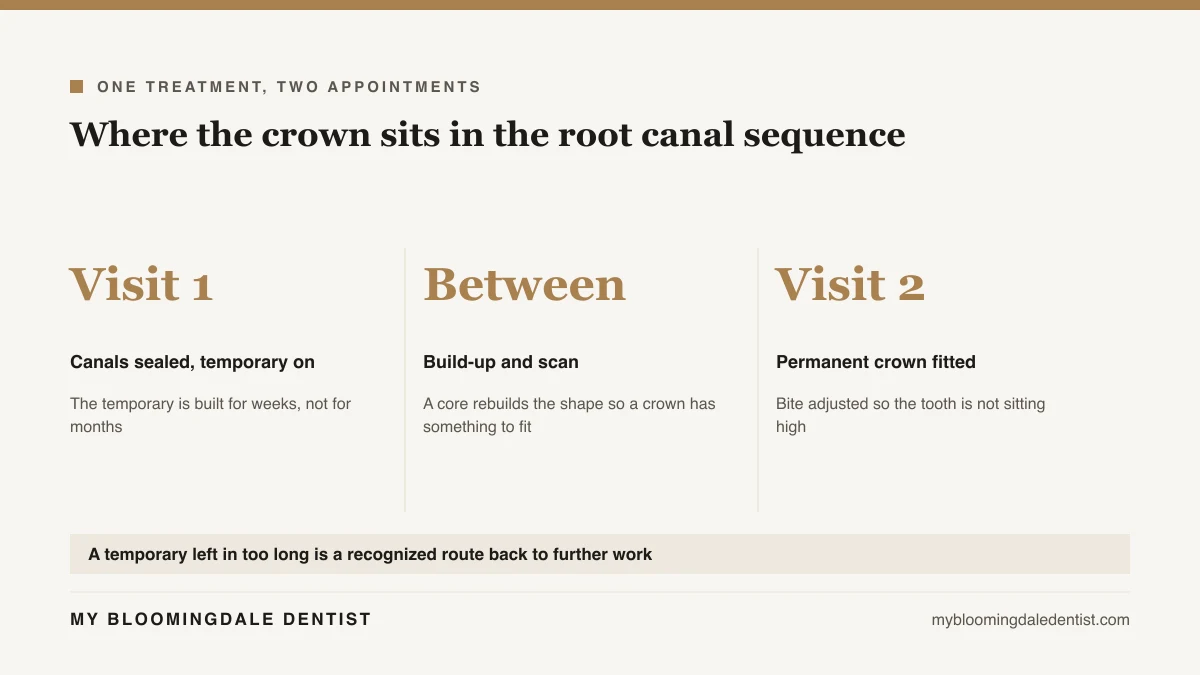
The temporary filling placed at the end of your root canal is exactly what its name says. It is there to keep the cleaned canals sealed and stop food packing into the access hole for the few weeks until the permanent restoration goes on. It is not a durable material and it is not meant to be one. Left in for months it wears down, and when it wears through, bacteria find their way back into canals that were cleaned and sealed at some expense.
A leak under a temporary is a recognized route back to further work on a tooth that was already treated. The treatment was not faulty. The seal on top of it failed. That is worth knowing because the gap between your two appointments is the one variable in this whole process that is entirely within your control.
If the temporary comes out, cracks, or starts to feel rough against your tongue before your crown appointment, it is worth calling rather than waiting. Emergency dental care in Bloomingdale, IL covers a lost temporary, and it is a short appointment to replace one.
Is a filling ever enough after a root canal?
Yes, and any dentist who says otherwise is overstating it. The honest version has conditions attached.
A front tooth with a small access opening, thick walls left on all sides and no history of a large restoration is often fine with a bonded filling in the access hole. That is a genuine case and it comes up regularly. What makes it work is that the tooth still has its own structure and takes light force.
The conditions stop being met on a molar with an old wide restoration, a fractured cusp, or walls that were already thin before treatment started. In those cases a filling seals the hole and leaves the underlying problem exactly as it was. The tooth is not weak because of the access hole. It is weak because of everything that happened before the root canal, and the root canal made it a little weaker still. In those cases a filling is the cheap answer that does not hold.
There is a third option in between, and it is the one most people are never offered. An onlay is a lab-made restoration that covers only the cusps that need covering and leaves the sound walls of the tooth standing, so it gives the treated tooth real protection without taking the tooth down on every side the way a full crown does. On a premolar with sound walls and a modest access opening it can be the middle answer. On a molar with a lost cusp or a crack running through it, it is not, because that tooth needs holding together as one piece. Crown and bridge treatment in Bloomingdale, IL covers onlays as well as full crowns, so ask for one by name at the restoration appointment and find out which of the three your tooth is.
The same call gets made on teeth that never had a root canal, and the signals are a little different. When a filling needs to become a crown works through the thresholds on an untreated tooth.
What the sequence looks like here
Here it is without the vagueness, so you can see what you are agreeing to before you agree to it.
- Diagnosis and treatment. A 3D X-ray shows the canals and the bone around the root tip. The canals are cleaned, disinfected and sealed, and a temporary filling goes on.
- The build-up. Before a crown can be made there has to be something to make it fit onto. If a lot of tooth is missing, a core is bonded into place to rebuild the shape. On a badly broken tooth a post may be set into a root canal to anchor that core.
- The scan. A digital scan records the prepared tooth, the teeth either side and how your bite closes. That is what the crown is made to.
- The fit. The permanent crown is seated and the bite is adjusted so the tooth is not sitting high. A crown sitting even slightly high is a common and easily missed reason a treated tooth stays tender, and it takes minutes to correct.
You leave the first visit with a temporary and instructions about chewing on that side. You leave the last one with a tooth you can use normally. The number of visits depends on the tooth and on whether a build-up is needed, and it gets confirmed at your consultation rather than guessed at here.
What does it cost to find out where you stand?
If you have had a root canal elsewhere and have been sitting on a temporary filling wondering what to do next, the cheapest useful step is to have the tooth looked at properly. A new-patient exam with X-rays here is $99, and it will tell you whether the seal is holding, how much tooth is left to work with and what restoration that tooth needs.
Crowns are quoted per tooth, because rebuilding a molar with one cusp missing is not the same job as covering a premolar with sound walls. That number comes in writing at the consultation, before anything is scheduled. Root canal treatment in Bloomingdale, IL sets out the treatment side of the same sequence.
If the tooth cannot be saved
Occasionally the answer is that there is not enough sound tooth left to restore, or a crack runs down into the root. It is better to be told that before a crown is made than after.
When that is the case, the tooth comes out, the site is given time to heal, and replacement is planned after that, in that order. What a bone graft does and how long it takes to heal explains the step that often comes between removal and replacement. There is no timetable promised at the consultation for work that depends on how your body heals.
A $99 new-patient exam includes X-rays and tells you whether the seal is holding and what the tooth needs, with the figure in writing before anything is booked. Appointments in English, Vietnamese, Korean and Spanish.
Book a restoration consultationRelated reading
If the answer turns out to be that the tooth has to go and you are weighing up what replaces it, what an implant really feels like, step by step deals with the question most people are too polite to ask. Anything else, get in touch with the office.
Frequently asked questions
Because the two procedures do different jobs. The root canal removes the infection from inside the tooth; the crown protects what is left of the tooth from breaking. Reaching the canals means drilling through the strongest part of the tooth, usually on top of existing damage, so a treated back tooth has lost structure and is hollow where the access opening was. The ADA describes the follow-up visit as replacing the temporary with a regular filling or a crown to protect the tooth from further damage.
Less time than most people take. The temporary filling is designed to seal the tooth for a few weeks, not for months, and once it wears through, bacteria can get back into canals that were cleaned and sealed. A leaking temporary is a recognized route back to further work on a tooth that was already treated. Book the restoration appointment at the same time as the root canal rather than deciding about it afterwards.
Sometimes, and it is worth asking about by name. An onlay covers only the cusps that need covering and leaves the sound walls of the tooth standing, so it protects a treated tooth without taking it down on every side. It suits a premolar with sound walls and a modest access opening. It is not the answer on a molar that has lost a cusp or has a crack running through it, because that tooth has to be held together as one piece. My Bloomingdale Dentist places onlays as well as full crowns.
Often not. A front tooth has a small access opening, takes light biting force and usually keeps most of its own structure, so a bonded filling in the access hole is frequently enough. The picture changes on premolars and molars, which do the crushing and grinding and split apart once they are hollow. Tooth position is what decides it, not a blanket rule.
A core rebuilds the missing shape of the tooth so a crown has something to fit onto, and a post is a small anchor set into one of the root canals to hold that core when very little tooth is left above the gum. Not every tooth needs one. It depends on how much sound structure remains once the temporary and any old restoration are removed.
Crowns are quoted per tooth, because rebuilding a molar with a missing cusp is a different job from covering a premolar with sound walls. My Bloomingdale Dentist gives that figure in writing at the consultation before anything is scheduled, and a new-patient exam with X-rays is $99 if you need the tooth assessed first.
Sources: MouthHealthy by the American Dental Association, Root Canals · MouthHealthy by the American Dental Association, Crowns · National Institute of Dental and Craniofacial Research, Tooth Decay · MedlinePlus, Tooth Disorders. General information, not a diagnosis; your own dentist’s reading of your history and your scan takes precedence.