Almost everything written about clear aligners stops at the last tray. That is a strange place to stop, because the question of whether a retainer after clear aligners does its job, and what relapse looks like when it does not, is the one that decides what the whole course was worth two years later.
This is the part after the finish line. What relapse is, when the drift starts, what each stage of retention asks of you, and what to do if your teeth have already shifted.
What is relapse after clear aligners?
Relapse means teeth moving away from where treatment put them and back toward the position they held before. It is not sudden and it is not usually dramatic. A lower front tooth turns a few degrees. A gap that closed opens by a fraction. Six months later the difference is visible in a photograph and hard to see in a mirror.
The reason is not mysterious. Teeth sit in bone, and the AAO is clear that tooth movement is a natural, lifelong process, so teeth will continue to move even after treatment. It also names the window that matters most: there is a settling in period right after treatment ends, where your teeth are particularly prone to moving back to their original positions. The AAO describes the mechanism plainly: force applied during bone remodeling causes the teeth to drift in the direction of the force. Once the trays stop applying force, whatever else is acting on the tooth, the bite, the lips, the tongue, a habit, is the force that remains.
Why the drift starts the day the last tray comes out
Retention is not an afterthought bolted onto the end of treatment. It is the second half of the same job. The FDA’s own page on clear aligners puts the retainer in the sequence rather than outside it: after your last set of clear aligners, your dentist or orthodontist may recommend using a retainer to keep your teeth in place and prevent teeth from shifting back.
The American Dental Association frames it the same way when it describes orthodontic treatment generally: retainers preserve and stabilize the results of your orthodontic treatment. Different sources, same structure. Moving teeth and holding teeth are two phases of one treatment.
The first stretch after the last tray is when tissue is least settled, which is why instructions are usually strictest then and relax later. What does not happen is the risk disappearing. The AAO is explicit that a retainer is typically necessary for a lifetime, though the frequency of wear may decrease over time.
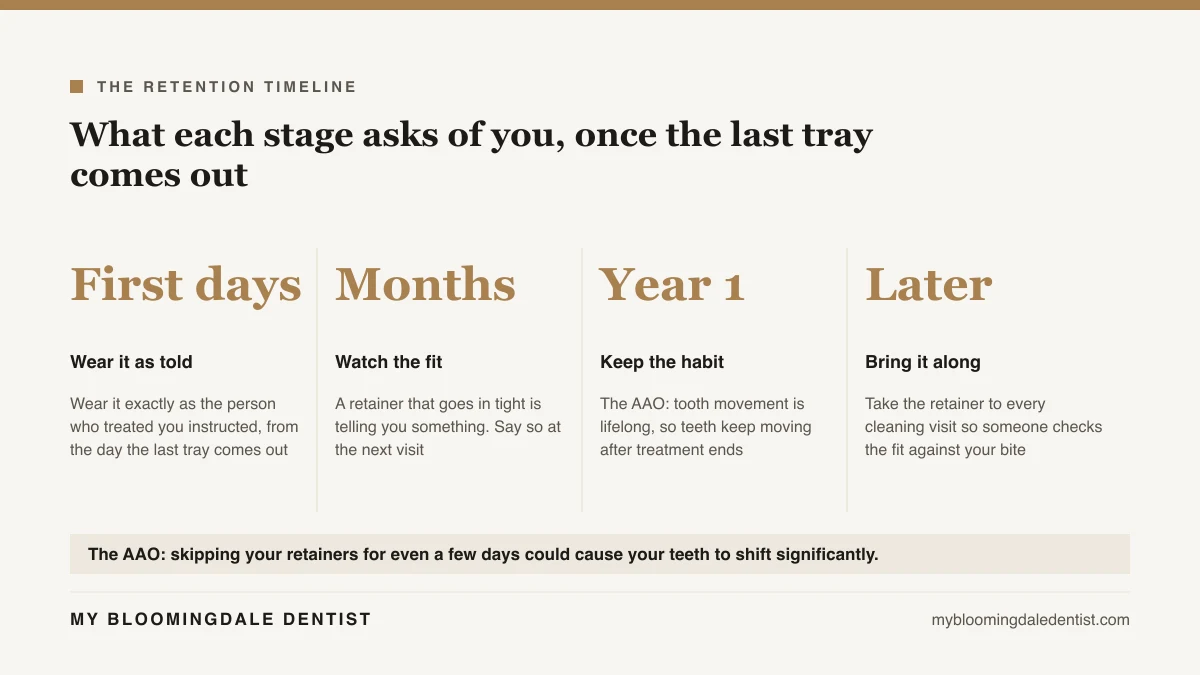
The retention timeline, and what each stage asks of you
Exact schedules are set by the person who treated you, because they depend on how far your teeth moved and how much your bite changed. The pattern below is the shape of it, not a prescription.
| Stage | What is happening | What you do | What to report |
|---|---|---|---|
| The first days | Bone and soft tissue are least settled | Wear it exactly as the person who treated you instructed | Anything that rubs, and any tooth the retainer does not seat over properly |
| The first months | Tissue is reorganizing around the new positions | Keep to the wear instruction rather than easing off early | A retainer that has started going in tight |
| The first year | Wear usually reduces to nights | Turn it into a routine, so it survives holidays and house moves | Any night you had to force it on |
| Years after | Teeth keep the ability to move, so the habit stays | Take it to cleaning visits so someone checks it against your bite | Cracks, warping, and a case you have stopped using |
One signal is worth more than all the others. A retainer that has begun to feel tight is telling you the teeth have moved a little since it was made. That is the early warning, and it is much easier to act on in the week it appears than in the year after it is ignored.
What kinds of retainer are there?
There are three common types, and the AAO describes them in a way worth borrowing because it is neutral.
- Clear removable retainers. The AAO calls them removable plastic trays that sit over your teeth. They look much like the trays you finished with, which makes them the familiar option for someone coming off aligner treatment.
- Hawley retainers. The AAO describes a combination of acrylic or hard plastic and a metal wire. It adds that the retainer sits either on the roof of your mouth or under your tongue, and that the wire retainer can often be personalized with a variety of colors and designs.
- Fixed retainers. A custom-fitted slender wire cemented or bonded to the inner side of either the upper or lower teeth, in the AAO’s words. Nothing to remember to put in, and more work to clean around.
Which type suits a given mouth is a clinical decision that depends on what was moved and how likely it is to move back, and it belongs to the person who treated you. Some people finish with a combination. What matters here is that you know the choices exist and that you ask which one your plan ends with, before the plan ends.
How do you live with a retainer without losing it?
Most retainer problems are ordinary life rather than anything clinical.
- Clean it daily. The AAO notes bacteria grow on a dirty retainer the same way they grow on teeth, so it needs daily attention.
- Keep it away from heat. Hot water, a dashboard, a dishwasher. Plastic that warps no longer fits, and a retainer that no longer fits is not doing anything.
- Use the case, every time. The two great retainer killers are a napkin at a restaurant and a coat pocket.
- If it snaps, cracks or stops fitting, say so straight away rather than nursing it along. The AAO’s own line is to consult your orthodontist if you feel your retainer no longer fits as it did at first. A cracked retainer holds unevenly.
- Take it with you to a routine cleaning and exam visit. Five seconds of someone watching it seat while you are already in the chair beats a month of guessing.
If it has been missing for a while, do not force an old one back in after a long gap without having it looked at. If the teeth have moved, an old retainer is applying force in a direction nobody planned.
Your teeth already moved. Now what?
This is the branch almost nothing on the internet covers, and it is the one most people are on when they go looking.
Start with the honest scale of it. A small drift, often a lower front tooth rotating slightly, is one version of this. A bigger change, where the way your teeth meet has shifted rather than just their line-up, is a different conversation and it starts with someone measuring the bite instead of looking at the smile.
What decides which one you are looking at is not something you can judge from a mirror or a photo. It takes a scan and an exam, which is also how the first course started. The clear aligners in Bloomingdale, IL page sets out how that assessment runs, and Dr. Henry Kim is the one who reads it.
What is worth resisting is the version of this problem that gets solved online. Mail-order trays bought against a photo are the fastest way to turn a small drift into a bite problem. The FDA’s position is not ambiguous: clear aligners are prescription devices, only safe to use under the supervision of a licensed practitioner, and the agency has not authorized clear aligners sold directly to consumers without a prescription and that supervision.
Where a retainer fits into treatment here
Treatment at My Bloomingdale Dentist is planned from a Trios digital scan rather than putty impressions, and the plan that comes back shows the movement the trays are meant to produce. The course ends with a retainer, which the clear aligner page already states, and the retention conversation belongs at the start rather than at the end. Ask what the retention stage looks like at the consultation, when you are still deciding, rather than on the day your last tray comes out.
If you have come off treatment somewhere else and want to know where you stand now, that starts with an exam. For new patients that is a $99 exam with X-rays, and anything that comes out of it is quoted in writing before it is scheduled.
A $99 new-patient exam with X-rays and a 3D scan is where that gets measured rather than guessed at. Appointments in English, Vietnamese, Korean and Spanish.
See the clear aligner treatment pageRelated reading and next steps
If you are still at the stage of deciding how to straighten teeth in the first place, how aligners and braces compare is a separate question with its own answer. If attachments are part of your plan, what those bonded bumps on the teeth do is worth a read too. For anything else, contact the Bloomingdale office.
Addison and Carol Stream patients can start from clear aligners in Addison, IL or clear aligners in Carol Stream, IL.
Frequently asked questions
Longer than most people expect. The American Association of Orthodontists states that you will likely need to wear retainers for the rest of your life, and that a retainer is typically necessary for a lifetime, though the frequency of wear may decrease over time. The exact schedule is set by the person who treated you, because it depends on how far the teeth moved.
Relapse is the word for teeth moving away from where treatment put them and back toward their earlier positions. It is usually gradual: a lower front tooth rotating slightly, or a closed gap opening a fraction. It happens because tooth movement is a natural, lifelong process, as the AAO puts it, and because the bite, lips and tongue keep applying force once the trays stop.
A retainer that has started going in tight generally means the teeth have shifted a little since it was made. It is the earliest warning you get, and it is far easier to deal with in the week it appears than a year later. Report it rather than forcing it, especially if you have gone a long stretch without wearing it.
The American Association of Orthodontists describes three. Clear removable retainers are plastic trays that sit over the teeth. Hawley retainers combine acrylic or hard plastic with a metal wire. Fixed retainers are a slender wire cemented or bonded to the inner side of the upper or lower teeth. Which one suits a given mouth is a clinical decision, and some people finish with a combination.
Not necessarily. A small drift and a change in the way the teeth meet are different situations, and how far things have moved is what decides the answer. Which one you are looking at takes a scan and an exam to establish, not a photograph.
Sources: American Association of Orthodontists, Retainers · American Association of Orthodontists, Will My Teeth Stay Where My Orthodontist Moved Them · U.S. Food and Drug Administration, Clear Dental Aligners · MouthHealthy by the American Dental Association, Orthodontics. General information, not a diagnosis; your own dentist’s reading of your mouth takes precedence.