Most clear aligners vs braces comparisons are written by someone selling one of them, which is why they all read the same way: a tidy table, a paragraph of honesty near the bottom, and a conclusion that happens to match whatever the author provides. This one has the honest part in the middle, where it belongs, because the list of things trays cannot do is the part that decides whether the rest of the comparison even applies to you.
Clear aligners vs braces, head to head
Start with the parts everyone agrees on.
| Clear aligners | Braces | |
|---|---|---|
| Visibility | Low. Trays are clear, though bonded attachments on some teeth are visible close up | High. Brackets and wires on the front of the teeth for the whole course |
| Typical treatment time | Several months to about a year for most cases we see | The ADA puts most people in braces for one to three years |
| Eating | Take them out. No food is off the list | The ADA advises avoiding popcorn, corn on the cob, chewing gum, whole apples and other sticky foods |
| Cleaning | Brush and floss normally with the trays out | Brackets are harder to clean around, and the ADA warns that too many sugary foods with braces can leave plaque build-up that permanently stains or damages teeth |
| Depends on you | Completely. The FDA says aligners should be worn at least 20 hours a day or as your dentist directs | Barely. They are bonded on and working whether you think about them or not |
| Range of cases | The FDA describes them as commonly used for mild to moderate problems | A much wider range, including the cases below that trays cannot reach, though some of those still need a surgical step as well |
Two rows in that table do most of the work. “Depends on you” is why a disciplined wearer often finishes faster with trays than they would have with braces, and why someone who leaves them in a locker does not. “Range of cases” is the next section.
What can clear aligners not fix?
This is the section the category writes as one cautious paragraph near the bottom of a sales page. It deserves better, because it is the only part of the comparison that can rule an option out.
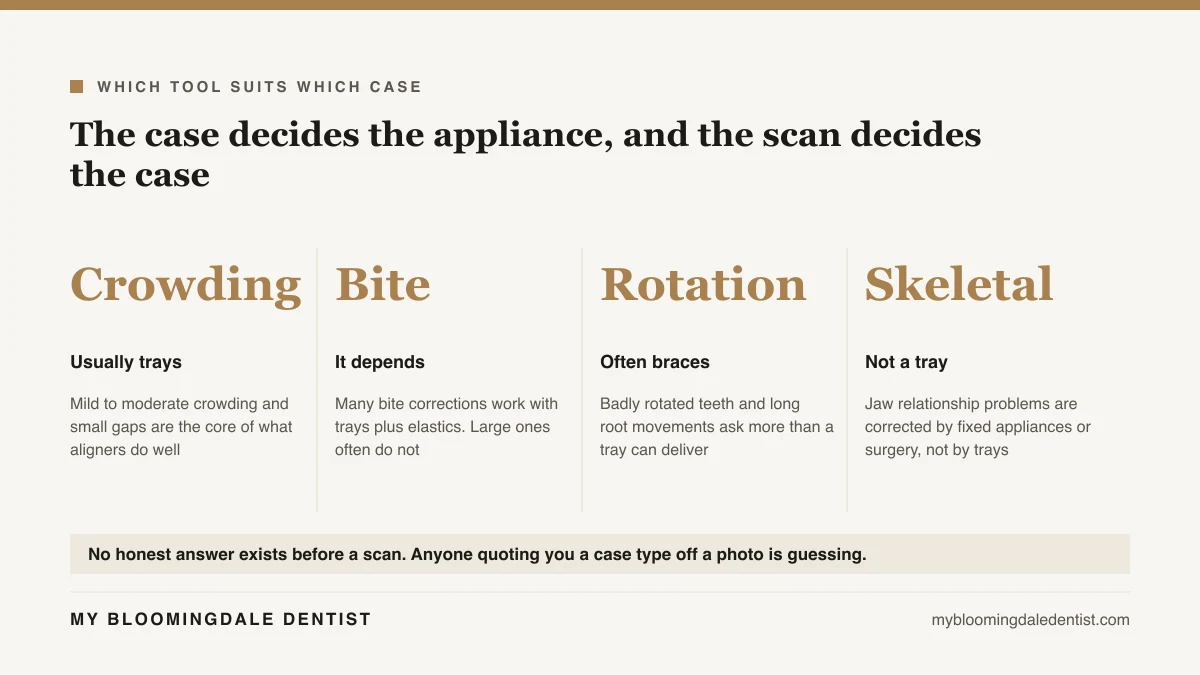
- Skeletal problems. If the upper and lower jaws do not relate to each other properly, the issue is where the bones sit, not where the teeth sit. Moving teeth around a skeletal discrepancy can hide it and cannot correct it. That is fixed appliance or surgical territory.
- Severe rotations. A rounded tooth such as a canine, turned well out of line, is one of the hardest things to grip. Trays plus attachments reach further than they used to, and past a point they run out.
- Large vertical movements. Pulling a tooth down that is sitting high, or pushing one up, asks for sustained force in a direction a shell struggles to deliver.
- Heavy root movement, where the crown is roughly where it should be and the root underneath is not. Trays move crowns well and roots less well.
- Impacted teeth that have not come through and need to be brought into the arch, which usually needs a fixed appliance and sometimes a surgical step first.
- Closing large extraction spaces, where the scale of the movement and the control needed both favor a wire.
The FDA states it in one line: clear aligners may not effectively treat more complex orthodontic conditions. That is not a warning about quality. It is a statement about what a removable shell can physically do.
The boundary has moved over the years and it will keep moving, because bonded attachments and elastics let a plan reach cases that trays alone could not. What has not changed is that the boundary exists, and that it sits in a different place for every mouth. A case that one plan calls borderline is a straightforward one for a different set of teeth.
There is a second category worth naming, because people arrive asking for aligners when straightening is not their problem at all. A tooth that is chipped, worn short or discolored is sitting in the right place and looking wrong, and no amount of movement changes that. Those cases belong with cosmetic dentistry in Bloomingdale, sometimes on their own and sometimes after alignment. Straightening first and restoring second is a common order, and knowing which half you need is the point of the consultation.
Where clear aligners genuinely win
When the case does suit them, the advantages are not marketing.
The obvious one is that adults get through a year of treatment without a visible braces phase at work. The underrated one is cleaning. You take the trays out to brush and floss, so nothing changes about your routine, and the ADA’s warning about sugary foods leaving plaque build-up around brackets simply does not apply. Gum health during treatment tends to be easier to hold onto as a result, and a routine cleaning visit partway through is a straightforward appointment rather than an archaeological dig.
Eating is the third. Nothing is off the list, because the trays come out. That matters more than it sounds over a year.
And there is a specific case trays suit almost perfectly: teeth that were straight once and drifted afterward, usually because a retainer stopped being worn. The movement needed is small, the discipline is usually there the second time, and the whole thing is over quickly.
Where braces still win
Braces are not the old option. They are the one that works on the widest range of cases and the one that does not depend on the patient remembering anything. For the list above, they are not a compromise, they are the correct tool. For someone who knows they will not keep a removable appliance in, they are also the realistic tool, whatever anyone would prefer.
They are also the more predictable choice when a case is borderline, because a wire can be adjusted at the chair as things develop, where a tray set was planned before treatment started and reaches a point where it has to be re-planned instead.
That re-planning is worth understanding before you start, because it is normal rather than a failure. Teeth do not always track a digital plan exactly, and when they drift off it the usual answer is a fresh scan and a new run of trays to finish the job. It is one of the reasons the treatment time you are quoted at the start is a plan rather than a promise, whichever appliance you choose.
What decides the cost?
Here is the part comparison articles usually get wrong by quoting a range. The two appliances overlap so heavily on price that the appliance is not what you are choosing between financially. What moves the number is the case.
- How far the teeth have to move, and whether one arch or both are being treated.
- How long the plan runs, which drives the number of visits.
- Whether the bite is being corrected as well as the alignment, which adds elastics and stages.
- What the retention stage looks like at the end.
Which is why we do not publish a range here. At My Bloomingdale Dentist the exact price for clear aligner treatment comes at the consultation, after the scan, in writing, and financing is available. If your dental plan has an orthodontic benefit, the terms vary a lot from plan to plan, including whether it is a separate lifetime maximum and whether it treats both appliances the same way. Worth checking your own plan before you decide anything, and we check it with you at the visit.
The one figure we do publish is the front door: a $99 new-patient exam with X-rays.
How does the decision get made here?
The order matters more than the opinions. A Trios digital scan comes first, with no putty impressions, and the plan built from it shows the movement the trays would have to produce. That is the point at which anyone can honestly say whether your case is on the list above or not. Before the scan, everything is a guess, including ours.
Dr. Henry Kim, DMD confirms candidacy from that scan rather than from a photograph, and if the answer is that trays are not the right tool for your case, you find that out before you have paid for a course of them rather than nine months in. The clear aligner treatment in Bloomingdale, IL page covers how the course itself runs, from the scan through to the retainer at the end.
A $99 new-patient exam with X-rays and a Trios 3D scan answers it, with the plan, the timeline and the price all quoted in writing. Appointments in English, Vietnamese, Korean and Spanish.
See how clear aligner treatment runsRelated reading and next steps
If you have already decided on trays, the next two questions are what gets bonded to your teeth during treatment and what holds the result afterward. Both get settled at the consultation, once the scan shows what your plan needs. For anything else, send the office a question.
Coming from Addison or Carol Stream? clear aligners in Addison, IL and clear aligners in Carol Stream, IL cover the consult from your side of town.
Frequently asked questions
For the cases they suit, yes. The FDA describes clear aligners as commonly used to treat mild to moderate orthodontic problems including crowded teeth, gaps and bite problems, and notes they may not effectively treat more complex conditions. Braces cover the wider range. The honest comparison is not appliance against appliance, it is appliance against your particular case.
Skeletal problems where the jaws themselves do not relate properly, severely rotated teeth, large vertical movements, heavy root movement, impacted teeth that need bringing into the arch, and closing large extraction spaces. Those cases need fixed appliances and sometimes surgery. A scan is what establishes which list your case is on.
It depends on the case rather than the appliance. The American Dental Association puts most people in braces for one to three years. Most clear aligner cases we see finish in several months to about a year, because they are the milder cases by definition. Trays also only move teeth while they are being worn, so an inconsistent wearer can turn a short plan into a long one.
They overlap enough that the appliance is rarely what decides the number. What decides it is how far the teeth have to move, whether one arch or both are treated, how long the plan runs, and whether the bite is being corrected as well as the alignment. We quote the exact price for clear aligner treatment in writing at the consultation after the scan, and financing is available.
That is one of the cases clear aligners suit best, because the movement needed is usually small. It most often happens when a retainer stopped being worn. The assessment is the same either way: a scan and an exam establish how far things have drifted and whether the bite changed as well as the alignment.
Sources: U.S. Food and Drug Administration, Clear Dental Aligners · MouthHealthy by the American Dental Association, Braces · MouthHealthy by the American Dental Association, Orthodontics. General information, not a diagnosis; your own dentist’s reading of your mouth takes precedence.