The thing nobody tells you about clear aligner attachments and buttons is that they exist at all. You look at the category, you see a smooth tray and a promise that nobody will notice, and then at the first appointment a tray goes in over a row of small bumps that were bonded to your teeth before it. It is a surprise that costs the whole category a certain amount of trust, and it does not need to be one.
So here is the honest version: what these things are, why a tray usually cannot work without them, how visible they really are, and the questions worth asking before you sign anything.
What are clear aligner attachments and buttons?
An attachment is a small piece of composite resin, the same family of material used for a tooth-colored filling, shaped and bonded onto the surface of a specific tooth. It is not drilled into anything. It sits on the enamel, and the tray is made with a matching dimple that fits over it.
Think of it as a handle. A tray on its own is a smooth shell sitting over smooth teeth, and a smooth shell can squeeze. What it struggles to do is grab. An attachment gives the tray a purchase point so it can push a tooth in a chosen direction, rotate it, or hold it still while the teeth either side move.
A button is a different tool for a different problem. It is a small anchor, sometimes composite and sometimes metal, placed so a small elastic band can hook onto it. Elastics pull one arch against the other, which is how a bite gets corrected rather than just a crowded row of teeth being tidied up. If your plan includes elastics, it needs something to hook them to.
The American Dental Association describes braces as small brackets cemented to your teeth, connected by a wire. Attachments are not brackets and there is no wire, but the borrowed idea is the same one: at some point, something has to be fixed to the tooth for a force to act on it.
Why can a smooth tray not do the whole job?
Trays are good at some movements and poor at others. Tipping a tooth sideways is straightforward. Rotating a round tooth such as a canine, pulling a tooth down that is sitting high, or moving a root rather than just the crown, all ask for a grip the tray does not naturally have.
The FDA puts the scope of the category plainly: clear aligners are commonly used to treat mild to moderate orthodontic issues, including crowded teeth, gaps between teeth, and bite problems. The same page notes they may not effectively treat more complex conditions.
Attachments are one of the ways a plan works toward the harder end of that range instead of giving up on it.
Which is the useful way to think about them. An attachment is not a sign that something has gone wrong with your case. It is usually a sign that your plan is trying to do something a bare tray could not.
How visible are they, honestly?
Less visible than braces. More visible than nothing. The honest answer is that it depends entirely on where they go.
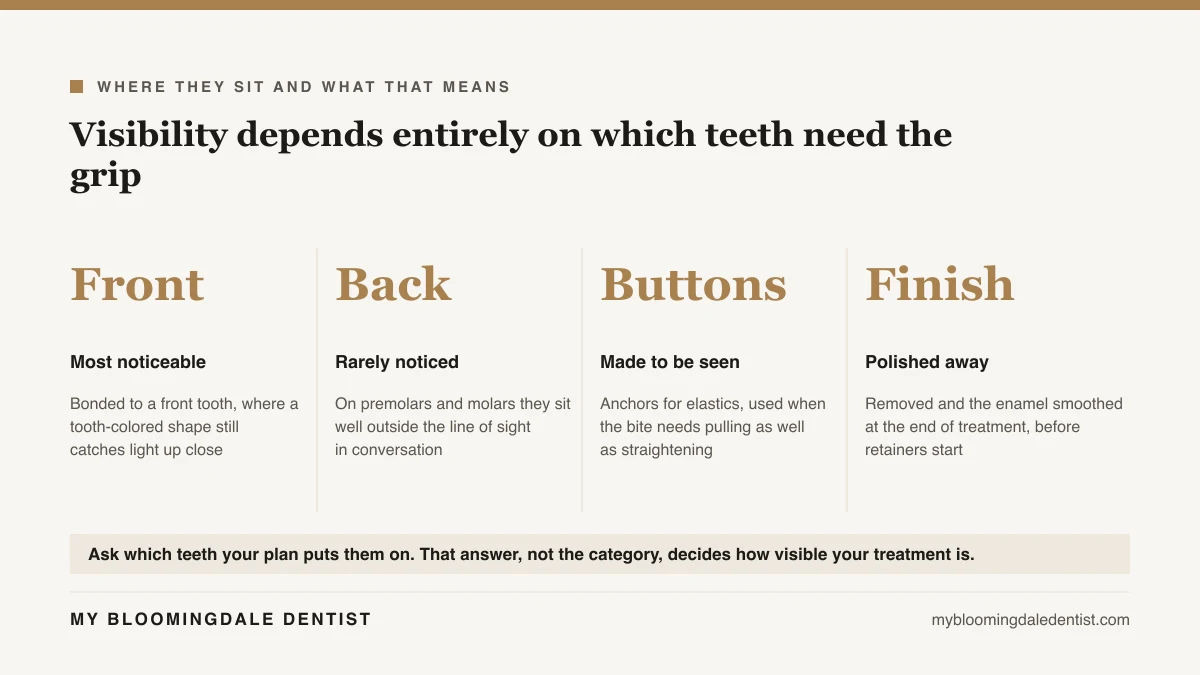
| Where it sits | How noticeable | Why it is there | What you can do about it |
|---|---|---|---|
| Front teeth | The most noticeable. Tooth-colored, but it still catches light close up | Rotation or a tooth that needs bringing down into line | Ask whether the plan can achieve the same result with fewer of them up front |
| Premolars and molars | Rarely noticed | Anchorage, so the back teeth hold while the front ones move | Nothing. This is where most of them sit and where they cost you least |
| Buttons for elastics | Made to be seen, because the elastic has to reach them | Bite correction, pulling one arch against the other | Ask when in the plan the elastics start and how long that stage runs |
| After the last tray | Gone | They have done their job | They are removed and the enamel is polished back before retainers begin |
Two things make a real difference to how they look. Staining is one: composite picks up color from coffee, tea, red wine and smoking, and an attachment that has gone dull is more obvious than a fresh one. Keeping up with cleaning matters more during treatment than it did before. The other is expectation. Knowing where yours will sit before you start is the difference between a detail and a surprise.
What changes day to day?
Nothing dramatic, but a few things are different from the version in the advertising.
- The trays feel tighter. That is the point. A tray that grips is a tray that is working, and it will be harder to pop off in the first days after a new set.
- Brushing takes longer. Plaque gathers at the edge of a bonded shape the same way it gathers at the edge of a bracket. A soft brush around each attachment, every time, is the whole trick.
- Coffee is a staining question, not a wearing question. You take the trays out to drink anyway. The attachments stay on your teeth, so they take the color.
- One can come off. It happens, usually while flossing or eating something firm. It is not an emergency and it does not undo your progress, but it does mean the tray has lost its grip on that tooth, so it is worth a call rather than waiting for the next scheduled visit.
If one does come off, keep wearing the current tray unless you are told otherwise. Stopping is the thing that actually loses ground.
The questions to ask before you start
This is the part that turns a surprise into a decision. Every one of these has an answer before your first tray is made, because the digital plan already contains it.
- Does my plan use attachments, and on which teeth?
- How many of them sit on teeth that show when I smile?
- Does my plan use elastics, and if so, when do they start?
- If a shorter plan meant fewer attachments up front, is that a trade I can make?
- What happens to them at the end, and is removing them part of what I am paying for?
An honest answer to the first question is sometimes “we will know once the plan comes back”, and that is fine. What is not fine is being told there are none when the plan has not been built yet.
What your scan shows you before you commit
At My Bloomingdale Dentist the process starts with a Trios digital scan rather than putty impressions, and the plan that comes back from it is a preview of the movement the trays are meant to produce. That preview is where the timeline and the price get answered, with the exact price quoted at the consultation and financing available. It is also the moment to ask the attachment question. The clear aligner therapy for adults and teens in Bloomingdale page covers how the whole course runs.
Two adjacent points worth knowing. Attachments bond to enamel, so a tooth that carries a crown behaves differently and your plan has to account for it; if you have dental crowns and bridges in Bloomingdale already, say so at the consultation rather than on fitting day. And because plaque collects around anything bonded to a tooth, a routine cleaning and exam partway through treatment is worth more than it usually is. The FDA is clear that clear aligners are prescription devices, only safe to use under the supervision of a licensed practitioner, and this is one of the reasons why: somebody has to look at the gums around those attachments while the teeth are moving.
A $99 new-patient exam with X-rays and a Trios 3D scan is where the plan, the timeline and the price all get answered. Appointments in English, Vietnamese, Korean and Spanish.
See how a clear aligner plan is builtRelated reading and next steps
If you are still deciding between trays and fixed appliances at all, the clear aligners versus braces comparison is a separate question worth its own read. For what happens after the last tray, how retainers and relapse work is the next read. For anything else, get in touch with the office.
Clear aligners in Carol Stream, IL and clear aligners in Addison, IL explain the same treatment for patients driving in from those towns.
Frequently asked questions
Attachments are small tooth-colored composite shapes bonded onto the surface of specific teeth so the trays have something to grip and push against. Buttons are small anchors placed so an elastic band can hook onto them, used when the bite needs pulling as well as the teeth being straightened. Neither is drilled into the tooth; both sit on the enamel and come off at the end of treatment.
No, but plenty of plans use them. A bare tray can tip a tooth sideways quite easily and struggles to rotate a rounded tooth, bring a high tooth down, or move a root. Whether your case needs them, and on which teeth, is decided by the digital plan built from your scan, so it is a question you can have answered before your first tray is made.
They are less visible than braces and more visible than nothing. On back teeth they sit out of the line of sight. On front teeth a tooth-colored shape still catches the light close up, and buttons for elastics are meant to be seen because the elastic has to reach them. Staining from coffee, tea, red wine or smoking makes them more obvious, so cleaning matters more during treatment.
They are removed and the enamel underneath is polished smooth, which happens before the retainer stage begins. Nothing is left behind on the tooth. It is worth confirming at the consultation that removal is included in what you are quoted.
Keep wearing your current tray unless you are told otherwise, and tell whoever is managing your treatment rather than waiting for the next scheduled appointment. The tray has lost its grip on that tooth, so that particular movement stalls until the attachment is back on. Stopping treatment altogether is what loses ground.
Sources: U.S. Food and Drug Administration, Clear Dental Aligners · MouthHealthy by the American Dental Association, Braces · MouthHealthy by the American Dental Association, Orthodontics. General information, not a diagnosis; your own dentist’s reading of your mouth takes precedence.