Anyone comparing snap in dentures vs implants hits the same confusion immediately: half the articles treat them as opposites, and the other half use the words interchangeably. Both are wrong. Here is the actual difference, what each one costs in this area, and a straightforward way to work out which one fits your mouth.
The confusion, cleared up in one paragraph
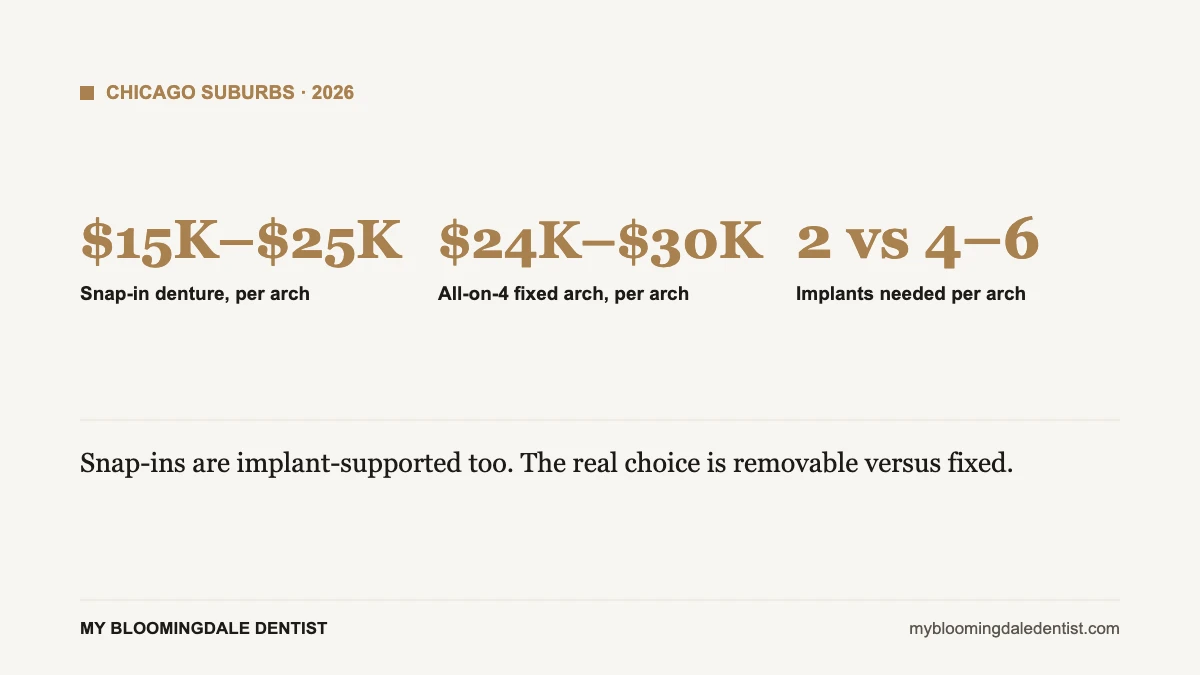
A traditional denture rests on the gums and is held by suction or adhesive. A snap-in denture is a denture that clips onto two to four implants and lifts out for cleaning. A fixed implant bridge such as All-on-4 is screwed onto four to six implants and only a dentist removes it. So snap-in dentures already use implants. The question is not implants or no implants. It is whether your teeth come out at night.
Side by side
| Snap-in denture | Fixed implant arch | |
|---|---|---|
| Implants per arch | 2–4 | 4–6 |
| Chicago-area cost | $15,000–$25,000 | $24,000–$30,000 |
| Comes out | Yes, daily | No, dentist only |
| Covers the palate | Usually a slim plate | No palate coverage |
| Bite strength | Roughly 60–80% of natural | Close to natural teeth |
| Cleaning | Out of the mouth, simple | Brush, floss threaders, water flosser |
| Bone preservation | Good at the implant sites | Good across a wider span |
| Typical relines or repairs | Attachments every 1–2 years | Fewer, but pricier when needed |
| Suits limited bone | Often yes | Sometimes needs grafting |
What each option costs here
Chicago-suburb ranges, per arch. Both arches roughly double these figures.
| Option | Range | Notes |
|---|---|---|
| Traditional denture, no implants | $1,000–$3,000 | Lowest cost, most movement, bone continues to shrink |
| Snap-in on 2 implants | $15,000–$19,000 | Entry point for implant retention |
| Snap-in on 4 implants | $19,000–$25,000 | Noticeably more stable than two |
| All-on-4 fixed arch | $24,000–$30,000 | Permanent, no palate |
| All-on-6 fixed arch | $28,000–$35,000 | More support, better for heavy bite forces |
Who each one is actually right for
Snap-in dentures tend to win when
- Budget is the deciding factor and the gap between the two options matters.
- Significant bone has already been lost and grafting is something you would rather avoid.
- You want to clean everything out of the mouth, which is simpler with limited hand strength or arthritis.
- You are already in a full denture and the problem you want solved is slipping, not the denture itself.
A fixed arch tends to win when
- You want teeth that never move and never come out.
- You have enough bone, or are willing to graft.
- Eating normally matters more than the cost difference.
- The palate coverage of a removable plate bothers you, which for many people affects taste.
What changes after five years
Most comparisons stop at the price and never mention what maintenance looks like, which is where the two options genuinely diverge.
A snap-in denture relies on nylon attachments that wear. Expect them replaced every one to two years, usually a small cost per visit. The denture itself may need relining as the gums settle, and a full replacement is normal somewhere between five and ten years.
A fixed arch needs less routine attention but the interventions are larger. The prosthesis is cleaned professionally, and if it fractures or wears, replacement costs considerably more than a new denture. Implants themselves, in either option, commonly last decades when the gums stay healthy.
Over ten years the two often land closer together than the initial quotes suggest. Ask any practice for the expected maintenance schedule in writing before you decide on price alone.
Bone is what usually decides it
Cost gets the attention, but bone volume is what most often rules an option in or out. Once teeth are gone the jaw begins resorbing, quickly in the first year and steadily after that. Someone who has worn a full denture for a decade has a very different jaw from someone extracting teeth next month.
A fixed arch asks more of the bone. Four to six implants have to carry a rigid bridge and the biting force that comes with it, and the back implants in particular need height and width. Where that bone is gone, the options are grafting, a sinus lift on the upper arch, or angling implants to find the bone that remains.
A snap-in denture asks less. Two to four implants placed at the front of the jaw, where bone survives longest, can retain a denture that still rests partly on the gums. This is why patients told they are “not a candidate for implants” frequently turn out to be candidates for snap-ins.
None of this is guesswork. A 3D scan measures it in a single appointment, and until that scan exists any recommendation is a guess dressed up as advice.
Coming from Addison? The scan-first, written-quote-first consult is set out at dental implants in Addison, IL.
Questions to ask before you commit
- How much bone do I have, and does it rule either option out?
- How many implants would each option need in my case?
- Is grafting required, and is it inside the quoted price?
- What does maintenance cost per year for each option?
- How often will attachments or relines be needed?
- If I choose snap-in now, could I convert to fixed later with these implant positions?
- What is the warranty on the implants, and separately on the teeth?
The reline question matters more than it looks, because the ridge under any denture keeps changing shape. Why dentures stop fitting over time sets out the timeline.
If a conventional denture is on the table, the first month with a new denture covers speech, eating and sore spots in plain terms.
Can you start with one and switch later?
Sometimes, and it is worth asking. If implants are placed in positions that would also support a fixed bridge, some patients begin with a snap-in denture and convert later when budget allows. That path has to be planned at the surgical stage, because implant position and angle decide whether conversion is possible. If you think you may want fixed teeth eventually, say so at the consultation rather than after.
A consultation with 3D imaging shows how much bone you have, which decides most of this before budget ever enters the conversation.
Book a consultationRelated reading
For a full breakdown of pricing and the add-ons quotes leave out, see our full-mouth dental implants cost guide. You can also read more about dental implants, dentures and full-mouth restoration, or contact the practice. And if you are curious how you found this guide in the first place, Dr. Kim wrote about the story behind our new website.
Either route is a long commitment, so it helps to know what you are committing to. Our guide to how long the implant and the teeth on top really last gives separate timelines for the post, the crown and the denture attachments that snap onto it. And before surgery is booked, the safety record behind implants covers complication rates, the titanium question and the screening that should happen first.
Bone is what decides most of this, and two follow-up guides go straight at it. If a scan has come back short, how bone volume is measured and what happens when it falls short covers what a graft is for and how much time it adds. And if the real problem is a lower denture that will not stay down, mini implants and the dentures they hold in place explains the narrow-post option and who it does not suit.
Frequently asked questions
Not quite. Snap-in dentures are held in by implants, so they are an implant treatment, but the denture itself lifts out for cleaning. A fixed implant bridge such as All-on-4 stays in permanently. The real difference is removable versus fixed, not implants versus no implants.
Snap-in dentures. In the Chicago suburbs they typically run $15,000 to $25,000 per arch against $24,000 to $30,000 for an All-on-4 fixed arch, mainly because they need fewer implants. Maintenance costs narrow that gap over ten years.
They feel far more secure than a traditional denture because they lock onto implants, but a fixed arch feels closer to natural teeth. Bite strength with a snap-in is roughly 60 to 80 percent of natural, and most designs still cover part of the palate, which some people notice when eating.
Sometimes, if the implants were placed in positions and angles that also support a fixed bridge. It has to be planned at the surgical stage, so mention it at your consultation if fixed teeth are a possible goal.
Sources: ADA Health Policy Institute · MouthHealthy by the American Dental Association · National Institute of Dental and Craniofacial Research. Cost ranges reflect market observation across Chicago-area practices in 2026 and are not a quote from this practice.
My Bloomingdale Dentist welcomes implant and denture patients from across DuPage County, including Bartlett, Roselle, and Carol Stream. Most consultations can be scheduled within the week.
Planning implants later in life? Our guide to dental implants for seniors covers candidacy, healing timelines, and costs on a fixed income.
Snap-in dentures are one version of a wider category. For the full picture of how removable, implant-retained and fixed teeth compare on cost and daily life, our guide to the implant-supported denture middle path walks through all three side by side. And if the surgery step is what gives you pause, we have answered how much dental implants actually hurt honestly, day by day.
For a local comparison of the two approaches, see dental implants in Carol Stream, IL.