Mini dental implants get talked about in two unhelpful ways online. Either they are the cheap shortcut that saves you from a real implant, or they are a compromise that will let you down. Neither is true, and both miss what they are for. They are a different tool for a different job. Below: what the design is, how it compares on the things that matter, the one job it does better than anything else, who should walk away from it, and what it runs around Bloomingdale.
What a mini dental implant is
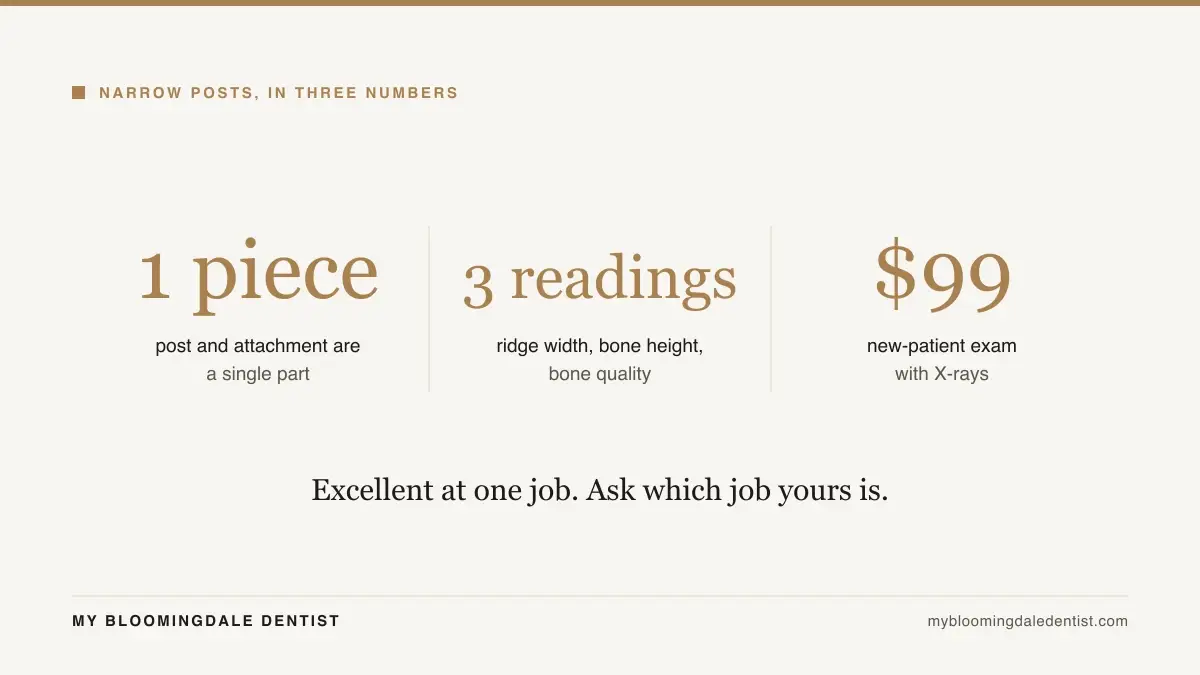
A standard implant is two pieces. A post fuses into the bone, then a separate abutment screws into the top of it and carries the crown. A mini is one piece: the post and the attachment are a single piece of metal, and the top of it sits above the gum from the day it goes in.
Everything else follows from that one design choice. Because it is narrow and one piece, it can often be placed through the gum without opening the site up, which is why the appointment is shorter and recovery is easier. And because it is one piece, what sits on top cannot be swapped out on its own later. That is the trade, and most pages on this topic skip it.
Mini dental implants versus standard implants
Comparing them on price alone is how people end up with the wrong one. Here is the comparison that matters.
| What you are comparing | Mini implant | Standard implant |
|---|---|---|
| The post | One piece: post and attachment are a single part | Two pieces: a post that fuses, plus a separate abutment |
| Width | Narrow, closer to the width of a toothpick | Noticeably wider |
| Surgery | Often placed through the gum without laying it open | Gum is opened, the site prepared, the gum closed |
| Bone required | Frequently workable on a ridge that has thinned | Needs more width, and the bone may have to be rebuilt first |
| What it carries best | Holding a lower denture down | Single crowns, bridges, full arches |
| Changing it later | One-piece design limits what can change without replacing the post | The crown can be replaced without disturbing the post |
| Healing before it is used | Shorter | Longer |
Read the last two rows rather than the first two. That is where the decision lives.
The job they do best: a lower denture that will not stay down
An upper denture has a palate to hold on to, so suction does a lot of the work. A lower denture has nothing to grip. It sits on a horseshoe of bone that has been shrinking since the teeth came out, and your tongue lifts it every time you talk. Adhesive is a workaround. Narrow posts are a fix. A handful go into the front of the lower jaw, housings go into the fitting side of the denture, and it clicks down onto them. You take it out to clean it and it stays put the rest of the time.
| Step | What happens | When |
|---|---|---|
| Scan and assessment | 3D imaging of ridge width, height and bone quality, plus how your current denture fits | Consult |
| Placement | Narrow posts placed along the front of the lower jaw | One appointment |
| Denture fitted to them | Housings set into the denture so it clicks onto the posts | Same visit or shortly after |
| Review | Bite checked, adjusted, recall schedule set | First weeks, then ongoing |
Who they are not for
This is the section that tends to go missing, so it goes here rather than at the bottom.
- Anyone wanting a single back tooth replaced. Molars take heavy chewing force. A narrow post is not the design for that job.
- Heavy grinders and clenchers. Grinding puts sustained sideways load on a post. That is hard on any implant and harder on a narrow one.
- Anyone with untreated gum disease. Gum disease takes bone. Placing anything into bone that is still being lost is treating the wrong problem first.
- Smokers, without a conversation first. The FDA notes that smoking can delay healing and affect the long-term success of an implant. It does not rule you out. It changes the odds and it should be said out loud.
- Anyone being offered minis because they are the cheaper option. That is the wrong reason and it is worth pushing back on. The right reason is the job.
The ADA makes the general point about implants: if you are in good general health this treatment may be an option, and your health matters more than your age.
How long they last, and what we will not tell you
Here is where we part company with most pages on this topic. You will find confident survival percentages for mini implants quoted all over the internet, usually with no source attached. We are not going to add another one: the long-term published data on narrow one-piece posts is thinner than the data on standard implants, and quoting a figure we cannot point you at would be dishonest.
What can be said is that how long any implant lasts comes down to the same short list. How well the bone took to it, how clean it is kept, how much force the bite puts through it, and whether gum disease is being controlled. The FDA is blunt about the maintenance half of that, saying that regularly cleaning the implant and surrounding teeth is very important for long-term success, and that if an implant feels loose or painful you should tell your dental provider right away. That advice applies to a narrow post exactly as it does to a wide one. Our breakdown of how long implants last, part by part goes through the same question for standard implants, and the failure points are the same ones.
How we decide whether they suit you
Same 3D scan, same three readings: how wide the ridge is, how much height sits above the nerve canal in the lower jaw, and how dense the bone is. Then two things a scan cannot show. How your bite closes, because that sets the load, and whether your gums are healthy enough to be placing anything at all.
If the bone is there for standard implants, that usually gets recommended, because it is the more versatile result. If the ridge has thinned to the point where standard posts would mean rebuilding the bone first, narrow posts are often the more sensible route, and the wait is a lot shorter. If neither is right, you get told that too.
The $99 new-patient exam here includes X-rays, and it is the cheapest way to find out which of those three you are.
What they cost around Bloomingdale
Minis cost less per post than standard implants, and stabilising a lower denture takes several of them, so the totals are not as far apart as the per-post figure suggests. Neither number is the point. The point is which one does the job your mouth needs.
What we publish: a complete single standard implant, meaning the post, the abutment and the final crown, starts around $2,800 for dental implant treatment in Bloomingdale, IL. Across the Chicago suburbs, implant-retained removable dentures generally run $15,000 to $25,000 per arch. That is area market data, not our quote. Narrow-post stabilisation is quoted at your consult in writing, before anything is scheduled, and denture treatment in Bloomingdale, IL covers relines and repairs on the same page.
Five questions to ask before you say yes
- Can I see my scan, and how wide is the ridge where these would go?
- Would standard implants work here if the bone were rebuilt first, and what would that change?
- How many posts are you placing, and what holds the denture if one of them fails?
- What is the total in writing, posts and denture work together?
- What is the recall schedule, and what gets checked at each visit?
Question two is the one that separates a practice giving you options from a practice selling you a product.
A consultation with 3D imaging shows what your ridge has to work with, and the full number in writing before anything is scheduled. Appointments in English, Vietnamese, Korean and Spanish.
Book an implant consultationRelated reading
Still deciding between a denture and implants at all? Snap-in dentures versus implants works through that choice first. If the bone is there for standard posts, an implant-supported denture is the fuller version of the same idea and covers cost and daily life. Anything else, get in touch with the office.
If the scan shows there is not enough bone to hold a post steady yet, what a bone graft does and how long it takes to heal explains the step that usually comes first.
Frequently asked questions
A standard implant is two pieces: a post that fuses into the bone and a separate abutment that carries the crown. A mini is one piece, narrower, and usually placed through the gum without opening the site. The trade is versatility. A standard implant can carry crowns, bridges and full arches; a narrow post is at its best holding a lower denture down.
It is not the job they are designed for. Molars take heavy chewing force and a narrow one-piece post is not built to carry it long term. If a back tooth is the problem, a standard implant is the sensible conversation, and a 3D scan will tell you whether the bone is there for one.
Often, yes. That is much of the reason they exist. Narrow posts frequently work on a ridge that has thinned over years of wearing a denture, where standard posts would need the bone rebuilt first. A 3D scan measures the ridge and settles it. It is not right for everyone.
Less per post than a standard implant, though stabilising a lower denture takes several of them. My Bloomingdale Dentist publishes around $2,800 for a complete single standard implant including the crown, and quotes narrow-post denture stabilisation in writing at the consult.
Sources: U.S. Food and Drug Administration, Dental Implants: What You Should Know · MouthHealthy by the American Dental Association, Implants · MouthHealthy by the American Dental Association, Dentures · MedlinePlus, Dental Health. General information, not a diagnosis; your own dentist’s reading of your health history and your scan takes precedence.