“Do dental implants hurt?” is the question that delays more implant consultations than cost does. The honest answer is more boring than the fear: the procedure is numb, the recovery is a few sore days, and the majority of patients rate it easier than a tooth extraction. What follows is the day-by-day version nobody publishes, how implant discomfort compares with dental work you have already survived, and the short list of symptoms that are not normal and deserve a call.
What placement actually feels like
The implant site is numbed with local anesthetic the same way it would be for a filling, and the anesthetic is not withdrawn until the dentist has tested it. During placement you will feel pressure, some vibration, and pushing. What you will not feel is sharp pain, because bone itself has very few pain-sensing nerves; the tissues that do feel pain are the ones the anesthetic covers. A single implant is commonly placed in under an hour, and many patients report the waiting room was the worst part.
If dental anxiety is the real obstacle, say so when you book. Knowing exactly what will happen at each step, and agreeing on a raise-your-hand signal before starting, does more for most nervous patients than they expect. Ask the practice what comfort options they offer for longer procedures.
The recovery, day by day
This is the timeline most pages skip. Individual healing varies, but a single, uncomplicated implant usually follows this arc:
| When | What is normal | What helps |
|---|---|---|
| Day of surgery | Numb for a few hours, then dull throbbing begins | Take the first pain reliever before the numbness fades |
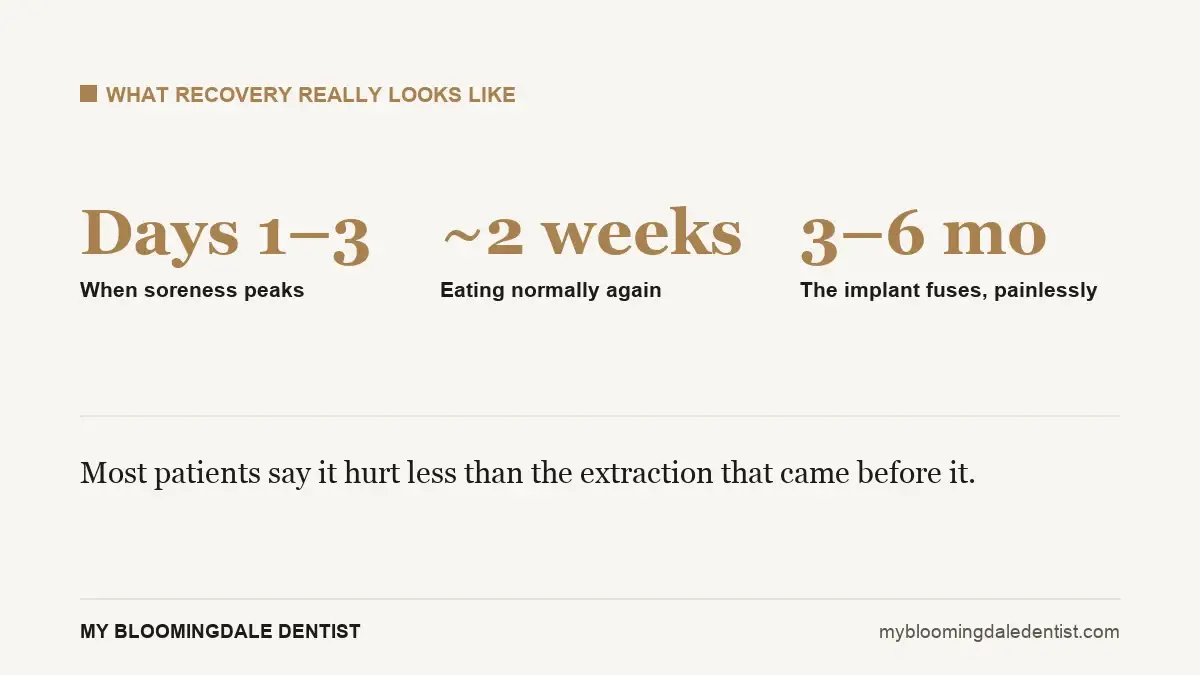
| Days 1–3 | The peak: soreness, swelling, maybe minor bruising and light oozing | Ice in 20-minute cycles, soft food, sleep with your head raised |
| Days 4–7 | Swelling and soreness fade noticeably each day | Warm salt-water rinses, keep brushing everything except the site |
| Week 2 | Most patients feel normal and chew normally | Stitches dissolve or are removed; back to routine |
| Months 1–6 | Nothing. The implant fuses with the bone silently | Normal hygiene and any scheduled checks |
Two useful markers: discomfort should trend down every day after day three, and over-the-counter medication should be enough for most people. When either of those stops being true, skip ahead to the “not normal” list below.
How it compares with dental work you already know
Patients rarely want a pain scale; they want a comparison with something they have felt. Ranked from easiest to hardest, typical patient reports put implant placement here:
- Filling: the easiest; implant placement is a step above it, mostly in duration.
- Implant placement: numb during, a few sore days after. Most patients rank it easier than an extraction because nothing inflamed is being removed; a healed, planned site is a calm site.
- Tooth extraction: the common reference point, and the frequent verdict is “the implant was easier than the extraction.”
- Root canal on an infected tooth: what most people fear an implant will feel like. It is not; the pain people remember from root canals is the infection beforehand, and an implant site has no infection.
How to keep the sore days short
Recovery quality is mostly decided in the first 72 hours, and mostly by the patient. The checklist that earns its keep:
- Medicate on schedule, not on pain. Take the recommended dose before the anesthetic fades and stay ahead of it for the first two days rather than chasing it.
- Ice early. 20 minutes on, 20 off, for the first day. It does more for swelling than anything you can take.
- Eat soft and cool for a few days: yogurt, eggs, soup that is not hot, pasta, smoothies eaten with a spoon.
- No straws, no smoking. Suction disturbs the clot; smoking starves the healing site of blood flow and is the single biggest patient-controlled risk to an implant.
- Keep the mouth clean. Gentle salt-water rinses after the first day, and keep brushing every tooth that is not the surgical site.
- Sleep with your head raised for two or three nights to limit morning swelling.
Normal versus not normal: when to call
Almost everything in the first week is normal. These are the exceptions that deserve a same-day call to the office:
- Pain that gets worse after day three instead of better, or stops responding to medication.
- Bleeding that stays active beyond the first day rather than tapering to light oozing.
- Fever, spreading facial swelling, or a bad taste that will not rinse away, which can signal infection.
- Numbness or tingling that persists after the anesthetic should have worn off.
- Months later: an implant that suddenly aches, feels loose, or has gum swelling around it. A healed implant should be silent; a noisy one needs looking at promptly.
None of these means disaster. All of them mean the office should see you rather than the internet.
Why we let extractions heal first
Some offices advertise a tooth pulled and an implant placed the same day. We deliberately do not work that way. When a tooth comes out, we let the socket heal before the implant goes in. The wait costs a few months on the calendar and buys a calmer recovery: one surgery at a time to recover from, a clean and settled site instead of a fresh wound, and where bone grafting is needed we do that in-house and let it mature properly. Patients planning around this timeline can see how the full sequence and the numbers fit together in our full-mouth implant cost guide.
A consultation with 3D imaging maps out exactly what your case would involve, and you will know the full plan before anything is scheduled. Appointments are available in English, Vietnamese, Korean and Spanish.
Book an implant consultationRelated reading
Weighing implants later in life? Our guide to dental implants for seniors covers candidacy, healing and bone loss. Wearing a denture that will not stay put? See how an implant-supported denture compares with regular dentures and fixed teeth on cost and daily life. For the money questions, see the full-mouth dental implants cost guide. You can also read about dental implant treatment at the practice, or contact the office to ask about your case.
Frequently asked questions
The placement itself is not painful because the area is fully numbed; you feel pressure and vibration. Afterward, expect soreness that peaks over the first three days and is usually controlled with over-the-counter pain relievers. Most patients compare it to a tooth extraction or milder.
Soreness typically peaks on days one to three, fades noticeably through the first week, and most patients feel normal by around two weeks. Discomfort should improve daily after day three; pain that worsens instead is a reason to call your dentist.
Usually the opposite. An implant is placed into a planned, healed site rather than removing an inflamed tooth, and bone has few pain-sensing nerves, so most patients report the implant was the easier of the two.
No. Osseointegration, the months-long process where bone grows onto the implant, happens without any sensation. A healed implant should feel like nothing at all; aching, looseness or gum swelling months later is not normal and should be examined promptly.
Sources: MouthHealthy by the American Dental Association · MedlinePlus, U.S. National Library of Medicine · ADA Health Policy Institute. Recovery timelines describe typical single-implant cases; your dentist’s instructions for your case take precedence.