Most people researching implant supported dentures already know the two extremes. A traditional denture is affordable but slides around, needs adhesive, and lets the jawbone shrink underneath it. A fixed implant arch feels like real teeth but costs the most of any option in dentistry. What gets skipped in almost every explanation is the option sitting between them, so here is what it actually is, what it costs around here, and how to tell whether it fits your situation.
What an implant-supported denture actually is
Two to four small titanium posts are placed in the jaw, usually toward the front where bone stays strongest. Once they have healed, matching connectors are fitted into the underside of a denture, and the denture clicks down onto the posts the way a snap fastens on a jacket. The result is a denture that is held by the bone rather than by suction or paste.
Three things change on day one. The denture stops moving when you chew. The upper version can usually be made without the full palate plate, which gives you back your sense of taste and temperature. And the implants themselves keep stimulating the jawbone, which slows the shrinking that a gum-borne denture accelerates. You still take it out at night and clean it at the sink, which is exactly why many patients prefer it over a fixed bridge.
The middle path, side by side
Use this table to place the three options against each other before any consultation. Ranges are Chicago-area market figures per arch, not a quote from this office.
| Traditional denture | Implant-supported denture | Fixed implant arch | |
|---|---|---|---|
| Held by | Suction / adhesive | 2–4 implants, clips off | 4–6 implants, screwed on |
| Chicago-area cost | $1,000–$3,000 | $15,000–$25,000 | $24,000–$30,000 |
| Moves while eating | Often | No | No |
| Comes out at night | Yes | Yes, by design | No, dentist only |
| Covers the palate | Yes (upper) | Usually reduced or none | No |
| Protects jawbone | No | At the implant sites | Across a wider span |
| Surgery required | None | Minor, 2–4 implants | More, 4–6 implants |
| Cleaning | Simple, out of mouth | Simple, out of mouth | Brushing plus threaders or a water flosser |
If you have already narrowed it to the two implant options and want the head-to-head decision, our snap-in dentures vs implants guide walks through which one fits your bone, budget and hands.
The attachment systems, and what wears out
Ask any practice which attachment system they use, because this is the part that needs maintenance. Most implant-supported dentures use stud attachments: a small connector on each implant and a nylon insert inside the denture that grips it. The nylon is a wear part. Expect the inserts swapped every one to two years, a quick and inexpensive visit. The alternative is a bar attachment, where a thin metal bar joins the implants and the denture clips onto the bar; it spreads force well but costs more and asks more of your hygiene routine.
The denture itself behaves like any denture: as gums slowly change shape, it may need a reline, and a replacement somewhere in the five-to-ten-year window is normal. The implants underneath commonly last decades when the gums around them stay healthy. Budget for the wear parts and the option stays predictable; ignore them and the “cheaper than fixed” math erodes.
What it costs in the Chicago suburbs
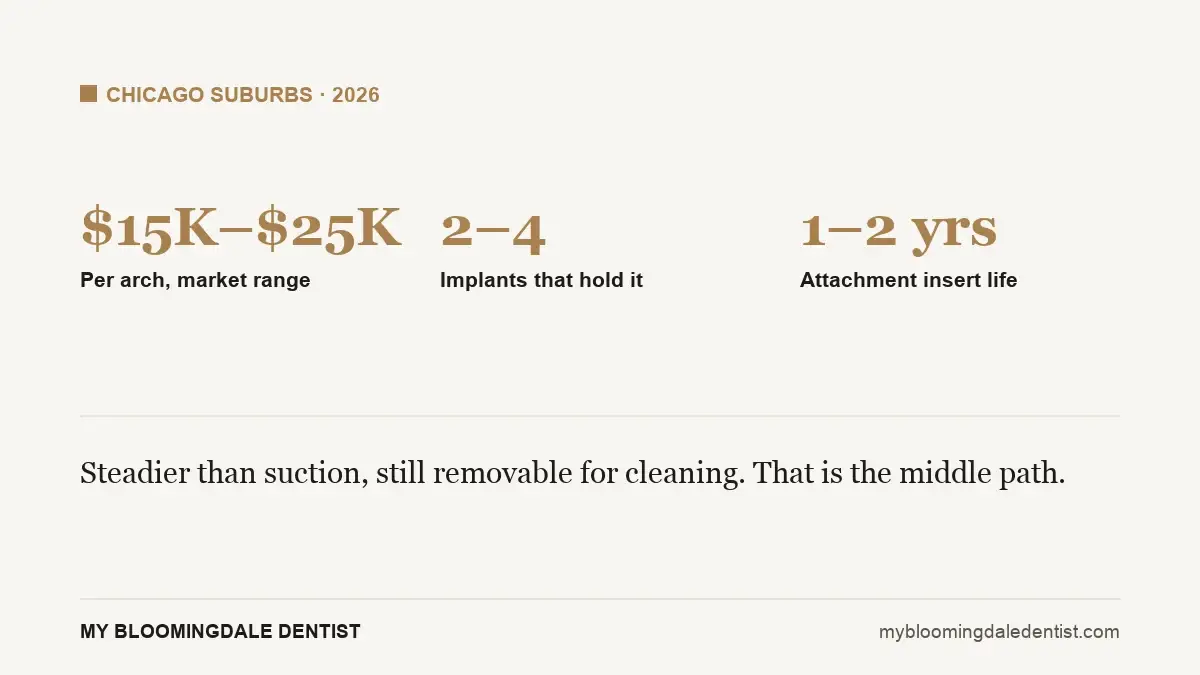
Per-arch market ranges observed across Chicago-area practices in 2026. Both arches roughly double the figure.
| Configuration | Range | Notes |
|---|---|---|
| On 2 implants | $15,000–$19,000 | The entry point; front-of-jaw placement |
| On 4 implants | $19,000–$25,000 | Noticeably more stable, better force spread |
| Stabilising an existing denture with mini implants | Lower than a new full setup | Uses the denture you already own; see below |
How the process goes, start to finish
A realistic sequence, so nobody surprises you with the timeline:
- Scan and plan. A 3D X-ray measures your bone and maps implant positions in one visit.
- Any extractions heal first. We deliberately let an extraction site recover before placing an implant in it. It is slower on the calendar and kinder to the bone, and it protects the implant’s long-term hold.
- Implant placement. A minor procedure under local anesthetic, usually shorter than patients expect for two to four posts.
- Healing, three to six months. The implants fuse with the bone. You wear a temporary or your existing denture, adjusted so it does not press on the sites.
- Attachment fitting. The connectors go in, the denture is fitted, and you practice clicking it in and out before you leave.
Total calendar time commonly lands between four and eight months depending on healing and whether extractions were needed.
Already wearing a denture? Mini implants can stabilise it
If you own a denture that fits reasonably well and the complaint is movement, you may not need a new denture at all. Narrow-diameter mini implants can be placed to stabilise the existing denture, often where bone has thinned too much for standard posts. They are a stabilisation tool for a loose denture rather than a substitute for a standard implant, and Dr. Kim places them here in Bloomingdale. It is frequently the lowest-cost route from a slipping denture to a steady one, and it is worth asking about before pricing a full new setup on our denture services page.
How to know if you are a candidate
Three questions decide it, and all three are answered by a scan rather than a guess:
- Is there enough bone at the front of the jaw? Usually yes, even after years in a denture, because the front of the jaw resorbs slowest. This is why patients told they were “not implant candidates” often still qualify for an implant-supported denture.
- Where bone is short, can it be grafted? General bone grafting is done in-house here and is often modest for a two-implant plan.
- Are the gums healthy? Untreated gum disease is the main threat to any implant, so it gets handled first.
A consultation with 3D imaging shows exactly how many implants your jaw can hold and what each path would involve. Appointments are available in English, Vietnamese, Korean and Spanish.
Book an implant consultationRelated reading
Deciding between the removable and fixed versions? Start with snap-in dentures vs implants. Nervous about the procedure itself? Read what getting a dental implant actually feels like, with a day-by-day recovery timeline. For the money side, our full-mouth dental implants cost guide covers every line item. You can also read about dental implant treatment and denture options at the practice, or contact the office with a question.
Frequently asked questions
Usually two to four per arch. Two is the entry point and works for many lower dentures; four adds noticeably more stability and spreads chewing force better, which matters most on the upper arch.
As a 2026 market range, about $15,000 to $25,000 per arch depending on the number of implants, with extractions and grafting often quoted separately. Stabilising an existing denture with mini implants typically costs less than a full new setup.
Yes, by design. They click off the implants for cleaning and sleep, which keeps hygiene simple. If you want teeth that never come out, that is a fixed implant arch, a different treatment with a higher cost.
Often, yes. If the denture fits well and is in good condition, connectors can sometimes be fitted into it, or narrow mini implants can be placed to stabilise it. A quick exam of the denture and a 3D scan of the jaw answer it definitively.
Sources: ADA Health Policy Institute · MouthHealthy by the American Dental Association · MedlinePlus, U.S. National Library of Medicine. Cost ranges reflect market observation across Chicago-area practices in 2026 and are not a quote from this practice.