Most people hear “root canal or pull it” as a choice between two procedures. It is better understood as one question with two possible answers. Dentists are not choosing which treatment is cheaper or faster. They are working out whether the tooth you have can be rebuilt into something that works for years. This post walks through the five things that decide that, what each path involves afterward, and what to ask at the visit. The sources are MouthHealthy and MedlinePlus, and anything that is general dental explanation is labeled that way.
The question the exam is answering
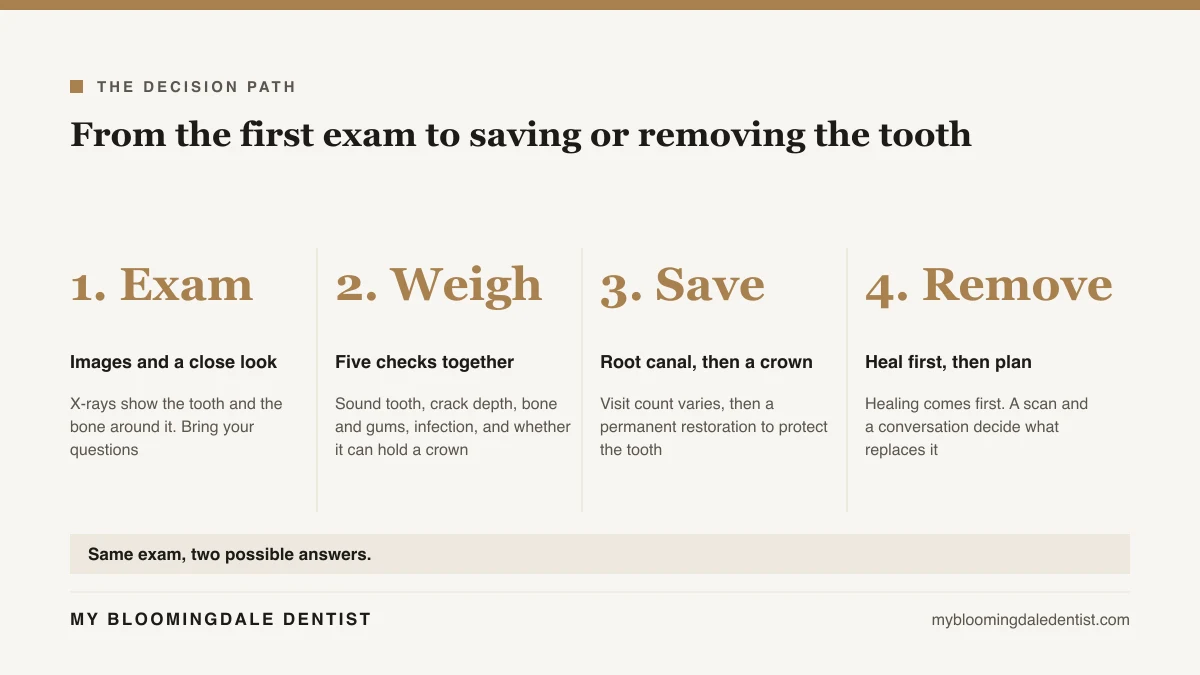
It is answering whether the tooth is restorable. MouthHealthy says a dentist may recommend a root canal for a severely damaged, decaying tooth or a serious tooth infection, and that before treatment the dentist takes X-rays to get a clear view of the tooth and the surrounding bone. Our root canal page describes the first step the same way: an exam and digital X-ray, then an explanation of what we see. The decision starts with that picture, not with a price or a preference.
The criteria, one by one
The table lays out the five things in plain terms. The middle column describes what points toward keeping the tooth, and the last describes what points toward removing it. No single row decides the case on its own. They are weighed together.
| What is checked | Points toward saving the tooth | Points toward removing it |
|---|---|---|
| How much sound tooth is left | Enough healthy structure remains to rebuild and to hold a crown | Decay or damage has taken so much that there is little left to rebuild |
| How deep any crack runs | As a general dental explanation, a crack limited to the crown of the tooth can often be managed | As a general dental explanation, a crack that runs down into the root is hard to repair |
| Bone and gum support | The tooth is firm, with healthy bone and gums around it | MouthHealthy says gum disease can cause tissue and bone loss until teeth feel loose and move, and MedlinePlus lists gum disease that loosens or damages teeth as a reason for extraction |
| The infection | MouthHealthy says a root canal treats an abscess caused by decay or a cracked tooth | MedlinePlus lists a deep infection in a tooth among the reasons people have a tooth pulled |
| Whether it can hold a crown | MedlinePlus says a root canal must be followed by a permanent restoration, so the tooth has to be able to take one | If the tooth cannot be restored to withstand chewing, the root canal alone does not solve the problem |
Why is saving the tooth the starting point?
Because a natural tooth does work a replacement has to imitate. Our root canal page says saving your natural tooth is almost always better for your bite and long-term cost, and that you get an honest recommendation for your specific tooth. This post is the long version of that honest recommendation. Saving a tooth is where the conversation starts, and it stops being the answer when the five rows above say the tooth cannot be rebuilt. MedlinePlus puts it this way: without treatment, the tooth may become so damaged that it must be removed. That is the same fork seen from the other side.
How do the bone and gums change the answer?
A tooth is only as secure as what holds it. MouthHealthy describes gum disease as an infection of the tissues that surround and support your teeth, a major cause of tooth loss in adults, and usually painless, so you may not know you have it. It also says advanced gum disease can lead to the loss of tissue and bone until teeth feel loose and start moving, and it gives a figure: chronic periodontitis affects 47.2% of adults over 30 in the United States. For this decision the point is simple. A root canal can treat the inside of a tooth, but it does not rebuild bone around the root. If a tooth is loose because of bone loss, the question is whether the support can be stabilized, and that is judged from the X-rays and a gum exam. Warning signs worth mentioning at the visit include gums that bleed easily, gums that have pulled away from the teeth, and any change in the way your teeth fit together when you bite.
What happens if you wait?
MouthHealthy says that if a damaged tooth goes untreated, the tissues around the root can become infected, and you will often feel pain and swelling and an abscess may form. It adds that bacteria can damage the bone that keeps the tooth connected to the jaw, which can put the tooth itself at risk. As a general dental explanation, that is the reason an exam is worth booking when a toothache keeps coming back, or has eased but not gone. As a general dental explanation, pain that eases does not mean the infection is gone. If you also have swelling or fever, our guide on swelling and when to go to the ER is the first thing to read.
Does fear of a root canal belong in the decision?
It often does, and it is worth saying out loud at the visit. MouthHealthy says there is little to no pain with a root canal because your dentist uses local anesthesia, and that once it is done you should no longer feel the pain you felt before. MedlinePlus says you may have some pain or soreness afterward and that an over-the-counter anti-inflammatory can help. Our root canal page makes the same point in plain words: the pain people fear is the infection, not the treatment. If anxiety about the procedure is pushing you toward removal, tell the dentist. The right answer is about the tooth, and a nervous patient deserves the same honest comparison as anyone else.
What the save path involves
MouthHealthy says a root canal usually takes 1 or 2 office visits, with local anesthesia so you do not feel the procedure. The dentist opens the tooth, removes the nerve from inside the tooth and root canals, cleans the inside, and fills the canals with a rubber-like material to seal them. A temporary filling protects the tooth until a permanent filling or crown can be placed. The crown is part of the treatment, not an add-on, and why a crown after a root canal is part of the same treatment explains where that step fits. Our root canal page describes the same three stages: diagnose, numb and clean, then seal and crown.
If the tooth has already had a root canal and hurts again, that is a different question from this one. It has its own guide on root canal retreatment, and the first step there is also an exam.
What the removal path involves
When the tooth cannot be saved, the order matters. MedlinePlus says an extraction is done under local anesthetic, the socket is cleaned and the bone smoothed afterward, and it takes 1 to 2 weeks for the socket to heal, with the caution that everyone heals at a different rate. Our extraction page describes using 3D images to plan the gentlest removal. MedlinePlus adds that affected bone and other tissue may take a bit longer to heal. Healing comes first. The replacement is planned after healing, not on the day of removal, and the scan and a conversation set what replaces the tooth and when.
Our extraction page says that for most teeth, apart from wisdom teeth, replacing the tooth protects your bite and bone, and it describes implant or bridge options. If you want the recovery side, our tooth extraction recovery timeline guide covers it day by day, and our dental implants page covers what replacement involves.
| After the decision | If the tooth is saved | If the tooth is removed |
|---|---|---|
| Visits | MouthHealthy says a root canal usually takes 1 or 2 office visits, then a follow-up for the permanent filling or crown | The removal visit, then a check as the socket heals, then a separate planning conversation about replacement |
| Healing | MedlinePlus says the tooth and area may feel sore for a short time and that most people return to their routine the same day | MedlinePlus says the socket takes 1 to 2 weeks to heal, and bone and tissue may take longer |
| What protects or replaces it | A permanent restoration, usually a crown, seals the tooth so it can take the force of chewing | Our extraction page names implant or bridge options for most teeth, planned after healing with a scan |
| What it asks of you | Keep the checkups and clean the crowned tooth like any other | Follow the aftercare, then decide on replacement so the space does not shift your bite |
What if the pain is from a crack?
A cracked tooth can go either way, depending on how deep the crack runs and what it has done to the nerve. The criterion for cracks has its own guide, cracked, chipped or broken: which one needs a chair today, so the short version here is that a crack above the gumline and a crack into the root are very different problems, and X-rays and an exam are how that gets sorted out.
What should you ask at the visit?
Going in with questions turns a rushed conversation into a useful one. These are worth asking, and you can write them down before you go.
- Can this tooth be restored so it lasts, and what in the images tells you that?
- How much of the tooth is sound, and does the bone around it look healthy?
- If we save it, what are the steps and how many visits, and what protects it afterward?
- If we remove it, what is the order, what does healing look like, and when do we talk about replacement?
- What happens if I wait?
A clear answer to each is what an honest recommendation looks like. A new-patient exam at the office costs $99 and includes X-rays, and any treatment is quoted in writing before it starts.
Getting seen at the office
If a tooth is hurting and you are weighing your options, call (224) 520-8665 and tell us which tooth and what you have noticed. The office sees patients during the week and on alternating weekends, so call first. Root canal treatment in Bloomingdale, IL and tooth extractions in Bloomingdale, IL each explain how that side of the work is done. If swelling or fever is part of it, our guide on swelling and when to go to the ER comes first. The whole appointment, not only the front desk, can be held in English, Vietnamese, Korean or Spanish.
Call and tell us the tooth and what you have noticed. New-patient exam $99, X-rays included. Every price in writing before treatment. English, Vietnamese, Korean and Spanish spoken.
See how root canal care works hereRelated reading
If the tooth has to come out and you are weighing what replaces it, what an implant really feels like, step by step covers that side. A question that can wait a day can go through the contact form.
Frequently asked questions
A tooth that already had a root canal and hurts again is a different case. Root canal retreatment explains what that means and when the tooth is still worth saving.
They decide whether the tooth can be restored so it lasts. The exam and X-rays look at how much sound tooth is left, how deep any crack runs, the bone and gum support, the infection, and whether the tooth can hold a crown. MedlinePlus says that depending on the source of infection and the severity of decay, a tooth may or may not be salvageable.
Our root canal page says saving your natural tooth is almost always better for your bite and long-term cost. It is not always possible. MedlinePlus lists a deep infection, gum disease that loosens teeth, and trauma among the reasons teeth are pulled. Your own tooth decides it.
MedlinePlus says a root canal must be followed by a permanent restoration so the tooth can withstand chewing. MouthHealthy says a crown protects the tooth from further damage. A permanent filling is the other possibility, and the dentist decides which fits your tooth.
Healing comes first. MedlinePlus says the socket is cleaned and the bone smoothed, and that everyone heals at a different rate, usually 1 to 2 weeks for the socket. What replaces the tooth is planned after healing, with a scan and a conversation about your options.
It depends on how deep the crack goes. MouthHealthy says root canal treatment is one option when an abscess is caused by decay or a cracked tooth. A crack that runs into the root is a harder problem, and the exam and X-rays show which one you have.
A new-patient exam is $99 and includes X-rays. Any treatment is quoted in writing before it starts, and the exam is where your questions about saving or removing the tooth get a straight answer.
Sources: MouthHealthy by the American Dental Association, Root Canals · MouthHealthy, Abscess · MouthHealthy, Gum Disease · MedlinePlus, Root canal · MedlinePlus, Tooth extraction. General information for patients, not a diagnosis; your own dentist’s reading of your tooth takes precedence.