Every guide on this topic gives a range so broad it is useless, and almost none of them are local. A national chain publishes one number, an implant manufacturer publishes another, and neither mentions Illinois. This is a Chicago-area price guide: what each procedure actually costs here, what moves the number up and down, and how to put two quotes side by side without being fooled by the headline figure.
“Full mouth” means three different procedures
This single fact explains most of the confusion. Three very different treatments get sold under the same phrase, and they are not priced anywhere near each other.
- Implant-retained removable denture. A denture that snaps onto two to four implants and comes out for cleaning. Fewest implants, lowest cost, and the closest thing to a traditional denture that still stops the slipping.
- Fixed full arch (All-on-4 or All-on-6). A permanent bridge anchored to four or six implants. It does not come out. This is what most people picture and what most quotes describe.
- Individual implants for every tooth. One implant per missing tooth. Highest cost by a wide margin, and rarely the recommendation for a full arch.
A $17,000 quote and a $45,000 quote can both be honest. They are frequently describing different treatments.
What full mouth implants cost in the Chicago suburbs
| Option | Chicago-area range (per arch) | What you get |
|---|---|---|
| Implant-retained removable denture | $15,000–$25,000 | Snaps onto 2–4 implants, removed for cleaning |
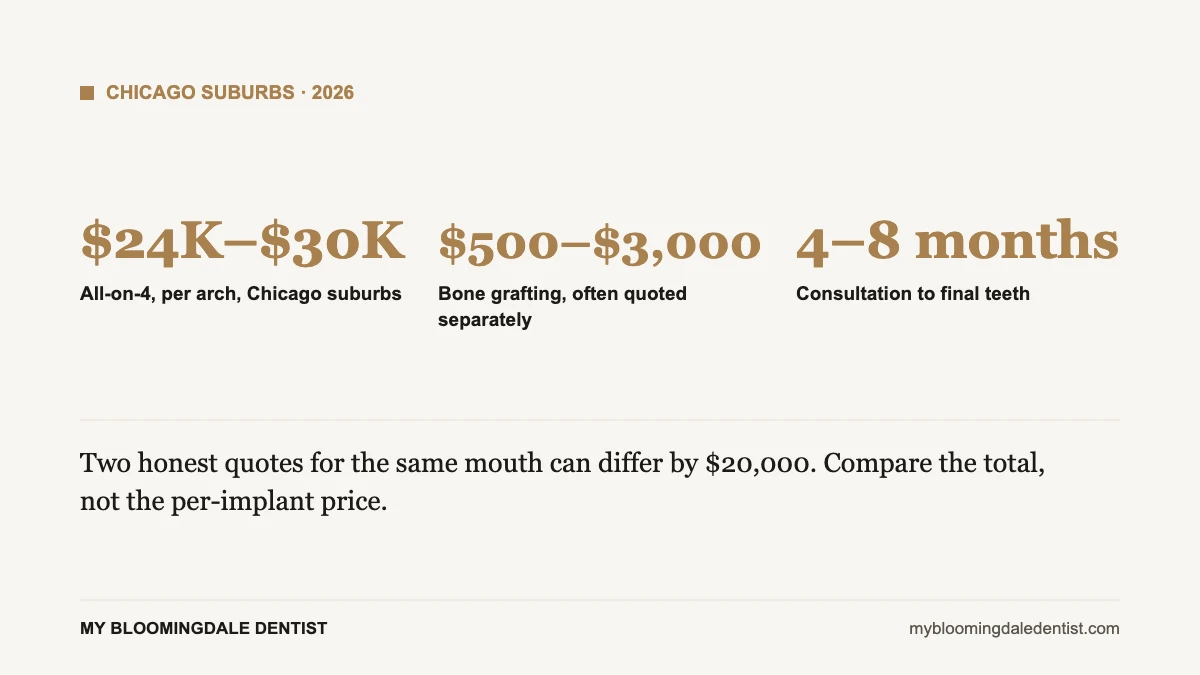
| All-on-4 fixed arch | $24,000–$30,000 | Permanent, non-removable, 4 implants |
| All-on-6 fixed arch | $28,000–$35,000 | Permanent, 6 implants, more support |
| Implant-supported fixed bridge | $30,000–$45,000 | Permanent, more implants and material |
| Individual implants, full arch | $35,000–$50,000 | Each tooth replaced separately |
| Single implant and crown (for reference) | $3,500–$6,000 | One tooth |
Why two quotes for the same mouth differ by $20,000
When patients bring us two estimates that are tens of thousands apart, the gap is almost always explained by one of these:
- Implant count. Four, six or eight implants per arch. Each one adds hardware and surgical time.
- Prosthesis material. Acrylic costs less up front. Zirconia costs more and resists wear and staining far longer.
- The temporary. You wear something while the implants heal. Some quotes include it and some bill it separately.
- Extractions and bone grafting. Frequently excluded from the headline number.
- Sedation. Local anesthetic, oral sedation and IV sedation are three different line items.
- Imaging, surgical guide and follow-ups. Bundled in some practices, itemized in others.
- Who does what. One office handling surgery and restoration, or a surgeon and a restorative dentist billing separately.
The costs the headline number leaves out
| Add-on | Typical range | When it applies |
|---|---|---|
| Bone graft | $500–$3,000 | Bone has resorbed after long-term tooth loss |
| Sinus lift | $1,500–$3,500 | Upper arch, insufficient bone height |
| Simple extraction | $200–$500 each | Remaining teeth need removing |
| Surgical extraction | $400–$1,200 each | Broken or impacted teeth |
| 3D CBCT scan | $200–$500 | Nearly always required for planning |
| Temporary denture | $500–$1,500 | Worn during healing |
On a mouth that has been in dentures for years, grafting alone can add several thousand dollars. That is not padding. It is the groundwork that decides whether the implants hold.
What insurance actually pays
Most dental plans classify implants as major restorative work and cover around half the cost, which sounds generous until you reach the annual maximum. Typical plans cap out between $1,000 and $2,000 a year, so the benefit is usually exhausted early in a full-arch case. Medical insurance occasionally contributes when tooth loss followed an accident or disease. FSA and HSA dollars apply and are worth timing across two plan years where the treatment schedule allows.
The practical takeaway: insurance rarely moves a full-arch case by more than one annual maximum. Plan around financing, and treat any coverage as a discount rather than the funding model.
How long the treatment takes, and how that affects cost
Timeline matters to the budget because most practices stage payments against it. A typical fixed full-arch case in this area runs four to eight months from consultation to final teeth.
| Stage | Typical timing | What happens |
|---|---|---|
| Consultation and 3D imaging | Week 1 | Scan, bone assessment, treatment plan and firm quote |
| Extractions and grafting if needed | Weeks 2–4 | Remaining teeth removed, bone rebuilt where it has resorbed |
| Implant placement | Surgery day | Implants placed, temporary arch fitted the same day in most cases |
| Healing and integration | 3–6 months | Bone fuses to the implants; you wear the temporary throughout |
| Final prosthesis | 1–2 visits | Permanent arch fitted and adjusted |
If a graft is required the schedule stretches, sometimes by several months, because bone has to heal before implants can be placed. That is the most common reason a quoted timeline moves.
Legitimate ways to bring the cost down
There are honest levers, and there are false economies. The honest ones:
- Choose removable over fixed. An implant-retained denture on four implants solves the slipping problem for roughly $10,000 less per arch than a fixed bridge.
- Treat one arch at a time. Many patients only need the upper. Doing one arch well beats doing two badly.
- Split across two benefit years. If treatment spans a plan renewal, you may collect two annual maximums instead of one.
- Ask about acrylic now, zirconia later. Some practices will fit an acrylic final arch and upgrade the material at replacement.
The false economy is dental tourism or the lowest bidder on materials. When a foreign-placed arch fails, the revision is paid for twice, and few local practices will warranty another surgeon’s work.
How to compare two quotes properly
Take this list to every consult and ask for the answers in writing. An office that will not put them in writing is not giving you something you can compare.
- How many implants, and can that number change during surgery?
- Is the final prosthesis acrylic or zirconia?
- Is the temporary included?
- Are extractions and bone grafting inside this number or billed separately?
- What imaging is included, and is the surgical guide part of it?
- How many follow-up visits are covered, and are adjustments billed?
- Is sedation included, and which type?
- Who places the implants and who makes the teeth?
- What is the warranty on the implants, and separately on the prosthesis?
- What is the total out-the-door figure for a finished arch?
A consultation with 3D imaging shows which of the three procedures you actually need. That is the only point at which a price becomes meaningful.
Related reading
If you are weighing removable against fixed, start with our guide to snap-in dentures. For the treatment itself, see dental implants and full-mouth restoration, or contact the practice with questions.
Frequently asked questions
- How much do full mouth dental implants cost in the Chicago area?
- A fixed All-on-4 arch typically runs $24,000 to $30,000 in the Chicago suburbs, and an implant-retained removable denture usually falls between $15,000 and $25,000 per arch. Both arches roughly double those figures. Groundwork such as extractions or bone grafting is often quoted separately and can add $500 to $3,000.
- Is All-on-4 cheaper than individual implants?
- Yes, and usually by a wide margin. All-on-4 restores a full arch on four implants, while individual replacement can require eight or more. In Chicago-area terms that is roughly $24,000 to $30,000 per arch against $35,000 to $50,000.
- Does dental insurance cover full mouth implants?
- Most plans cover implants as major restorative work at around 50 percent, but annual maximums of $1,000 to $2,000 cap what you actually receive. Expect insurance to offset a portion of one arch rather than fund the treatment. FSA and HSA funds apply, and medical insurance sometimes contributes after accident-related tooth loss.
- Why is one implant quote so much lower than another?
- Usually because the two quotes describe different treatments or exclude different items. Check the implant count, whether the prosthesis is acrylic or zirconia, and whether extractions, grafting, the temporary and sedation are included. Compare total out-the-door figures for a finished arch, never per-implant prices.
Sources: ADA Health Policy Institute · MouthHealthy by the American Dental Association · National Institute of Dental and Craniofacial Research. Cost ranges reflect market observation across Chicago-area practices in 2026 and are not a quote from this practice.