If a dentist has told you that you have impacted wisdom teeth, the next question is usually whether to monitor or remove them. Most people hear the word “impacted” and assume surgery is coming. It is better understood as a description of where the tooth is stuck, not a verdict on what to do about it. This guide covers the findings that point each way, what watching a tooth involves, and what to ask at the visit.
Does “impacted” mean the tooth must go?
MouthHealthy says wisdom teeth usually come in between the ages of 17 and 21, and that a tooth is impacted when it is trapped in your jaw or under your gums. MedlinePlus says a tooth that does not come through, or comes through only partway, is considered impacted, and that this most commonly happens with wisdom teeth because they are the last to arrive.
It does not say every one of them is a problem. MedlinePlus says impacted wisdom teeth are very common, are often painless and do not cause problems. It also says that no treatment may be needed if an impacted wisdom tooth is not causing any problems. The word describes position. What the tooth is doing to the mouth around it is what decides the plan.
Findings that point toward removal
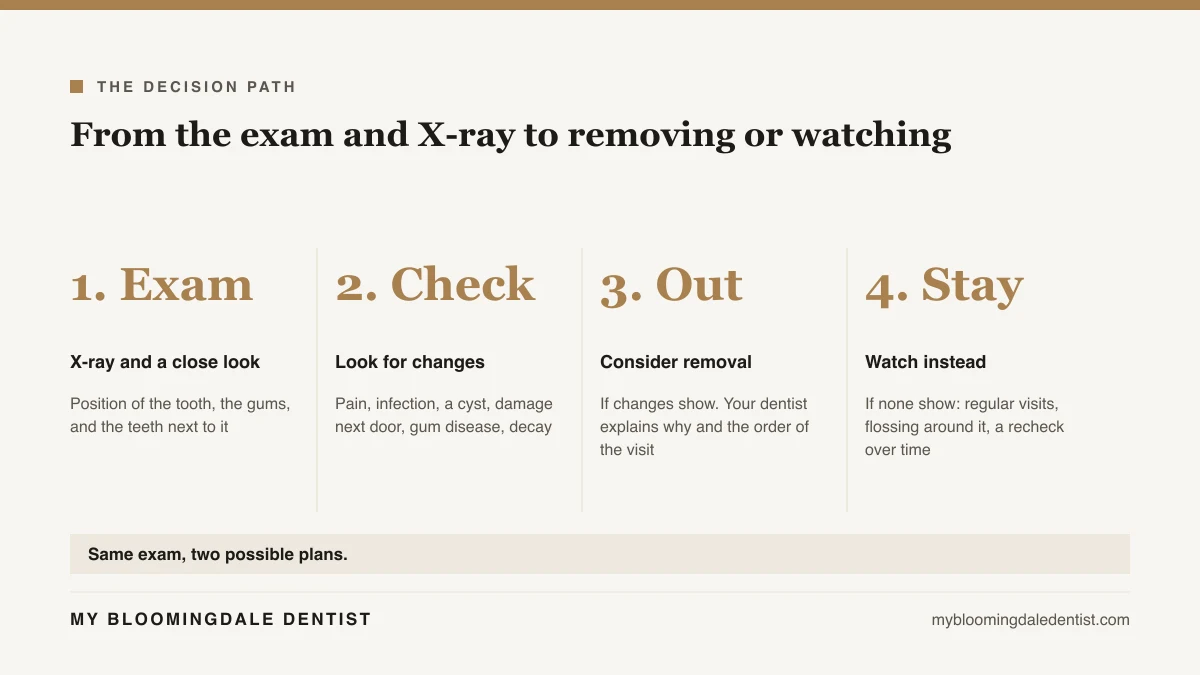
MouthHealthy says every patient is unique, but in general wisdom teeth may need to be removed when there is evidence of changes in the mouth. The table sets those findings next to what each source says is going on. No single row decides a case. They are weighed together at the exam.
| What the exam or X-ray finds | What the source says |
|---|---|
| Pain, or swelling and tenderness around the tooth | MouthHealthy lists pain among the changes that can lead to removal. MedlinePlus says a partly emerged tooth can trap food and plaque, causing inflamed, tender gums called pericoronitis |
| Infection | MouthHealthy lists infection, and says a partly emerged tooth can give bacteria a place to enter the gums |
| A cyst or other growth around the tooth | MouthHealthy lists cysts and tumors, and says a cyst on an impacted tooth could damage the roots of nearby teeth or the bone that supports them |
| Damage to the tooth next to it | MouthHealthy lists damage to neighboring teeth. MedlinePlus says trapped debris can lead to decay on the wisdom tooth or the neighbor, or even bone loss |
| Gum disease | MouthHealthy lists gum disease among the reasons |
| Decay that cannot reasonably be restored | MouthHealthy lists tooth decay if it is not possible or desirable to restore the tooth |
MouthHealthy adds that a dentist may also recommend removal as part of treatment for braces or other dental care. MedlinePlus says removal is the usual treatment for an impacted wisdom tooth, though it adds that no treatment may be needed if the tooth is not causing problems. That is why the question deserves a real conversation even when you feel fine.
When watching is a reasonable plan
The same two sources describe the other side. A tooth that is not causing pain, infection or damage, and shows none of those changes on the X-ray, may not need treatment right away. MouthHealthy is plain about the condition attached: wisdom teeth that are not removed should continue to be monitored, because the potential for developing problems later still exists.
So watching is a plan with parts, not a decision to forget about the tooth. The second table lays out what MouthHealthy says the plan involves, plus the warning signs MedlinePlus lists.
| Part of the plan | What it involves |
|---|---|
| Regular dental visits | MouthHealthy says regular visits let your dentist evaluate your wisdom teeth and your overall dental health |
| Cleaning around the tooth | MouthHealthy says to floss around your wisdom teeth. MedlinePlus says trapped food and plaque around a partly emerged tooth are what cause the trouble |
| Knowing the warning signs | MedlinePlus lists these symptoms of a partly impacted tooth: bad breath, an unpleasant taste near the tooth, red or swollen gums, and pain or tenderness of the gums or jaw |
| Rechecking over time | MouthHealthy says people are at greater risk for health problems as they age, including with their wisdom teeth. The question gets asked again at checkups |
Why does age come into the decision?
MedlinePlus says having wisdom teeth removed before age 20 often has better results than waiting until you are older. Its reason is that the roots are not fully developed yet, which makes the tooth easier to remove and helps healing. It adds that as a person ages the roots become longer and curved, the bone becomes more rigid, and complications can develop.
That is a reason to have the conversation early, not a reason to rush into removal. If you are a young adult with an impacted tooth that shows no changes on the X-ray, asking what the plan is for the next few years is a fair question. If you are older, the same question applies with more weight on how the tooth looks today.
What the exam and X-ray show
MouthHealthy says that before any decision, your dentist will examine your mouth and take an X-ray, and that together you can discuss the best course of treatment. MedlinePlus says the dentist looks for swollen tissue over the area, and for gums showing redness, drainage and tenderness, and that dental X-rays confirm which teeth have not emerged.
That is the whole reason to book the visit. A tooth cannot be sorted into “watch” or “remove” from how it feels alone, because MedlinePlus says a fully impacted tooth may have no symptoms at all. Our tooth extraction and wisdom teeth page describes removal of impacted or crowded wisdom teeth before they cause pain, infection or shifting, and 3D images used to plan surgical extractions.
What should you ask at the visit?
A short list turns the appointment into a plan you can follow. You can write these down before you go.
- What do the X-rays show about the position of each wisdom tooth, and the teeth next to it?
- Is anything on the list of removal findings present today, even a small one?
- If we watch, how often should I come in, and which changes should make me call sooner?
- If we remove, what is the order of the visit, and what does healing involve?
- Does anything about my age or my other dental work change the timing?
What should you do while you wait?
Keep cleaning around the back teeth, and keep your checkups. If you notice a swollen gum, a bad taste or tenderness near a wisdom tooth, do not wait for the next scheduled visit. Swelling that spreads, or swelling with a fever, is a different situation, and our guide on dental swelling and when to go to the ER explains how to tell which route fits.
If the tooth does come out
MedlinePlus lists impacted teeth that are causing problems, such as wisdom teeth, among the reasons people have a tooth pulled. The aftercare is its own subject. Our tooth extraction recovery timeline covers the days after, and the dry socket prevention guide covers dry socket, the complication that makes aftercare matter.
Getting seen at the office
If you have been told your wisdom teeth are impacted, or something near the back of your mouth has started to bother you, call (224) 520-8665 and tell us what you have noticed. The office sees patients during the week and on alternating weekends, so call first. A new-patient exam is $99 and includes X-rays, and any treatment is quoted in writing before it starts. The whole appointment, not only the front desk, can be held in English, Vietnamese, Korean or Spanish.
Call and tell us what you have noticed. New-patient exam $99, X-rays included. Every price in writing before treatment. English, Vietnamese, Korean and Spanish spoken.
Ask about your wisdom teethFrequently asked questions
No. MedlinePlus says impacted wisdom teeth are very common and often painless, and that no treatment may be needed if the tooth is not causing a problem. MouthHealthy says a tooth that stays should keep being monitored. The call is made at an exam with an X-ray.
MedlinePlus lists bad breath, an unpleasant taste near the tooth, red and swollen gums, pain or tenderness of the gums or jaw, and difficulty opening the mouth. MouthHealthy lists pain, infection, cysts, damage to neighboring teeth, gum disease and decay among the changes that can lead to removal.
MouthHealthy says teeth that are not removed should continue to be monitored, with flossing around them and regular dental visits so your dentist can evaluate them. It is a plan with checkups, and the question is asked again at those visits.
MedlinePlus says removal before age 20 often has better results than waiting, because the roots are not yet fully developed. That is a reason to have the conversation early. Whether a particular tooth needs to come out is still decided by the exam and the X-ray.
MouthHealthy lists damage to neighboring teeth among the reasons removal may be recommended, and says an impacted tooth that forms a cyst could damage nearby roots. MedlinePlus says trapped debris can lead to decay on the neighboring tooth. The X-ray shows whether this is happening.
A new-patient exam is $99 and includes X-rays. Any treatment is quoted in writing before it starts, and the exam is where your question about keeping or removing the tooth gets a straight answer.
Sources: MouthHealthy by the American Dental Association, Wisdom Teeth · MedlinePlus, Impacted tooth · MedlinePlus, Tooth extraction