Most people picture adjusting to new dentures in the first month as a test of patience. It is partly that, and partly a set of small decisions you can get right: what to eat on day one, how to read a sore spot, when adhesive is a help and when it is covering for something. The guidance below comes from MedlinePlus, the American Dental Association (ADA), the National Institute on Aging (NIA) and the Food and Drug Administration (FDA). Where your own dentist gives you different instructions, follow your dentist.
The first day, and what to do about each part of it
MedlinePlus says dentures “may feel strange at first” and that speaking and eating may feel different. The ADA adds that new dentures “may feel awkward for a few weeks” and may feel loose “while the muscles of your cheek and tongue learn to keep them in place.” It also lists a temporary rise in saliva as something that happens. So the first day is mostly a list of sensations, each with a sensible response.
- Loose or bulky feeling: normal while your muscles learn the new shape. Wear it as your dentist instructed; the muscles are what is adapting.
- More saliva than usual: the ADA says it increases temporarily. Swallow normally and let it settle.
- Hot food and drinks: MedlinePlus and the NIA both warn that dentures can make it harder to feel heat. Let the first sip cool before you commit.
- A bone or hard bit in your food: the same warning applies. Chew slowly and check what is in your mouth.
- If your denture was made right after your teeth came out, follow your own dentist’s instruction for the first night. The ADA notes an immediate denture may need to be relined or remade once the jaw has healed.
Week by week: the first month at a glance
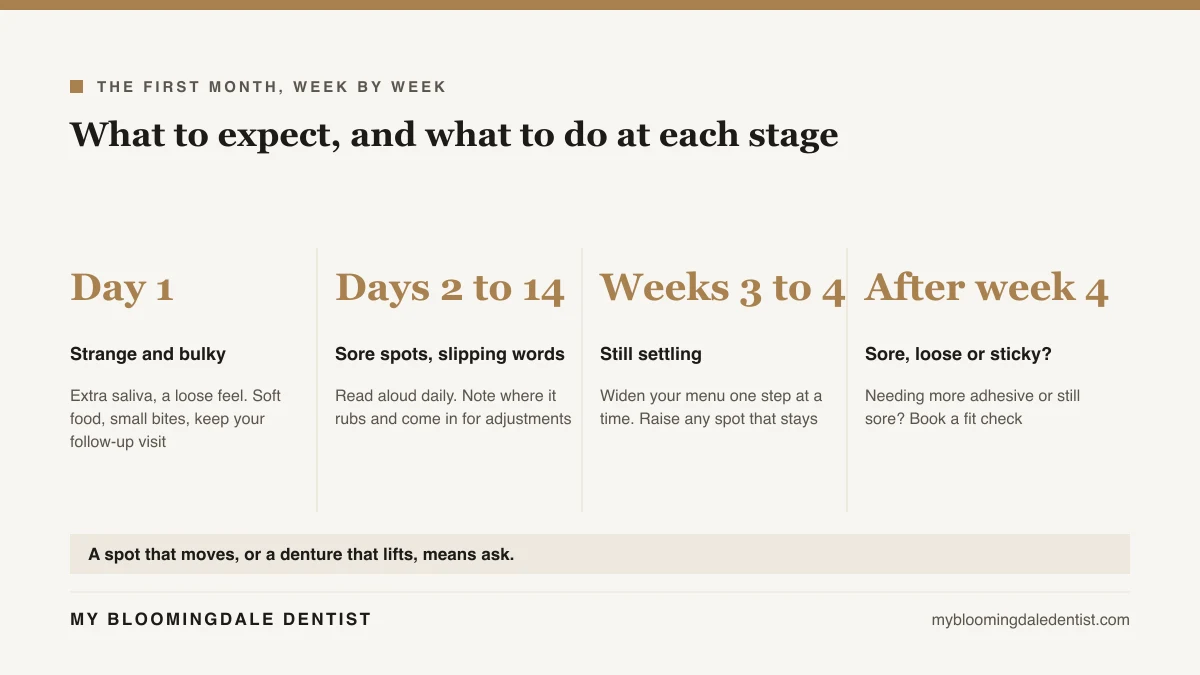
This is a pattern, not a schedule. The ADA’s phrase is “a few weeks,” and our dentures page says most people feel largely normal within a few weeks, with the first two being the awkward ones.
| When | What is common | What to do |
|---|---|---|
| Day 1 | Strange feel, extra saliva, a sense that the denture is large | Soft food, small bites, and keep the follow-up visit you were given |
| Days 2 to 14 | Minor soreness, words that slip, a denture that shifts when you laugh or yawn | Read aloud, note exactly where it rubs, and come in for adjustments rather than waiting |
| Weeks 3 to 4 | Chewing and speech are still settling, and any spot that remains is worth a visit | Widen your menu a step at a time and keep tracking any spot that persists |
| After week 4 | Largely normal within a few weeks, according to our dentures page | If it is still sore, still loose or still leaning on adhesive, book a fit check |
Is this sore spot normal, or is the fit wrong?
This is the question that matters most in month one, and the answer comes from three observations, not from how much it hurts. Where is it, does it stay in one place, and is it better than it was yesterday? The ADA says minor irritation or soreness is not unusual and that “if any problem persists, particularly irritation or soreness,” you should consult your dentist. Our dentures page says the same thing in plain terms: sore spots in the first two weeks are normal and worth coming in for.
| What you notice | What it usually points to | What to do |
|---|---|---|
| One small tender spot, always the same place, a little better each day | As a general dental explanation, a pressure point where the denture presses harder on one place | Book an adjustment. Do not file, trim or bend the denture yourself |
| General tenderness across a whole area that eases a little each day | The settling the ADA describes | Keep your follow-up visit and mention it there |
| Soreness that moves to a new place each time one is fixed | The fit as a whole, not a single spot | Ask for a full fit check, not another spot touch-up |
| The denture lifts, slides or clicks when you chew or talk | A stability problem | Book a fit check, and skip the thicker layer of adhesive |
| A sore that is not healing, or pain that does not settle after an adjustment | Something to look at, not wait out | Call the office and describe it |
MedlinePlus is direct about who makes the change: “Be sure to let your dentist handle these adjustments.” A spot you can see in the mirror is tempting to fix at home. Leave it for the visit, and write down where it is instead. Before you call, take a minute to note three things: which side it is on, when it hurts (chewing, talking or at rest), and whether it was there when you woke up. A clear description lets the visit go straight to the right spot instead of searching for it.
How do you eat in month one, and in what order?
In order of difficulty. The NIA’s advice for learning to eat with dentures is to start with soft, nonsticky food, cut it into small pieces, and chew slowly using both sides of your mouth. Our dentures page gives the same last piece: chew on both sides at once so the denture stays seated. The NIA also says to avoid small crunchy foods such as popcorn kernels that can get trapped under the denture and hurt your gums.
A workable sequence: scrambled eggs, soft fish, pasta and cooked vegetables in the first days, then softer meats and bread without a hard crust, then raw fruit cut small, and last the foods that fight back, such as steak, raw carrots and whole apples. Test hot soup and tea on the spoon first. Because MedlinePlus warns that dentures can make it harder to feel heat, a burn can happen before you notice it. Moving up a step only when the last one feels comfortable gives a sore spot time to show itself before you have loaded it with something harder.
Why do some words slip, and what fixes it?
MedlinePlus says speaking and eating may feel different at first, and the ADA says the muscles of the cheek and tongue take time to learn to hold the denture. As a general dental explanation, the words people notice first are the ones that need the tongue to meet the teeth precisely. The fix on our dentures page is practical: read out loud for ten minutes a day. Reading gives you a steady stream of words to repeat.
Pick one short passage, read it twice a day, and go slowly over the words that catch. If a particular sound keeps catching after a couple of weeks, note the sound, and mention it at your follow-up. That detail helps in the chair.
Is adhesive helping, or hiding a fit problem?
MedlinePlus says that if your dentures move too much, denture adhesive may help. The FDA draws the line: “In most cases, properly fitted and maintained dentures should not require the use of denture adhesives.” It also says “a large amount of denture adhesive will not necessarily address problems with ill-fitting dentures.” Its practical tests are simple. Start with a small amount, and if the adhesive oozes off the denture into your mouth, you are likely using too much. The ADA suggests looking for products with its Seal of Acceptance and following the instructions exactly.
Needing a thicker layer each week is the sign to book a visit. Our dentures page calls that a fit problem that adhesive is masking. What happens to fit in year two, and the reline that answers it, is covered in why dentures stop fitting and what a reline does.
If your lower denture still floats after the first month, and adhesive is carrying it, anchoring it is the usual next conversation. Narrow-post mini implants are one way to stabilize a lower denture, and who mini dental implants are for covers who they suit and who they do not.
The night-time and cleaning routine
The NIA and MedlinePlus agree: brush the denture daily with a denture-care product, take it out at night, and keep it in water or a denture-cleansing liquid. The NIA adds the reason, which is that leaving dentures in while you sleep can lead to swollen gums. The ADA gives the detail: rinse the dentures before brushing to remove loose food, use a soft-bristled brush and a non-abrasive cleanser so the surfaces do not get scratched, and when they are out of your mouth keep them covered in water so they do not warp.
The ADA also asks you to brush your gums, tongue and the roof of your mouth every morning with a soft brush before the dentures go in.
A practical tip beyond those sources: clean the denture over a sink of water or a folded towel so a drop does not crack it, and give it one fixed place to live when it is out, such as a labeled case beside the sink, so it never ends up wrapped in a tissue on a tray.
When to come back in, and what an adjustment visit is
Come back for your scheduled follow-up even if things feel fine; the ADA notes that follow-up appointments are generally needed after a denture is inserted “so the fit can be checked and adjusted.” Come back sooner for any of the rows in the triage table above that point to the fit, and for any sore that is not settling. In the ADA’s words, that is so the fit can be checked and adjusted. Bring the denture, and the adhesive you use if you use one, so both can be seen. It is easier when you have written down which day, which side and which activity brings the soreness on.
Getting seen at the office
Call (224) 520-8665 and say which day you are on and where it rubs. The office sees patients during the week and on alternating weekends. For dentures, dentures in Bloomingdale, IL with Dr. Kim explains how fitting and follow-up are handled, and any new denture plan is quoted in writing before anything is scheduled. New patients pay $99 for the exam, X-rays included. The whole appointment, not only the front desk, can be held in English, Vietnamese, Korean or Spanish. Weighing a different route? snap-in dentures compared with implants sets out the trade-offs.
Call and tell us the day and where it rubs. New-patient exam $99, X-rays included. Every price in writing before treatment. English, Vietnamese, Korean and Spanish spoken.
See how denture care works hereRelated reading
A question that does not need a call can go through send the office a message.
Frequently asked questions
The American Dental Association says new dentures may feel awkward for a few weeks until you become accustomed to them. Our dentures page puts it the same way: most people feel largely normal within a few weeks, and the first two are the awkward ones. If it is still sore, loose or leaning on adhesive after the first month, that is a reason to book a fit check.
Yes. The American Dental Association lists a temporary increase in saliva flow among the things that are not unusual with new dentures, and says these problems should go away as your mouth becomes accustomed to them. If it does not settle, mention it at your follow-up.
Minor irritation or soreness is not unusual at first, according to the American Dental Association. As a general dental explanation, a small spot that stays in one place and improves each day is a pressure point that an adjustment can address. Soreness that moves around, a denture that lifts when you chew, or pain that does not settle after an adjustment points to something more, and the ADA says to consult your dentist if any problem persists.
MedlinePlus and the National Institute on Aging both advise taking dentures out at night and keeping them in water or a denture-cleansing liquid, and the NIA says leaving them out while you sleep helps prevent swollen gums. If your denture was placed right after extractions, follow your own dentist’s instruction for the first night.
MedlinePlus says adhesive may help if your dentures move too much. The FDA says properly fitted and maintained dentures should not require it in most cases, and that a large amount will not necessarily solve an ill-fitting denture. Use a small amount as directed, and treat needing more each week as a sign to have the fit checked.
The National Institute on Aging suggests starting with soft, nonsticky food, cutting it into small pieces and chewing slowly on both sides of your mouth. Avoid small crunchy foods such as popcorn kernels that can get trapped under the denture. Add harder foods one step at a time as the last step feels comfortable.
Sources: MedlinePlus, Dentures · MouthHealthy by the American Dental Association, Dentures · National Institute on Aging, Taking Care of Your Teeth and Mouth · U.S. Food and Drug Administration, Denture Adhesives. General information for patients, not a diagnosis; your own dentist’s instructions take precedence.