Most recovery guides describe the same tooth extraction recovery timeline in nearly the same words, and they are not wrong. What they tend to leave out is the column next to the timeline: at each stage, what is normal, what is not, and what to do about it at nine at night when you cannot ask anyone. This post is the timeline with that column attached. The ranges are published by MedlinePlus, the American Dental Association and the American Association of Oral and Maxillofacial Surgeons (AAOMS); where your own aftercare sheet differs, follow the sheet.
What does a normal tooth extraction recovery timeline look like?
The socket fills with a blood clot, oozing slows the same day, your face feels the extraction most on days two and three, and from there the pain steps down. MedlinePlus says “it will take 1 to 2 weeks for the socket to heal” and adds that “affected bone and other tissue may take a bit longer to heal.” Writing about wisdom tooth removal, AAOMS says “Swelling, pain and discomfort are common during the first few days after surgery,” and “after about a week, the surgical site begins to regenerate new tissue to close the site.” Below is that curve in stages, with the off-curve column attached.
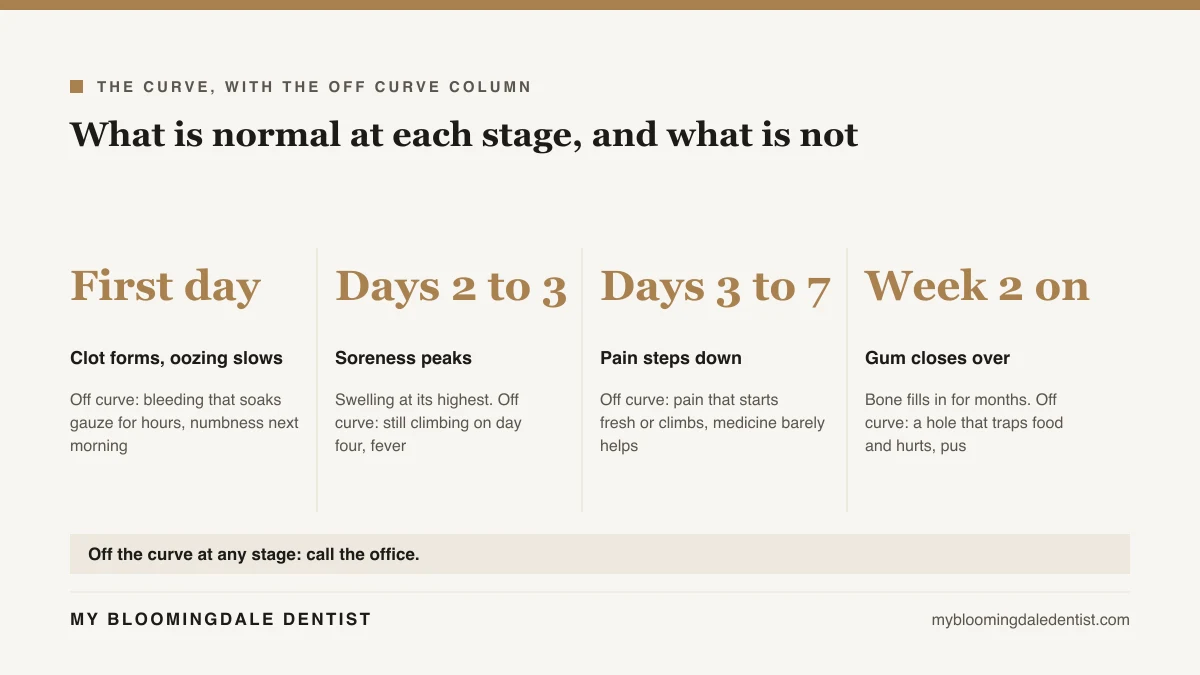
| Stage | What is normal | What is off the curve | What to do |
|---|---|---|---|
| First 24 hours | Oozing that tapers over the day, a numb lip or cheek for a few hours, soreness as the numbing wears off, some swelling starting | Bleeding that soaks through gauze for hours, numbness still present the next morning | Firm pressure on fresh gauze; if it will not slow, call. Numbness past the first day is a call, not a wait |
| Days 2 to 3 | Swelling and soreness at their peak, a tight jaw, bruising on some people, a dark clot in the socket | Swelling that is spreading rather than peaking, a fever, pain or swelling still climbing on day four | Cold compress on the cheek, keep the protocol; if it is climbing, or you have a fever, call |
| Days 3 to 7 | Pain stepping down each day, a whitish layer forming over the socket, chewing coming back on the other side | Pain that starts fresh or climbs after a better day, a bad taste or smell, pain that medicine barely touches | Call the same day; that pattern can mean a lost clot |
| Week 2 and after | Gum closing over, a soft dent where the tooth was, bone filling in under the gum over months | A hole that still traps food and hurts, swelling that returns, pus | Call for a check. If the tooth is being replaced, a 3D scan later reads how much bone has filled in |
The first 24 hours
You leave with gauze in your mouth, and MedlinePlus explains why: it is there “to stop the bleeding,” and “this will also help a blood clot to form.” That clot is the whole point of the first day. Bite on the gauze as you were told and do not keep checking on the socket. The ADA says “in most cases a small amount of bleeding is normal,” and pink saliva for the rest of the day is what that looks like. Blood that keeps soaking a pad hours later is not, and the first response is firm pressure on fresh gauze for a solid stretch. If that does not slow it, call.
Your lip and cheek stay numb for a while; MedlinePlus says “this will wear off in a few hours,” which is also your warning not to chew on that side until it does. Eat soft, cool food. MedlinePlus lists “yogurt, mashed potatoes, soup, avocado, and bananas.” Skip the straw for at least the first day, longer per our own aftercare, because the suction can disturb the clot. Do not spit or rinse hard; the ADA’s instruction is “don’t smoke or rinse your mouth vigorously.” As general aftercare, keep your head propped up when you lie down.
Off the curve on day one: bleeding that will not slow with pressure, and numbness still there the next morning. Nerve damage is on MedlinePlus’s list of extraction risks. Call and describe exactly where.
Days 2 and 3: why does it feel worse before it feels better?
Because swelling follows a curve of its own. The body sends fluid to the site over the first couple of days, so the second and third mornings are when your face looks and feels the most changed. In its wisdom tooth guidance, AAOMS tells patients to “use an ice pack intermittently for the first 48 to 72 hours to help reduce swelling,” and MedlinePlus gives the pattern: “a cold compress 10 to 20 minutes at a time.” Rest counts here too; AAOMS says to avoid “strenuous activities, exercises and sports that can interfere with the healing process” in the first few days.
Swelling that peaks and then starts to fall is the curve. Swelling that is still growing on day four, or has started spreading down the jaw or toward the eye, is not, and neither is a fever. Both are on MedlinePlus’s list of reasons to call your dentist. Our guide to facial swelling and the ER draws the line past which that call is to 911 instead.
Days 3 to 7
From the third day, pain should step down rather than up. You can brush your other teeth; the ADA says to brush and floss as usual “but don’t clean the teeth next to where the tooth was removed” at first, and AAOMS’s wisdom tooth instructions ask for “extra care to avoid traumatizing the extraction site” in the first 24 to 48 hours. Salt-water rinses start when your aftercare says so, and they are gentle; AAOMS describes “a half teaspoon of salt dissolved in a glass of warm water.” Chewing comes back on the other side first, and MedlinePlus says to avoid hard and crunchy food for a week.
Somewhere in this stretch a whitish or grayish layer appears over the socket. That is usually new tissue, not infection. The thing to call about is pain that changes direction: pain that was easing and then climbs, or severe pain that starts fresh in the first few days. That pattern can mean the clot came out early, which MedlinePlus lists as a reason to call. It gets its own full guide on this site; the short version is call the same day.
Week 2 and beyond: the bone underneath
By the end of the second week the gum has usually closed over and the soreness is gone, and that is where most recovery guides stop. The extraction is not finished. As a general dental explanation, there are two kinds of healing happening in a socket: the soft tissue over it, which closes in weeks, and the bone inside it, which fills in over months. The dent you can feel with your tongue flattens slowly as it does. That second process is the one that matters if the tooth is going to be replaced, because an implant sits in bone, not in gum.
The bone also changes shape as it heals. Our own guide to grafting puts it plainly: bone starts shrinking the moment a tooth is gone, and the longer a gap has sat, the likelier a graft becomes. How much bone is there, and whether the healed site can hold a post as it is, is a question a 3D scan answers, not a feeling.
Which four deviations are worth a call?
If you remember nothing else from this page, remember these four. Three are on MedlinePlus’s call list; lingering numbness is a call because nerve damage is on its list of risks.
- Pain that starts fresh or climbs after it had been easing, in the first days after the extraction. That can be the lost-clot pattern. Same-day call.
- Pain the medicine you were given does not touch, or pus at the site. MedlinePlus lists continued pain and pus among the reasons to call.
- Numbness in the lip, chin or tongue that does not fade after the first day. Call and describe exactly where.
- A fever, chills, or swelling that is spreading rather than peaking. MedlinePlus lists fever or chills and severe swelling among the reasons to call; if swelling reaches the eye or makes swallowing or breathing hard, that is the ER.
Everything else on the curve, including the worst morning on day two or three, is what healing looks like.
What makes recovery harder, and what can you change?
Some of it you cannot change: an impacted tooth, a root that broke, a tooth that had to be removed surgically rather than lifted out, all mean more tissue was disturbed and the curve runs a little longer. Our extractions page plans those with 3D imaging for exactly that reason. The rest comes down to two things. Suction, meaning straws, hard spitting, smoking and vaping, pulls on the clot. Tobacco slows healing on top of that, which is why AAOMS’s wisdom tooth aftercare advises stopping smoking completely for at least a few days after surgery. These are risk factors, not predictions. They are where the odds move.
What comes next if the tooth is being replaced?
Healing first. For most teeth other than wisdom teeth, our extractions page says replacement protects the bite and the bone, and the options it walks through are an implant or a bridge carried on the neighboring teeth. The order is fixed: the socket heals, a 3D scan reads how much bone has filled in, and only then is the route chosen and priced in writing. There is no same-day version of any of it here. A single dental implant from Dr. Kim is planned, placed and restored in one office, and if the scan shows the site needs building up first, when a bone graft comes into the implant plan explains what that adds and what it does not.
Getting seen at the office
For anything in the off-curve column, call (224) 520-8665 and say which day you are on and what has changed. Same-day emergency slots are held during the week, with patients seen on alternating weekends; call first so the visit is planned before you arrive. A tooth that has not come out yet, and hurts, belongs on the emergency dentist page. For the extraction itself, tooth extraction and wisdom teeth removal in Bloomingdale, IL sets out how simple and surgical removals are planned, with comfort options and a replacement plan mapped before the tooth comes out. New patients pay $99 for the exam, X-rays included, and every treatment price is put in writing before anything starts. The whole appointment, not only the front desk, can be held in English, Vietnamese, Korean or Spanish.
Call and say which day you are on. New-patient exam $99, X-rays included. Every price in writing before treatment. English, Vietnamese, Korean and Spanish spoken.
Read about extractions at the officeRelated reading
If an implant is on the table afterward, what dental implant recovery feels like day by day runs the same kind of curve for that procedure. Questions that can wait a day go through send the office a message.
Frequently asked questions
MedlinePlus says it takes one to two weeks for the socket to heal, and that affected bone and other tissue may take a bit longer. Soreness and swelling peak around day two or three and step down over the first week. Under the closed gum, the bone keeps filling in for months, which is the part that matters if the tooth is going to be replaced. A surgical or impacted extraction runs a little longer than a simple one.
Soreness and swelling are often at their peak on days two and three, so a hard third morning is on the curve. What is off the curve is pain that changes direction: pain that was easing and then climbs, or severe pain that starts fresh in the first few days. That pattern can mean the clot has come out early, and it is a same-day call.
Soft, cool food for the first days. MedlinePlus lists yogurt, mashed potatoes, soup, avocado and bananas, and says to avoid hard and crunchy foods for a week. Chew on the other side, skip anything hot or spicy at first, and drink from a cup rather than a straw, since suction can disturb the clot in the first days.
Gently, and only if you must, for the first few days. The American Dental Association says not to rinse vigorously, and MedlinePlus says you may rinse and spit starting about three days after surgery. Salt-water rinses start when your aftercare instructions say so; the American Association of Oral and Maxillofacial Surgeons describes a half teaspoon of salt in a glass of warm water, rinsed gently several times a day. Hard swishing and spitting pull on the clot the same way a straw does.
In the first week a whitish or grayish layer over the socket is usually new tissue forming, not infection. Pus looks different and comes with swelling, a bad taste or a fever, and those are on MedlinePlus’s list of reasons to call your dentist. If you are not sure, call and describe it.
There is no fixed number, because the answer depends on healing that cannot be scheduled. The socket heals first, then a 3D scan reads how much bone has filled in and whether the site can hold a post as it is or needs building up first. Only then is the route chosen and the price put in writing. There is no same-day version of this sequence at the office.
Sources: MedlinePlus, Tooth extraction · MouthHealthy by the American Dental Association, Extractions · American Association of Oral and Maxillofacial Surgeons, Healing After Wisdom Tooth Extractions · AAOMS, Wisdom Tooth Extraction: Postoperative Instructions. General dental information for patients, not a diagnosis. Where your aftercare sheet differs, follow the sheet.