Most extraction aftercare pages mention dry socket in one sentence, as the reason not to use a straw, and then move on. That leaves out the three things a patient can use: a prevention plan by day rather than a list of don’ts, a way to tell dry socket apart from ordinary day-three soreness, and what the office does about it if it happens. This post is those three things. The clinical descriptions are drawn from MedlinePlus, the American Dental Association and the American Association of Oral and Maxillofacial Surgeons; the aftercare that applies to you is the sheet you were handed after your extraction, and it wins any disagreement with a web page.
What is dry socket, and what is the clot doing?
MedlinePlus, the National Library of Medicine’s patient site, describes it in four plain sentences: “After a tooth is removed, a blood clot forms in the socket. This protects the bone underneath as it heals. Dry socket occurs when the clot is lost or does not form well. The bone is exposed to the air.” The clot is a dressing. Lose it and the bone, with the nerve endings in it, sits open to air, food and saliva, which is why MedlinePlus adds that this “causes pain and delays healing.”
The American Association of Oral and Maxillofacial Surgeons (AAOMS) gives the mechanism: “A dry socket happens when a blood clot is dislodged or otherwise breaks down in the site of a tooth extraction.” Two routes, then. The clot can be pulled out physically, by suction or by poking at it, or it can break down early. MedlinePlus names drinking from a straw and rinsing and spitting a lot as things that can dislodge the clot, and smoking or tobacco as something that slows healing. Prevention aims at both.
Dry socket prevention, day by day
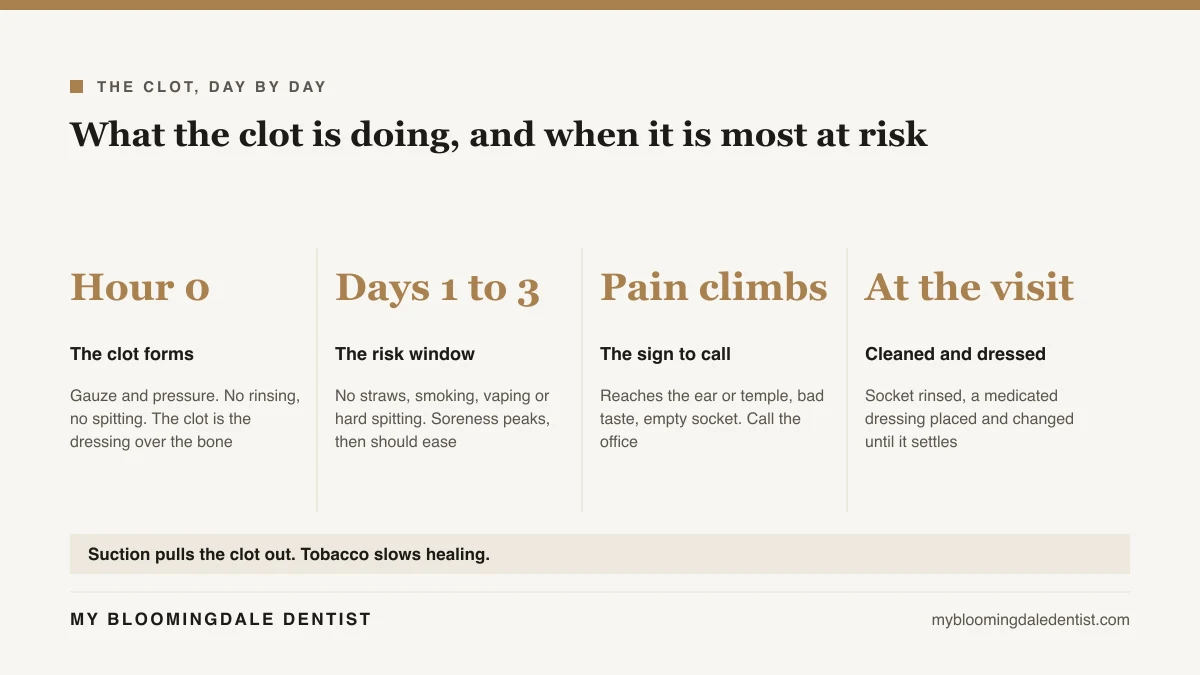
A list of don’ts is easy to forget by day two. A schedule is harder to drift from, and it also explains why each rule exists, which is what makes people keep it. The days below are the window in which the clot is most at risk; MedlinePlus puts the typical onset of dry socket pain at one to three days after the tooth is pulled, so that is where the protocol is strictest.
| When | Do | Avoid | Why the rule exists |
|---|---|---|---|
| The first 24 hours | Bite on the gauze as instructed, rest, eat soft and cool, keep your head up | Straws, smoking or vaping, spitting, swishing, hot drinks, alcohol, brushing the socket itself | The clot is forming. The ADA says not to smoke or rinse vigorously and to avoid a straw for 24 hours; AAOMS says the sucking action can dislodge a clot |
| Days 1 to 3 | Brush the other teeth, start gentle salt-water rinses only when your aftercare says to, keep eating soft | Still no straws, smoking or vaping, no forceful spitting, no poking at the site with a tongue or finger | This is the window MedlinePlus names for dry socket pain. As a general dental explanation, the clot is in place but not yet anchored by new tissue |
| Days 3 to 7 | Let pain step down on its own, keep food out of the socket, ease back toward normal eating as comfort allows | Smoking, hard or crunchy food over the site, anything that makes you want to swish hard | Pain that climbs instead of falling here is the signal to call. New tissue is beginning to cover the site |
Our extractions page says the same thing in fewer words: no smoking or straws for a few days, gentle rinsing. The table is that sentence with the reasons attached.
Why do straws, smoking and spitting all get named?
Because straws and smoking work the same way, and spitting is the mirror image. Drawing on a straw or a cigarette creates negative pressure in the mouth, and negative pressure pulls on a clot that is only held by the walls of the socket. AAOMS says it directly about straws: “Aggressive sucking through a straw can loosen blood clots and cause complications such as dry sockets.” Smoking and vaping involve the same draw, with the added problem that tobacco slows healing; the ADA’s advice for someone who already has a dry socket includes “avoiding cigarette smoking or other tobacco use, as it can delay healing,” and AAOMS tells patients it is best to stop smoking completely for at least a few days after surgery.
Once you see the mechanism you can generalize to the things no list mentions. Slurping soup or drinking from a sports bottle with a valve: anything that makes you suck is on the same list as the straw. Spitting and hard swishing work the other way, by force rather than suction. MedlinePlus names rinsing and spitting a lot as things that can dislodge the clot, and the ADA’s rule for the first few days is “if you must rinse, rinse your mouth gently.”
Is this dry socket, or is this just day three?
Here is the question the one-sentence warnings never answer. Soreness in the first few days is expected, and soreness alone does not mean the clot is gone. The pattern matters more than the pain level. The right-hand column below is drawn from the symptom lists MedlinePlus and AAOMS publish; the left is what an ordinary recovery looks like at the same point.
| What you notice | Ordinary healing | The dry socket pattern |
|---|---|---|
| Timing | Sore from the start, worst around day two or three, then easing each day | Pain that starts, or sharply worsens, one to three days after the extraction |
| Where it hurts | At the site and the jaw around it | MedlinePlus: pain that radiates from the socket to your ear, eye, temple or neck on that side |
| What the socket looks like | A dark clot sitting in the hole, later a whitish layer of new tissue | An empty socket with the clot missing, and, in AAOMS’s words, “visible bone in the socket” |
| Taste and smell | Nothing unusual | A bad taste, bad breath or a foul smell, sometimes a slight fever |
| Pain relievers | Take the edge off as expected | Help less than they should; MedlinePlus says to call if the pain is not relieved by the medicine you were given |
MedlinePlus lists a slight fever among dry socket symptoms and says a worsening taste or breath can be a sign of infection, so either one is a reason to call. Swelling that is spreading belongs on a different page, when dental swelling belongs in the ER. If you cannot tell what you are looking at, call and describe it.
What raises the risk before the tooth even comes out?
MedlinePlus lists the things that make a dry socket more likely: poor oral health, a difficult tooth extraction, taking birth control pills, smoking or using tobacco, not taking proper care of the mouth afterward, and having had a dry socket before. AAOMS adds the pre-operative version of two of them: stop smoking before the extraction, not only after, and tell the office about any medicines that affect clotting.
None of that is a prediction. What the list changes is how seriously you take the first three days. If you smoke, if the tooth is impacted or being removed surgically, or if you have been through this before, the protocol above is not advice, it is the plan. It also helps to say so at the appointment. An extraction that the 3D imaging shows will be surgical is planned differently from a simple one, and knowing you have had a dry socket before is useful to the person doing it.
What does the office do about a dry socket?
This is the part a one-line warning leaves out. The ADA describes it as “cleaning the site of the extraction and placing a medicated dressing in the socket,” then “changing the dressing daily until the pain diminishes and the socket begins to heal.” MedlinePlus describes the same visit: the dentist cleans out the socket, fills it with a medicated dressing or paste, and has you come in to have the dressing changed.
So a dry socket visit, here or anywhere, looks like this. The socket is cleaned out to flush food and debris, the step MedlinePlus lists first. A dressing carrying a soothing medication is placed into the socket so the bone is no longer open to air. The dressing is changed over the following days until the socket is comfortable and healing on its own. The dressing covers the exposed bone again, which is the point of it. Pain relievers are discussed at the visit and, if there are signs of infection, so is anything else that is needed.
What it is not: a second surgery. If the plan was to replace the tooth, that plan waits until the socket has healed, and what a bone graft for a dental implant does covers how the 3D scan reads the bone when that time comes.
What not to do at home
Home remedies for dry socket circulate widely, and most of them go into the socket. Do not put anything into the socket yourself, whatever you have read about. Do not try to rinse it clean with force. Do not take more pain medicine than the label or your dentist allows to get through the night; call instead. The home measures MedlinePlus lists for someone with a dry socket are short: take pain medicine and antibiotics as directed, apply a cold pack to the outside of your jaw, rinse the socket carefully only as your dentist directs, and do not smoke, use tobacco or drink alcohol. Everything else is the dentist’s job.
Getting seen at the office
If the pattern above fits, call (224) 520-8665 and say you think it is a dry socket. The office holds same-day emergency slots during the week and sees patients on alternating weekends, so call first and the visit is planned before you arrive. If the extraction was done here, the extractions page already says we are a call away if anything feels off, and this is exactly that. If it was done elsewhere, you are still welcome; the $99 new-patient exam includes the X-rays, and anything beyond the exam is quoted in writing before it starts. For an extraction that has not happened yet, gentle tooth extractions in Bloomingdale, IL sets out how the imaging, the removal and the aftercare are planned, and same-day emergency dental care covers the case where the tooth cannot wait. Appointments can be held in English, Vietnamese, Korean and Spanish, covering the whole visit and not just the front desk.
Call and describe what you are feeling. $99 new-patient exam with X-rays; treatment quoted in writing first. Care in English, Vietnamese, Korean and Spanish.
See how extractions are planned hereRelated reading
For swelling, fever or an infection after an extraction rather than a lost clot, the swelling guide draws the line between the dentist and the ER. For what an ordinary week of healing looks like, the extraction recovery timeline runs it hour by hour and day by day. For anything that is not urgent, you can contact the office and the team will call you back.
Frequently asked questions
MedlinePlus puts the typical onset at severe pain one to three days after the tooth is pulled. That is why the prevention protocol is strictest in the first three days; as a general dental explanation, the clot is in place but not yet anchored by new tissue. Pain that is still easing day by day past that point is the ordinary curve.
Normal soreness is at the site, peaks around day two or three, and eases each day after. The dry socket pattern is pain that starts or sharply worsens one to three days out, radiates toward the ear, eye, temple or neck on that side, comes with a bad taste or smell, and is not relieved by the pain medicine you were given. Looking in, the socket appears empty rather than holding a dark clot.
Not for the first day at least, and our own aftercare says a few days. The American Dental Association says to avoid drinking through a straw for 24 hours, and the American Association of Oral and Maxillofacial Surgeons says aggressive sucking through a straw can loosen blood clots and cause complications such as dry sockets. The same applies to smoking, vaping, hard spitting and vigorous rinsing, because all of them pull on the clot.
Yes. MedlinePlus lists smoking or using tobacco among the factors that make dry socket more likely, and the American Dental Association notes that tobacco can delay healing. AAOMS advises stopping before the extraction as well as for at least a few days after. If you smoke, the first three days of the protocol are the plan, not a suggestion.
The American Dental Association describes the treatment as cleaning the site of the extraction and placing a medicated dressing in the socket, then changing the dressing until the pain diminishes and the socket begins to heal. It is not a second surgery; the dressing covers the exposed bone and is changed until the socket begins to heal.
Replacement waits until the socket has healed, dry socket or not. A 3D scan then reads the bone and the options come from that scan. No timeline is promised for work that depends on healing, and every option is quoted in writing before it starts.
Sources: MedlinePlus, Dry socket · MedlinePlus, Tooth extraction · MouthHealthy by the American Dental Association, Dry Socket · MouthHealthy by the American Dental Association, Extractions · American Association of Oral and Maxillofacial Surgeons, What is Dry Socket? · AAOMS, Wisdom Tooth Extraction: Postoperative Instructions. General dental information, not a diagnosis. Your own aftercare instructions take priority over anything written here.