Every guide to a knocked out tooth says the same thing about the first 30 minutes: hurry. True, but not useful on its own. What you need is what the hurry is for, so the two or three decisions in those minutes go right, and what happens after you reach the chair, because a replanted tooth is followed for months. The steps below are general first aid drawn from MedlinePlus and the American Dental Association, not a diagnosis. If a tooth is out, start moving while you read.
What are the first 30 minutes deciding?
As a general dental explanation: a tooth is held in its socket by a thin living layer on the root surface, and a knocked out tooth is replanted in the hope that layer reattaches. Drying and scrubbing both damage it, which is why every step in the first half hour is about keeping the root wet and untouched until the tooth is back in the socket.
MedlinePlus, the National Library of Medicine’s patient site, puts the time pressure plainly: “The longer you wait, the less chance there is for your dentist to fix it.” It also gives the two rules that matter most, “Do not handle the roots of the tooth” and “Do not let the tooth dry out.” Every step below follows from those two.
Pick it up by the crown: the first minute
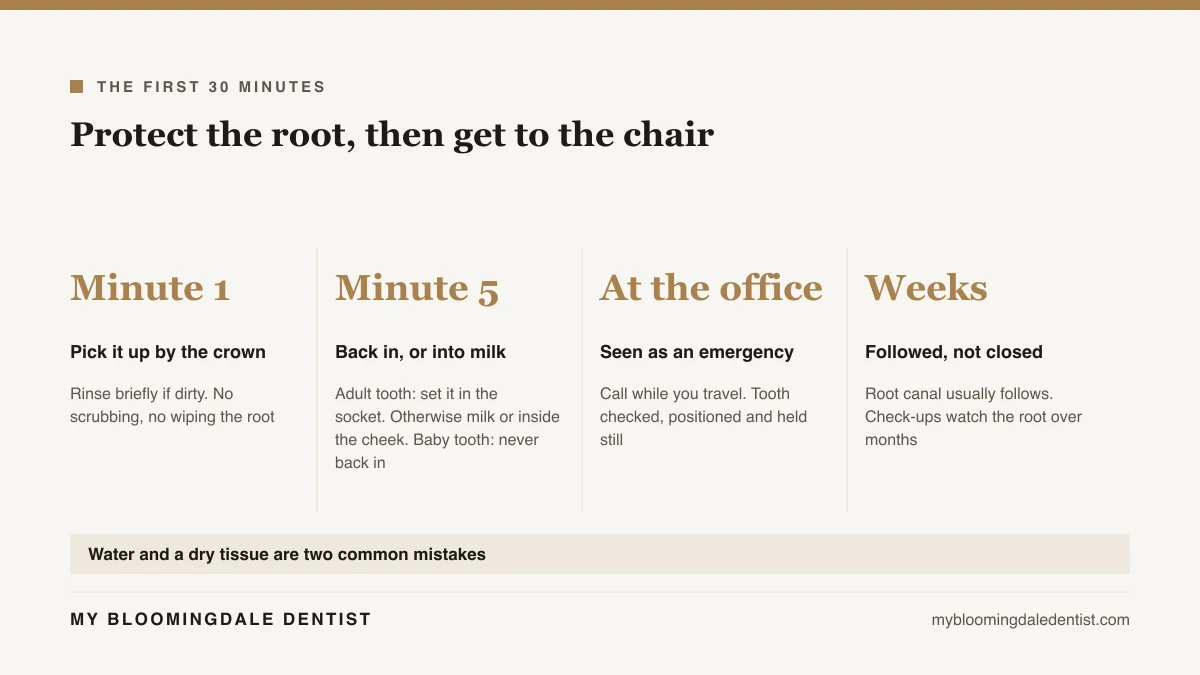
The crown is the white chewing part, the part you normally see. The root is the yellower, pointed part that was in the bone. Hold the crown. If the tooth landed somewhere dirty, rinse it briefly in milk or saline. No soap, no scrubbing, no wiping the root on a sleeve. MedlinePlus is specific: “Do not scrape or wipe the root of the tooth to remove dirt,” and do not clean it with alcohol or peroxide.
| Step | Why it matters | What it costs you if you skip it |
|---|---|---|
| Pick it up by the crown | The root surface is what the dentist is trying to save | A handled root is less likely to take |
| Rinse briefly, do not scrub | Clears grit without stripping the root | A scrubbed root is a root that will not take |
| Put it back, or keep it wet | Drying is the clock; a wet root buys time | A dry tooth loses its chance by the minute |
| Press gauze on the socket | Controls bleeding so the socket is workable | A bleeding, clotted socket is harder to replant into |
| Call the office while you travel | The office can plan the visit before you arrive | Minutes lost explaining it at the door |
Bleeding from the socket is normal. MedlinePlus advises pressing directly on it with gauze.
As general first aid, keep your head up rather than lying flat, and do not rinse the mouth hard, because that disturbs the clot forming in the socket.
What should you store the tooth in?
If the tooth is not going straight back into the socket, it needs to be wet, and the liquid matters. The American Dental Association’s patient site says to keep a knocked out adult tooth “moist at all times” and, if it cannot be set back in, to “place it in between your cheek and gums, in milk, or use a tooth preservation product that has the ADA Seal of Acceptance.” MedlinePlus lists the same set: a container with a small amount of cow’s milk or saliva, or holding the tooth between the lower lip and gum.
- Cold milk in a small container, so the tooth is fully covered. This is the option most people can find within a minute.
- Inside the mouth, between the cheek and the gum. Good for an adult who will not swallow it. Not for a child.
- A tooth preservation kit, if a school, gym or first aid box has one. Sports programs sometimes stock them.
Two common choices are the wrong ones. Plain tap water is not on either source’s list, and it damages the root cells over time. A dry tissue, napkin or pocket is the worst option, because it is the drying the whole exercise is trying to prevent. If milk is not available, the patient’s own saliva beats water.
Should you put it back in yourself?
For an adult, permanent tooth, yes, if you can do it without forcing it. MedlinePlus says to “try to place the tooth back in your mouth where it fell out, so it is level with other teeth,” then bite down gently on gauze to hold it. The ADA says the same: place it back in the socket without touching the root, and then get to the dentist right away. Putting it back is not the end of the job. It still needs to be seen, positioned and stabilized by a dentist, but the socket is the best storage container there is.
The distinction almost every page skips is age. A baby tooth is not replanted. MedlinePlus: “In most cases, only permanent teeth are replanted into the mouth. Baby teeth are not replanted.” The concern is the adult tooth forming underneath. If a child loses a baby tooth in a fall, control the bleeding, keep the tooth so the dentist can confirm it came out whole, and bring the child in to be checked. If a child loses a permanent tooth, the American Academy of Pediatric Dentistry gives the same instruction as for an adult: hold it by the crown, try to reinsert it, and otherwise put it in a glass of milk and go straight to the dentist.
Not sure which it is? Between about six and twelve a child has a mix of both, and a front tooth that came out could be either. When in doubt, do not force it back in. Put it in milk and let the dentist decide. That costs nothing on the clock and avoids the one mistake that cannot be undone.
What happens at the office
The visit starts with the socket and the tooth, not with paperwork. The area is checked for fragments and for damage to the bone and the neighboring teeth, and an X-ray, including a 3D X-ray where needed, shows what the socket looks like and whether anything is broken below the gum. If the tooth has not already been set back in, that is done now, and the position is checked against the teeth beside it.
A replanted tooth then needs to be held still while the root surface reattaches. The standard approach dentists use is a splint: the tooth is bonded to its neighbors for a period so it cannot move, the way a broken bone is held. How long it stays, and what else the tooth needs, is decided at the visit, on the X-ray and on how long the tooth was out. Most search results stop at “see a dentist within 30 minutes.” The part they leave out is that the tooth is then watched at follow-up visits over the following weeks and months, because a root that has been out of the socket can change afterward, and the earlier a change is seen, the more can be done about it.
That is why the first 30 minutes matter beyond the day itself: a tooth that went back in fast, wet and unscrubbed gives the follow-up something to work with. Emergency dental care in Bloomingdale, IL covers what the same-day visit involves and what it costs to be seen.
Does a replanted tooth need a root canal?
Usually, yes, and it helps to know that before the dentist says it. MedlinePlus states it directly: “After your tooth has been replanted, you will most likely need a root canal to remove the cut nerve that is inside your tooth.” When a tooth leaves the socket, the nerve and blood supply that ran into the tip of the root are torn, so the inside of the tooth is cleaned out and sealed to keep it from becoming infected later.
The timing is decided at the office, on the patient’s age, whether the root tip was still developing, and how long the tooth was out. What matters for you is that the root canal is part of the same case, not a separate problem that turned up later. Root canal treatment explains the procedure, and why a crown usually follows a root canal covers what comes after it. Front teeth are sometimes an exception on the crown, and that call is made once the tooth has settled.
If the tooth cannot be saved
Sometimes the tooth is not found, arrives dry hours later, or the socket is too damaged to take it back. Sometimes a replanted tooth is lost at a later follow-up. In each case the sequence is the same, and it starts with healing, not with a replacement. The socket and the bone around it are allowed to heal first, and only then are the options planned: a dental implant, a bridge carried on the neighboring teeth, or a removable option. Nothing is promised on a timeline for work that depends on healing. The dental implants in Bloomingdale, IL page sets out what a single implant involves and what a complete one costs, quoted in writing before anything starts.
In the meantime, keep the neighboring teeth and the gum in the gap clean, because they carry whatever comes next. If the face swells in the days after the injury, that is a separate problem from the tooth, and dental swelling and when it belongs in the ER covers where that line sits.
Getting seen at the office
Call (224) 520-8665 while you are on the way and say a tooth has been knocked out. The office holds same-day emergency slots during the week and sees patients on alternating weekends, and a knocked out tooth is the fastest appointment it offers. If you are new to the practice, the $99 new-patient exam includes the X-rays, and any treatment is quoted in writing before it starts. Appointments can be held in English, Vietnamese, Korean and Spanish, covering the whole visit and not just the front desk.
Say it is a knocked out tooth so the office knows what is coming. $99 new-patient exam with X-rays; treatment quoted in writing first. Care in English, Vietnamese, Korean and Spanish.
See same-day emergency careRelated reading
For the infection side of a dental injury, the swelling guide sets out the warning signs. If the tooth broke instead of coming out, how to sort a broken or cracked tooth into today or this week is the guide to read. For anything that is not urgent, you can reach the office here.
Frequently asked questions
Pick the tooth up by the crown, not the root. Rinse it briefly if it is dirty, without scrubbing. If it is an adult tooth, set it back in the socket and bite gently on gauze; if you cannot, keep it in milk or inside the cheek. Press gauze on the socket, and call the dental office while you travel. MedlinePlus puts it simply: the longer you wait, the less chance there is for your dentist to fix it.
Water is not a storage liquid for a knocked out tooth. Both MedlinePlus and the American Dental Association point to milk, the patient’s own saliva, or a tooth preservation product instead. A dry tissue or pocket is worse still, because drying is what damages the root surface.
No. MedlinePlus states that in most cases only permanent teeth are replanted and that baby teeth are not replanted. The concern is the adult tooth forming underneath. Control the bleeding, keep the tooth, and have the child checked. If you are not sure whether it is a baby tooth or an adult tooth, put it in milk and let the dentist decide.
Most likely. MedlinePlus notes that after a tooth has been replanted you will most likely need a root canal to remove the cut nerve inside it. The timing is decided at the office and depends on the patient’s age, the root’s development and how long the tooth was out. It is part of the same case, not a separate problem.
It is held still against the neighboring teeth while the root surface reattaches, and it is then checked at follow-up visits over the following weeks and months. A tooth that has been out of the socket can change afterward, so the case is followed rather than closed on the day.
The socket is allowed to heal first, and the replacement is planned after that: a dental implant, a bridge, or a removable option. No timeline is promised for work that depends on healing, and every option is quoted in writing before it starts.
Sources: MedlinePlus, Broken or knocked out tooth · MouthHealthy by the American Dental Association, Dental Emergencies · American Academy of Pediatric Dentistry, Parent FAQ. General first aid information, not a diagnosis. If there is a head injury, loss of consciousness or bleeding that will not stop, call 911.