If you have been asking why dentures stop fitting when yours fit well for a year or two, and whether a denture reline is the fix, the answer is usually not the workmanship. A reline exists because of something that happens to everyone who has lost teeth. The ridge of gum and bone that a denture rests on is not a fixed surface. Once the roots that used to load it are gone, it slowly reshapes, and a denture made to fit it perfectly on one day is fitting a slightly different mouth a few years later.
Most denture articles stop at the first month: sore spots, speech, soft food. This one starts where those end, at the point where a denture that used to be fine begins to rock, rub or need more and more adhesive, and it covers what to do about it.
Why dentures stop fitting, and what to watch for
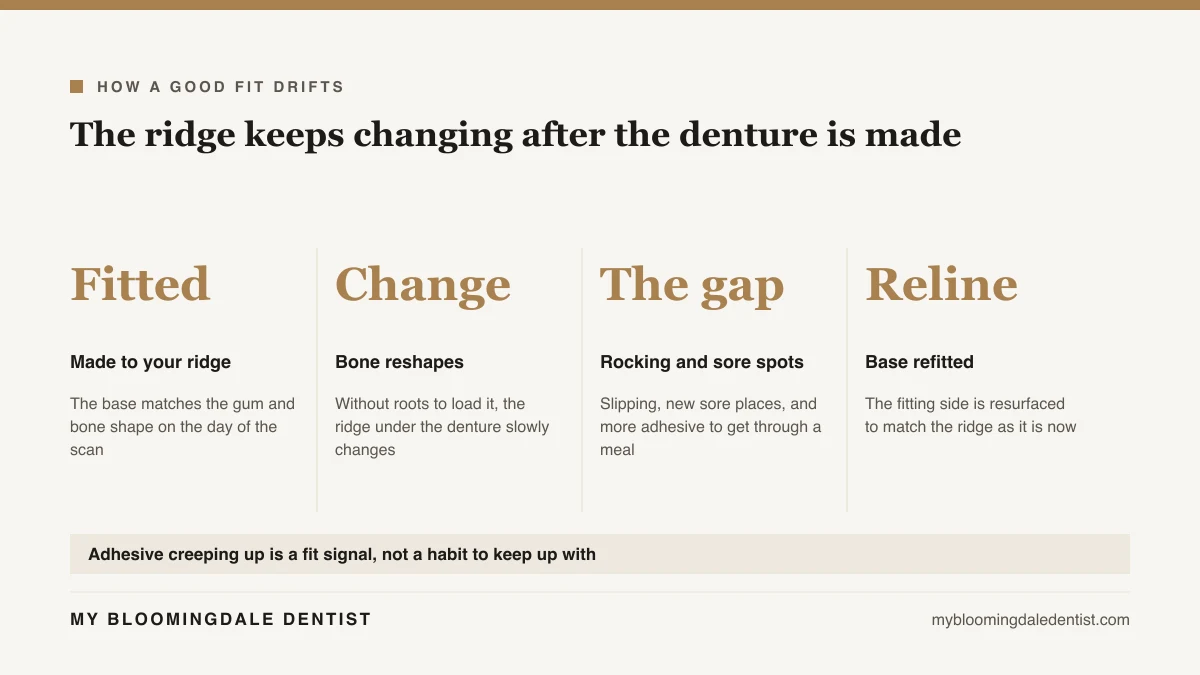
Natural teeth do more than chew. Every bite pushes force down through the roots into the jawbone, and bone that is loaded keeps its shape. When the teeth come out, that load stops. A denture sits on top of the gum and spreads force across the surface, which is not the same thing, so the ridge underneath gradually remodels.
The National Institute on Aging puts it plainly: as your gums change shape over time, your dentures may need to be adjusted or replaced. The change is slow and it does not stop, which is why the fit drifts rather than failing all at once. The lower ridge usually shows it first, because it offers less to hold onto than the upper.
The same thing explains why the first reline often comes sooner for people who had a denture made shortly after extractions. The ADA’s patient site notes that a denture made during the healing period may need to be relined or remade after your jaw has healed. The ridge changes most in those first months.
How to tell where you are on the timeline
The timing varies from person to person, so treat this as a pattern to recognize, not a schedule.
| Period | What changes | What you notice | What is usually done |
|---|---|---|---|
| First months after extractions | The ridge heals and changes the most | A denture that was snug starts to loosen | A reline once healing has settled |
| The years after that | Slow, steady remodeling of the ridge | Slipping, food under the plate, rubbing in new places | A reline every few years, checked at a yearly visit |
| Many years in, or a long gap between checks | The ridge and the denture teeth have both changed | Worn teeth, a face that looks shorter, relines that no longer hold | A new denture, or a rebase if the teeth are still sound |
Signs it is the fit, not you
Denture wearers are good at blaming themselves. The signs below point to the fit, not to anything you are doing wrong.
- The lower denture lifts or slides when you chew, and it used to stay put.
- Sore spots appear in new places, where there were none before.
- You need more adhesive than you used to, or it stops lasting through a meal.
- The denture clicks when you talk.
- Food keeps getting underneath the plate.
There is one useful distinction. A single sore spot that appears after a change, such as a new chip on the edge of the denture, is often a pressure point that a small adjustment fixes. Soreness that moves around, combined with looseness, is the fit, and adjusting one spot will just move the problem somewhere else.
Adhesive deserves its own line. The FDA advises against using more denture adhesive than recommended and notes that prolonged use of ill-fitting dentures may lead to an increase in bone loss. Adhesive creeping up is a fit signal. It is not a habit to keep up with.
What does a denture reline do?
A reline adds new material to the fitting side of your existing denture, the pink side that sits against your gums, so it matches the shape of the ridge as it is now. The teeth, the color and the look of the denture stay the same. Only the part that touches your mouth changes.
You may hear a few terms for it. A soft reline uses a cushioned material, often for tender gums or while a ridge is still healing. A hard reline uses a firmer acrylic meant to last longer. Which type suits a given mouth is a clinical call. At My Bloomingdale Dentist relines and repairs are handled in-house, and the denture care in Bloomingdale, IL page covers the service side of it.
What a reline does not do is just as important. It will not fix worn or chipped denture teeth, a cracked base, or a bite that has closed down as the teeth wore flat. If those are the problem, refitting the base on its own leaves you with a denture that sits better and still does not work well.
Reline, rebase, or a new denture?
These three get confused, and each one answers a different problem.
| Option | What it changes | When it fits | When it does not |
|---|---|---|---|
| Reline | The fitting surface only | The denture is in good shape and only the fit has drifted | Teeth are worn, the base is cracked, or the bite has collapsed |
| Rebase | The whole pink base, keeping the existing teeth | The teeth are still good but the base is worn, stained or damaged | The teeth themselves are worn down |
| New denture | Everything | Worn teeth, repeated relines that no longer hold, or a face that has changed shape | A good denture that just needs refitting |
The driver is always the same question: which part has worn out, the fit, the base or the teeth. Answer that and the choice mostly makes itself.
When is stabilizing the denture the better answer?
Sometimes the issue is not a fit that has drifted. It is a lower denture that has never really stayed down, because the lower ridge has little to grip. Relining that denture helps for a while, and then the same complaint comes back.
For that case, anchoring the denture is the reliable fix. Narrow-post mini implants can hold a lower denture down so it snaps into place, and they often work on a ridge too thin for standard implants. That is a way of stabilizing a denture, not a substitute for a standard implant, and who mini dental implants suit, and who should say no covers it in full. If you are weighing a bigger change, snap-in dentures compared with implants sets out the trade-offs.
How can you make a denture fit longer?
You cannot stop the ridge from changing, but you can stop small problems from becoming sores and catch the drift early.
- Take the denture out at night. The National Institute on Aging recommends brushing dentures every day and soaking them in water or a denture-cleansing liquid at night.
- Brush it daily with a soft brush and a non-abrasive cleanser, as the ADA advises. Harsh pastes scratch the surface.
- Keep it in water whenever it is out of your mouth. The ADA notes this keeps a denture from warping. Hot water can warp it too.
- Handle it over a folded towel or a sink of water, so a drop does not crack the base.
- Book a yearly check. The ADA recommends regular checkups so the dentist can see whether your dentures continue to fit properly, and the check also looks at the health of the gums and tissue under the denture.
The yearly check is the one that matters most. The drift is slow enough that you will not notice it week to week, which is exactly why it helps to have someone compare it against last year.
Booking a denture check
If your denture has started to rock, rub or eat through adhesive, the useful first step is an exam that looks at the ridge and the denture together. For new patients that is a $99 exam with X-rays, and any reline or new denture is quoted in writing before anything is scheduled.
Bring the denture you wear every day, plus any older one you still have, and note roughly when it was last relined. Knowing how fast the fit has drifted since then is one of the clearest guides to whether a reline will hold or whether it is time for a new denture.
A $99 new-patient exam with X-rays checks the ridge and the fit together, and every option is quoted in writing first. Appointments in English, Vietnamese, Korean and Spanish.
Book a denture checkRelated reading
If you are wondering whether a denture held on implants would stop the relines altogether, the middle path between regular dentures and fixed teeth is a good next read. For anything else, get in touch with the office.
Frequently asked questions
Because the gum and bone ridge under them keeps changing shape once the teeth are gone, while the denture stays the shape it was made. Without roots to load it, the ridge slowly remodels. The National Institute on Aging notes that as your gums change shape over time, your dentures may need to be adjusted or replaced.
It varies from person to person. Most people need one every few years, and a denture made shortly after extractions often needs its first reline once the jaw has healed, because the ridge changes most in those first months. A yearly check is the best way to catch the drift before it turns into sores.
A reline adds new material to the fitting surface of the denture so it matches your ridge again. A rebase replaces the whole pink base while keeping the existing teeth. A reline suits a denture in good shape whose fit has drifted; a rebase suits a denture whose teeth are still good but whose base is worn or damaged.
Needing more and more adhesive is usually a sign the fit has changed. The FDA advises against using more adhesive than recommended and notes that prolonged use of ill-fitting dentures may lead to an increase in bone loss. A fit check is the better answer than a thicker layer of adhesive.
It can help, but a lower denture that has never stayed down is often a ridge problem rather than a fit problem. In that case anchoring the denture on narrow-post mini implants is often the better answer, because it holds the denture down instead of relying on suction and adhesive.
Sources: National Institute on Aging, Taking Care of Your Teeth and Mouth · MouthHealthy by the American Dental Association, Dentures · U.S. Food and Drug Administration, Denture Adhesives. General information, not a diagnosis; your own dentist’s reading of your mouth takes precedence.