Most dental problems run on the clock of a normal appointment. A cracked filling, a tooth that aches when you bite, a chip with no pain: those are real, and they can usually wait a day or two for an exam. Dental swelling is different, and knowing when to go to the ER for it is the one piece of dental triage worth having before you need it. Swelling is the sign that an infection has moved out of the tooth and into the tissue around it. It is the point where a dental problem can start to become a medical one.
This guide does one job. It tells you where the line sits between the dental chair and the emergency room, what to do while you are getting there, and what happens once someone can look at the tooth. It is not a diagnosis, and if you are reading it with a face that is getting bigger by the hour, stop here and get seen.
When should dental swelling send you to the emergency room?
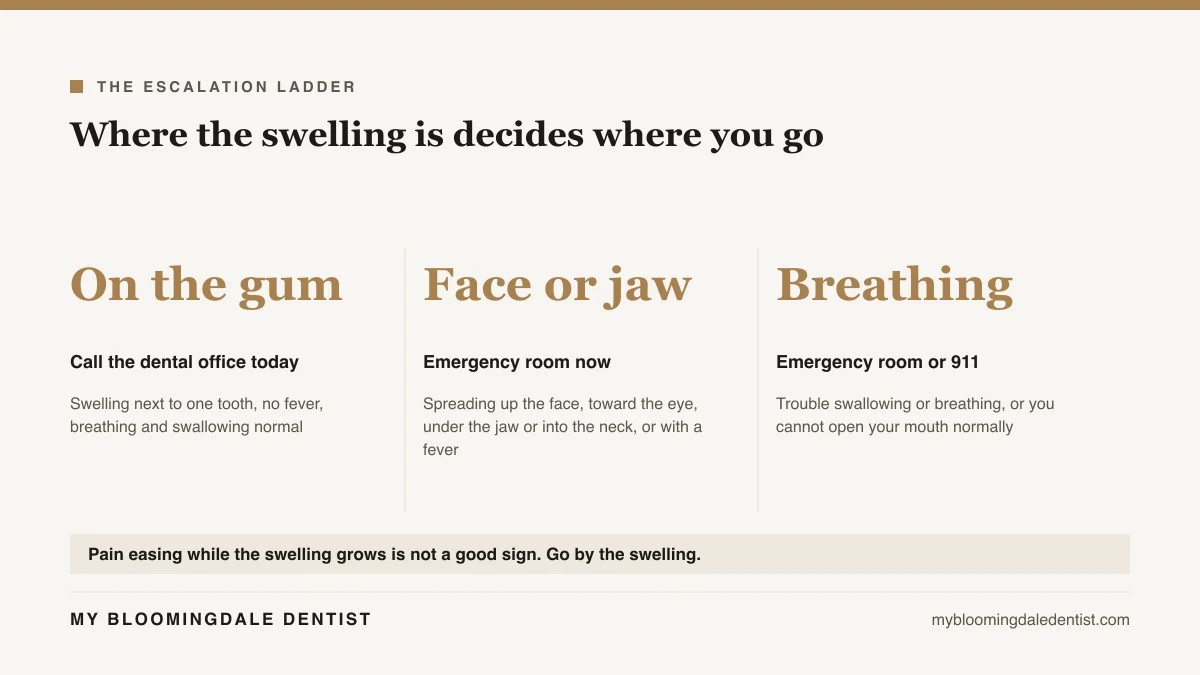
Four signs move a swollen face past what a dental office should be handling. If any one of them is present, the emergency room is the right door, not the dental office and not a wait until morning.
| What you see | What it suggests | Where to go | How fast |
|---|---|---|---|
| Swelling pushing the eye closed, or spreading up the side of the face | Infection moving into the tissue of the face | Emergency room | Now |
| Swelling under the jaw, into the neck, or under the tongue | Infection moving toward the space around the airway | Emergency room | Now |
| Trouble swallowing, trouble breathing, or you cannot open your mouth normally | Swelling is starting to affect the airway or the jaw muscles | Emergency room, or call 911 | Now |
| Fever with a swollen face, or you feel ill all over | The body is fighting an infection that is no longer local | Emergency room | Now |
| Swelling on the gum beside one tooth, no fever, swallowing and breathing normal | A local infection at the tooth | Dental office | Call today |
MedlinePlus, the National Library of Medicine’s patient site, lists a swollen area of the upper or lower jaw among the symptoms of a tooth abscess and calls it a very serious symptom. The ER cannot fix the tooth, and you will still need a dentist afterward. What the hospital can do is manage an infection that has spread and protect your breathing, and that comes first.
How is ordinary swelling different from an infection?
Not all swelling is infection. Some of it is the body’s normal response to treatment, and knowing the difference saves a lot of worry.
After a tooth is taken out, some puffiness in the cheek is expected. It usually builds over the first couple of days and then starts to go down. It sits over the area that was treated, it does not spread up toward the eye or down into the neck, and it comes without a fever. That pattern is the one to expect; anything else is a call to the office.
The pattern to watch for is the opposite one. Swelling that keeps growing after the first few days, swelling that appears days after the procedure when things had been settling, a bad taste or drainage from the area, or a fever are all reasons to call the office that did the work. None of this means you should talk yourself out of a call. If you are unsure which pattern you are looking at, the call is the answer.
Swelling that shows up with no treatment at all, around a tooth that has been aching or has gone numb, is a different story. That is usually an infection at the tooth, and it belongs in the dental office today, or in the emergency room if any of the four signs above are present.
What can you do at home while you get seen?
Nothing on this list treats an infection. These steps keep you more comfortable and keep you from making it worse while you arrange care.
- Put a cold compress on the outside of the face, on and off. The American Dental Association’s patient site recommends cold compresses on the face to keep swelling down.
- Rinse gently with warm salt water. MedlinePlus notes that warm saltwater rinses may help ease the pain.
- Keep your head raised when you lie down, and keep drinking water.
- Take over-the-counter pain relief only as the label directs, and tell whoever sees you what you took and when.
The things not to do matter as much. Do not hold heat against the outside of the face. Do not press an aspirin against the gum, which burns the tissue. Do not try to pop or cut a swelling yourself. And do not start leftover antibiotics from an old prescription; what to take, if anything, is a decision for whoever examines you.
What happens at the dental office when your face is swollen?
The appointment has one goal, which is to find the source of the infection and deal with it. Swelling is the symptom. The tooth, or the gum around it, is the cause.
First comes an exam and X-rays, including a 3D X-ray, to find which tooth is involved and how far the infection has reached into the bone. Then the infection is drained so the pressure comes off. The ADA lists antibiotics, drainage, cleaning between the tooth and gum when gum disease is the cause, and root canal treatment when decay or a crack is the cause, as the options a dentist may consider.
What ends the problem is removing the source. That usually means one of two things. A root canal cleans the infection out of the inside of the tooth and keeps the tooth, which is covered on the root canal treatment in Bloomingdale, IL page. When the tooth cannot be saved, it comes out, the area heals, and replacement is planned after that, in that order, with no finish date promised for work that depends on healing. Tooth extraction care covers that side.
Whatever else is used, the source still has to be treated.
Why a tooth infection is not a wait and see problem
A tooth infection does not stay put by default. The pus has to go somewhere, and in the upper jaw and the lower jaw the paths it can take lead toward the face, the eye and the neck. MedlinePlus lists spread of the infection to the soft tissue, to the jaw bone and into the blood among the complications of an untreated abscess.
The trap is the pain. MedlinePlus notes that the toothache may stop if pressure is relieved, but the infection will remain active and continue to spread. People read the relief as the problem going away. So the rule for swelling is simple. Track the size and the spread of the swelling, and ignore the pain as a guide.
The local stage is the easy one to treat. The spreading stage is the one that ends up in a hospital. The whole reason to know the four signs is to be on the right side of that line.
Getting seen at the office
If the swelling is on the gum and none of the four emergency room signs are present, call the office at (224) 520-8665 and describe what you are seeing. The office will tell you on the phone whether it needs to be today. The emergency dentist in Bloomingdale, IL page sets out what an emergency visit covers.
If you are new to the practice, a new-patient exam with X-rays is $99, and that is the visit that finds the cause. Any treatment is quoted in writing before it starts. If the tooth turns out to need a root canal, why a crown usually follows a root canal explains what comes after.
Call the office and describe it. A $99 new-patient exam includes the X-rays that find the source, and treatment is quoted in writing before it starts. Appointments in English, Vietnamese, Korean and Spanish.
See emergency dental careRelated reading
If you already know the tooth needs a root canal, what the crown after a root canal is for walks through the second half of that treatment. For anything else, contact the office.
Frequently asked questions
Go to the emergency room if the swelling is pushing an eye closed, spreading under the jaw or into the neck, if you have trouble swallowing or breathing, if you cannot open your mouth normally, or if you have a fever with a swollen face. Swelling that stays on the gum beside one tooth, with no fever and normal breathing and swallowing, is a call to the dental office today.
Not necessarily. MedlinePlus notes that a toothache may stop if pressure is relieved, while the infection remains active and continues to spread. For swelling, the pain is a poor guide. Watch the size and the spread of the swelling instead, and get the tooth looked at even if it no longer hurts.
Cold, on the outside of the face, on and off. The American Dental Association recommends cold compresses to keep swelling down. Avoid holding heat against the face. A cold compress makes you more comfortable while you arrange care; it does not treat the infection.
The ADA lists antibiotics alongside drainage, root canal treatment and cleaning between the tooth and gum as options a dentist may consider. Whichever is used, the source of the infection, usually the tooth itself, still has to be treated.
Some puffiness over the treated area in the first couple of days is expected, and it should then start to go down. Swelling that keeps growing after that, that appears after things had settled, that spreads toward the eye or neck, or that comes with a fever or a bad taste is a reason to call the office that did the work.
Sources: MedlinePlus, Tooth abscess · MouthHealthy by the American Dental Association, Abscess · MouthHealthy by the American Dental Association, Dental Emergencies · MedlinePlus, Tooth Disorders. General information, not a diagnosis. If you are having trouble breathing or swallowing, call 911.